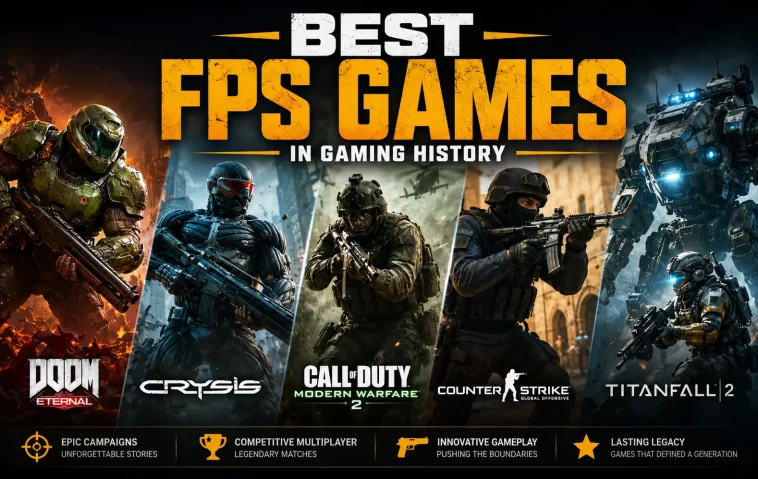
Best FPS games in gaming history — that’s the search I typed in more times than I’d like to admit, usually after finishing a campaign and wanting something just as good. I’ve been playing shooters since the days of loading Doom off a floppy disk, through the LAN party era of Counter-Strike, and right up to whatever’s dominating Steam Charts this year. Somewhere along the way I noticed most “best FPS” lists either ignore the classics or completely skip the games coming out right now.
This list doesn’t do that. It blends the genre-defining titles that built first-person shooters from scratch with the modern releases that are still shaping how the genre moves forward today. Some of these games are over thirty years old. Others launched in 2026. All of them earned their spot through innovation, sales, critical reception, or sheer staying power.
If you want a single list that actually respects both eras, you’re in the right place.
What Actually Makes an FPS “One of the Best”
Before diving into the rankings, it helps to know the criteria. Not every shooter that sold well belongs on a list like this.
I weighed each pick against a few consistent factors:
- Gameplay feel — Does the shooting itself feel satisfying, tight, and responsive?
- Innovation — Did the game introduce something the genre hadn’t seen before?
- Longevity — Does it still have an active community or measurable cultural footprint today?
- Critical reception — Strong scores across multiple major outlets, not just one glowing review.
- Influence — Did later games visibly borrow from its design?
Some entries are here purely for what they started. Others are here because they’re still being played and praised decades later. Both reasons count.
The Top 50 Best FPS Games in Gaming History
I’ve split this list by era and category so it’s easier to scan, whether you’re chasing nostalgia or looking for your next multiplayer obsession.
The Genre-Defining Classics (1992–2001)
These are the games that built the FPS genre from nothing.
- Wolfenstein 3D — Widely considered the origin point of the modern FPS formula.
- Doom — Established fast movement, deathmatch multiplayer, and modding culture almost single-handedly.
- Doom II: Hell on Earth — Expanded the original’s formula with new enemies and tighter level design.
- Duke Nukem 3D — Brought interactive environments and a charismatic protagonist to the genre.
- Quake — The first fully 3D FPS, introducing true online multiplayer and rocket jumping.
- Quake II — Refined online connectivity and arena-style map design.
- GoldenEye 007 — Proved console FPS games could rival PC, largely through its four-player split-screen mode.
- Half-Life — Shifted the genre toward cinematic, uninterrupted storytelling.
- Half-Life: Opposing Force — A strong expansion that added new weapons and enemy perspectives.
- Counter-Strike — Originally a Half-Life mod, it turned tactical team play into a competitive standard.
- Unreal Tournament — Set the bar for arena shooter multiplayer and weapon variety.
- Perfect Dark — Advanced console shooter design with deeper multiplayer options.
- System Shock 2 — Blended FPS combat with RPG systems and horror atmosphere.
The 2000s Boom
This decade turned FPS games into the most dominant genre in gaming.
- Halo: Combat Evolved — Popularized regenerating shields, vehicles, and console multiplayer.
- Halo 2 — Made online console multiplayer mainstream through Xbox Live.
- Halo 3 — Closed the original trilogy with some of the series’ best multiplayer maps.
- Medal of Honor: Allied Assault — Helped pave the way for the modern military shooter.
- Call of Duty — Brought cinematic WWII combat to a wider audience.
- Call of Duty 4: Modern Warfare — Introduced perks, killstreaks, and a progression system the genre still uses today.
- Half-Life 2 — Combined physics-based puzzles with one of gaming’s most respected campaigns.
- Far Cry — Popularized open-world sandbox shooting.
- Doom 3 — Pushed horror atmosphere and lighting technology forward.
- F.E.A.R. — Blended slow-motion combat with genuinely unsettling horror pacing.
- BioShock — Used its mechanics to tell a philosophical story about player choice.
- Team Fortress 2 — Helped create the hero shooter format still used today.
- Crysis — Became the technical benchmark every PC gamer measured their rig against.
- Left 4 Dead — Turned co-op zombie survival into its own subgenre.
- S.T.A.L.K.E.R.: Shadow of Chernobyl — Mixed survival, RPG, and shooter elements years ahead of its time.
The 2010s Era
A decade of refinement, reinvention, and a few genuine surprises.
- Battlefield 3 — Set a new bar for large-scale multiplayer destruction.
- Titanfall — Introduced fluid wall-running and mech combat to mainstream shooters.
- Titanfall 2 — Delivered what many consider the best single-player FPS campaign of the decade.
- DOOM (2016) — Rebuilt the original’s speed and aggression for modern hardware.
- Overwatch — Popularized the modern hero shooter format at scale.
- PUBG: Battlegrounds — Helped launch the battle royale genre into the mainstream.
- Apex Legends — Combined hero abilities with fast, fluid battle royale movement.
- Rainbow Six Siege — Built lasting esports relevance around destructible environments and tactical planning.
- Metro Exodus — Delivered atmospheric, story-driven shooting across a post-apocalyptic Russia.
- Destiny 2 — Blended loot-driven RPG progression with FPS combat at a massive scale.
- Counter-Strike: Global Offensive — Carried the tactical shooter torch into the esports era.
- VALORANT — Combined Counter-Strike-style fundamentals with character abilities.
Modern Standouts (2020–2026)
Recent releases proving the genre still has room to innovate.
- DOOM Eternal — Pushed aggressive, mobility-focused combat even further than its predecessor.
- DOOM: The Dark Ages — Took the franchise into a medieval setting while keeping its trademark momentum.
- Counter-Strike 2 — Modernized the legendary tactical shooter on the Source 2 engine.
- Helldivers 2 — Brought chaotic, satirical co-op shooting to a massive new audience.
- Battlefield 6 — Returned the series to large-scale destruction with refined gunplay.
- ULTRAKILL — A fast, stylish indie shooter built around skill-based momentum and stylish scoring.
- Marathon — Bungie’s extraction shooter revival, built on years of community testing.
- MOUSE: P.I. For Hire — A visually distinctive noir shooter styled after 1930s cartoon animation.
- Highguard — A fantasy multiplayer shooter from former Titanfall developers.
- Stalker 2: Heart of Chornobyl — A long-awaited sequel that revived open-world survival shooting.
Why the FPS Genre Keeps Reinventing Itself
It’s worth asking why first-person shooters have stayed relevant for over three decades when so many other genres have faded in and out of fashion.
Part of the answer is the perspective itself. Seeing the action through a character’s own eyes creates a kind of immersion other camera angles can’t fully match.
The other part is constant reinvention. Every decade has added something new to the formula:
- 1990s — Speed, modding, and the birth of online multiplayer
- 2000s — Cinematic storytelling and console-grade multiplayer
- 2010s — Hero shooters, battle royale, and esports infrastructure
- 2020s — Extraction shooters, live-service models, and indie-driven creativity
That layering effect is why new shooters can still feel fresh, even though the core idea — point, shoot, survive — hasn’t changed in over thirty years.
How You Can Find Your Next Favorite FPS
Knowing the history is one thing. Actually picking your next game is another. Here’s how you can narrow things down.
Step 1: Decide What You Actually Want From a Shooter
You should figure out whether you’re chasing a story, a competitive ranked grind, or something to play casually with friends. This single decision eliminates most of the list immediately.
Step 2: Match the Game to Your Platform
You’ll get the most flexibility on PC, since most major shooters launch there first with mouse-and-keyboard precision. If you’re on console, prioritize titles built specifically for controller balance, like Halo or Call of Duty.
Step 3: Check Whether the Multiplayer Is Still Active
You can check live player counts on sites that track Steam Charts before buying a multiplayer-only shooter. There’s nothing worse than buying a competitive game only to find empty lobbies.
Step 4: Try the Campaign-Only Classics First
You shouldn’t skip single-player FPS campaigns just because multiplayer dominates the genre’s reputation. Titanfall 2, Half-Life 2, and BioShock all hold up entirely on their own.
Step 5: Use Genre Tags to Filter Smarter
You can filter by sub-genre tags like “tactical shooter,” “arena shooter,” or “extraction shooter” on storefronts to skip games that don’t match your playstyle. This saves far more time than scrolling through general “FPS” categories.
Common Myths About FPS Games
A few misconceptions about this genre just won’t go away.
Myth: FPS games are only about reflexes. Tactical shooters like Counter-Strike and Rainbow Six reward planning and communication just as much as aim.
Myth: Older shooters haven’t aged well. Doom and Quake both run smoothly on modern hardware through community source ports, and their speedrunning scenes remain active.
Myth: Singleplayer FPS campaigns are dying out. Titanfall 2, Half-Life 2, and DOOM Eternal prove that strong single-player shooters still draw massive praise.
FAQ About the Best FPS Games in Gaming History
What is considered the first true FPS game? Wolfenstein 3D is widely credited as the game that established the modern first-person shooter formula in 1992, though earlier first-person games existed in more limited forms.
What’s the most influential FPS game of all time? Doom is usually named the most influential, since it pioneered deathmatch multiplayer, modding culture, and the fast-paced combat style still used today.
Which FPS game introduced storytelling to the genre? Half-Life is widely credited with shifting first-person shooters toward cinematic, uninterrupted narrative design.
What FPS game popularized console multiplayer? Halo: Combat Evolved and GoldenEye 007 are both credited with proving console shooters could support strong multiplayer experiences.
Are tactical shooters considered FPS games? Yes. Tactical shooters like Counter-Strike, Rainbow Six Siege, and VALORANT all fall under the FPS umbrella, even though they emphasize strategy over fast reflexes.
What’s a good FPS game to start with if I’m new to the genre? DOOM (2016) is a great starting point for fast, accessible single-player action, while Counter-Strike 2 is the better pick if you want competitive multiplayer.
Final Thoughts
The best FPS games in gaming history aren’t just the ones with the highest sales numbers. They’re the ones that changed how the genre moved, looked, or felt, often in ways still visible in games releasing this year.
Whether you’re chasing the raw speed of Doom, the tactical discipline of Counter-Strike, or the cinematic weight of Half-Life 2, this list should give you a solid map of where the genre has been and where it’s still headed. Pick one, load it up, and you’ll understand exactly why FPS games have stayed at the center of gaming for over three decades.
Editor’s Opinion
Ok so personaly i think Half-Life 2 and Titanfall 2 are still the best single player FPS campaings ever made, nothing else really comes close even today. Doom is obviously legendary but i think people sometimes forget how good Quake was for its time, it dosent get enough credit. Counter-Strike obviously deserves its spot too, ive sunk way to many hours into that game over the years lol. Newer stuff like Marathon and Stalker 2 are cool but we’ll see if they hold up the same way these older ones did. Just play a few from each era, you’ll see what i mean.
