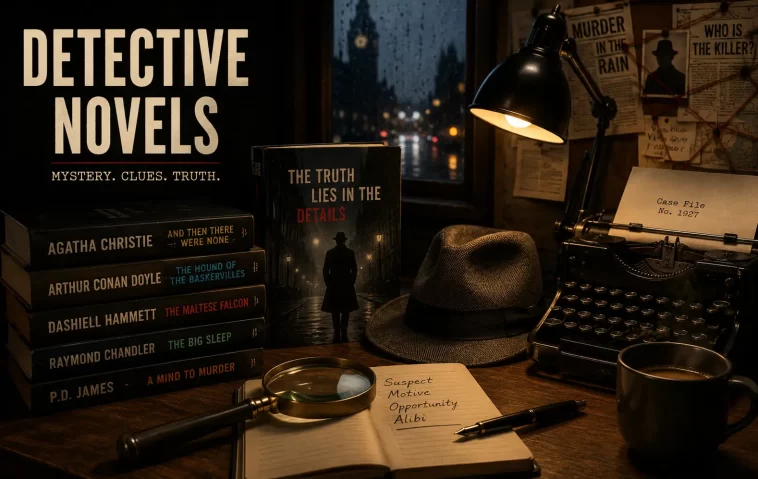
I still remember the first time a book made me gasp out loud on a train. It was a classic detective novel, and I never saw the ending coming. Since then I’ve read dozens of them, and I keep going back to the same shortlist whenever someone asks me where to start.
That’s exactly what this post is for. Below you’ll find 10 classic detective novels that have earned their reputation the hard way — through decades of readers trying (and failing) to guess the killer before the final chapter.
If you love a good whodunit, a locked-room puzzle, or a detective with more brains than the whole police force combined, you’re in the right place.
Why Classic Detective Novels Still Work Today
Modern thrillers move fast and rely on twists. Classic detective novels do something different — they play fair. The clues are all there, sitting in plain sight, and the fun is in realizing you missed them.
A few reasons this genre has never gone out of style:
- The puzzles are built with real logic, not cheap tricks
- The detectives (Holmes, Poirot, Marlowe) are unforgettable characters on their own
- The settings — foggy London, snowbound trains, quiet English villages — create atmosphere you can’t fake
- They reward careful readers, which makes finishing one feel like an achievement
Now let’s get into the list.
1. The Hound of the Baskervilles — Arthur Conan Doyle
You can’t talk about classic detective novels without starting with Sherlock Holmes. This one is widely considered his best full-length case.
A legendary hound is said to be stalking the Baskerville family across the misty moors of Dartmoor. Holmes barely appears for long stretches, leaving Dr. Watson to do the legwork, which only adds to the tension.
If you want a book that mixes gothic horror with cold, hard deduction, start here.
2. Murder on the Orient Express — Agatha Christie
A train stuck in a snowdrift. A murdered passenger. A dozen suspects, each with a motive. Hercule Poirot has to work out who did it before the train even reaches its next stop.
This is one of those classic detective novels where the solution is so clever that readers still argue about it decades later. You’ll want to reread the first chapters once you know the ending.
3. The Murder of Roger Ackroyd — Agatha Christie
This one changed the rules of the genre. Christie plays with the format of the detective story itself, and the final twist is still studied by mystery writers today.
You don’t need to know anything about the “trick” going in — in fact, it’s better if you don’t. Just pay close attention to every character, including the narrator.
4. And Then There Were None — Agatha Christie
Ten strangers are invited to an isolated island. One by one, they start dying, each in a way that matches an old nursery rhyme. There’s no detective at all — just you, the reader, trying to figure out who’s behind it before the list runs out.
This is arguably Christie’s tightest plot. If you enjoy tension that builds with every chapter, this belongs at the top of your list.
5. The Big Sleep — Raymond Chandler
Switch gears here. Instead of an English drawing room, you’re in 1930s Los Angeles with private eye Philip Marlowe. He’s hired for a simple job that spirals into blackmail, gambling debts, and multiple murders.
Chandler’s writing style is sharp, quotable, and moody. If you like your mysteries with a hard-boiled edge instead of tea and biscuits, this is the one to pick up.
6. The Maltese Falcon — Dashiell Hammett
Sam Spade is the private detective every hard-boiled hero since has tried to copy. When his partner is murdered, Spade gets pulled into a hunt for a priceless statue, surrounded by people who will lie to his face without blinking.
This book basically built the template for the modern detective thriller. Read it, and you’ll recognize its fingerprints on nearly everything that came after.
7. The Moonstone — Wilkie Collins
Often called the first true detective novel written in English, The Moonstone centers on a stolen diamond and the strange events surrounding it. The story is told through multiple narrators, each one giving you a different piece of the puzzle.
You’ll notice tropes here that became genre standards later on: the bumbling local police, the sharp outside detective, and a pile of red herrings. It’s slower than modern mysteries, but worth the patience.
8. Gaudy Night — Dorothy L. Sayers
Set at a women’s college in Oxford, this book follows writer-detective Harriet Vane as she investigates a wave of poison-pen letters and cruel pranks. Lord Peter Wimsey shows up eventually, but this is really Vane’s story.
If you want a classic detective novel with more depth and character work than most mysteries from its era, this is a strong pick.
9. The Murders in the Rue Morgue — Edgar Allan Poe
This short novel is often credited as the very first detective story ever written. Poe’s detective, C. Auguste Dupin, solves a bizarre locked-room murder using pure logic and observation.
Every fictional detective who came after — Holmes included — owes something to Dupin. It’s short, strange, and worth reading just to see where the whole genre began.
10. The Daughter of Time — Josephine Tey
This one flips the format entirely. A detective, laid up in a hospital bed with nothing to do, decides to investigate a 500-year-old murder mystery using nothing but portraits, old documents, and his own reasoning.
It’s a quiet, unusual book, but it was voted the top crime novel of all time by the UK Crime Writers’ Association. If you enjoy history mixed with detective work, don’t skip it.
How to Choose Which One to Read First
With so many classic detective novels to pick from, it helps to know what kind of mystery you’re actually in the mood for. Here’s a quick way to decide:
| If you want… | Start with… |
|---|---|
| A puzzle with a shocking twist | The Murder of Roger Ackroyd |
| Atmosphere and gothic tension | The Hound of the Baskervilles |
| A hard-boiled detective story | The Big Sleep or The Maltese Falcon |
| A closed-circle mystery | And Then There Were None |
| The origin of the genre | The Murders in the Rue Morgue |
You don’t need to read these in any particular order. Pick the one that matches your mood, and the rest will follow naturally once you’re hooked.
Tips for Getting the Most Out of Classic Detective Novels
- Read slowly during the middle chapters — that’s usually where the real clues are hidden
- Keep track of minor characters; classic detective novels rarely waste a name
- Avoid summaries or reviews that mention “the twist” before you finish
- Read the first chapter twice after you finish the book — you’ll catch details you missed
- Don’t rush to guess the killer; enjoy the process of being misled
Frequently Asked Questions
What makes a detective novel a “classic”?
A classic detective novel is usually one written before the mid-20th century that helped shape the rules of the genre — fair clues, a clever detective, and a satisfying, logical solution.
Which classic detective novel is best for beginners?
Murder on the Orient Express or The Hound of the Baskervilles are both great starting points. They’re accessible, well-paced, and represent the genre at its best.
Are classic detective novels hard to read?
Not really. Most are written in clear, straightforward prose. Some, like The Moonstone, use older language, but the plots are still easy to follow once you get a few chapters in.
Do I need to read Sherlock Holmes stories in order?
No. Most Holmes stories and novels can be read as standalone cases, though reading them in order lets you notice how his character develops over time.
What’s the difference between a detective novel and a thriller?
Detective novels focus on solving a puzzle through logic and clues, usually with a clear detective figure. Thrillers focus more on suspense, danger, and pacing, and don’t always involve a formal investigation.
Final Thoughts
Classic detective novels have survived for a reason — they respect the reader’s intelligence. Every clue matters, every character has a purpose, and the ending actually makes sense once you look back.
Whether you start with Holmes, Poirot, Marlowe, or Dupin, you’re in for a story built to outsmart you fairly. Pick one from this list, pour some coffee, and try to solve it before the last page does it for you.
Editor’s Opinion
Honestly, I think old detective books are way better than alot of new thrillers. They dont cheat you with fake twists, everything make sense at the end if you pay attension. My favrite is still Murder on the Orient Express, i read it twice becuase i missed so much stuff first time. If you never tryed classic mystery books, just start with one from this list, you wont regret it.
