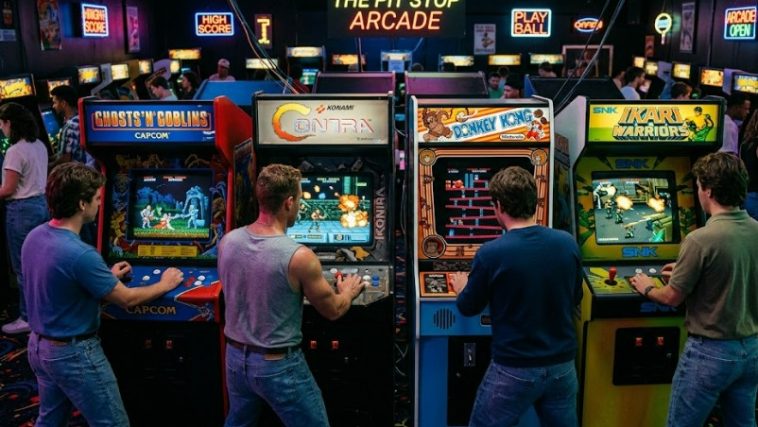
I once burned through eleven dollars in quarters on a single Saturday trying to clear the third loop of Gradius, and I didn’t even get that far. That’s the kind of math that defines the hardest arcade games of all time — not “hard” in the modern sense of a difficulty slider you can lower, but hard in the specific, deliberate, often genuinely fair way arcade cabinets were designed to keep you feeding them coins. So I went back through decades of cabinets, ranked them on actual skill-based difficulty rather than cheap unfairness, and built this list from games that earned their reputation rather than games that just felt unwinnable because of bad hit detection.
And before the comments start — yes, I specifically excluded games whose difficulty came from broken collision boxes or outright cheating AI. That’s a different, much shorter and much angrier list.
Quick Answer: Top 10 at a Glance
If you want the short version first:
- Battletoads (Arcade)
- Gradius III (Arcade)
- Ghosts ‘n Goblins
- Dragon’s Lair
- Contra (Arcade)
- 1941: Counter Attack
- Ikaruga
- Donkey Kong (Arcade, original)
- Defender
- R-Type
Full ranking and reasoning below, plus a breakdown of what actually makes a game “hard” in a way that’s fair versus a way that’s just designed to take your money.
What “Hard But Fair” Actually Means Here
This distinction matters more than most lists bother to make. A game like the original Donkey Kong is hard because the timing windows are tight and the patterns are genuinely demanding to learn — but once you know them, you can reliably execute them. That’s fair difficulty. A game with hit detection so generous toward enemies that you die from bullets that visibly missed you is a different kind of hard, and it’s the kind that exists specifically to drain your wallet rather than test your skill.
I weighted four things for this ranking: whether the difficulty came from learnable patterns versus arbitrary unfairness, how steep the actual skill ceiling is, whether skilled players can consistently progress further with practice, and cultural reputation as a “quarter-eater” among people who were actually feeding it quarters at the time.
The List: 50 Hardest Arcade Games of All Time
1. Battletoads (Arcade, 1994) The infamous Turbo Tunnel sequence requires near-frame-perfect reaction timing, and that’s before you even get to the rest of the game’s escalating difficulty curve.
2. Gradius III (Arcade, 1989) Losing your power-ups on death and having to rebuild from nothing mid-stage is one of the cruelest design decisions in the genre, and it’s exactly why this ranks this high.
3. Ghosts ‘n Goblins (Arcade, 1985) You have to beat the entire game twice in a row to see the true ending. Twice. That’s not a difficulty spike, that’s a design philosophy.
4. Dragon’s Lair (Arcade, 1983) Laserdisc-based quick-time events with zero margin for error and animation that doesn’t always telegraph what input it wants from you — brutal in a way that feels almost unfair until you’ve memorized every single prompt.
5. Contra (Arcade, 1987) One-hit deaths combined with relentless enemy spawn density. The Konami Code existed as a cultural phenomenon specifically because this game (and its NES port) needed it.
6. 1941: Counter Attack (Arcade, 1990) A vertical shoot-em-up with bullet density that ramps up faster than most players’ reflexes can keep pace with, especially in later stages.
7. Ikaruga (Arcade, 2001) The polarity-switching mechanic is elegant, but the game expects you to track and react to color-coded bullet patterns at a speed that takes most players dozens of attempts just to parse, let alone survive.
8. Donkey Kong (Arcade, 1981) The original. Tight jump timing, unforgiving barrel patterns, and a difficulty curve that escalates hard by the third or fourth level.
9. Defender (Arcade, 1981) A genuinely overwhelming number of simultaneous threats and a control scheme that took most players an embarrassing number of quarters just to get comfortable with, before difficulty even entered the conversation.
10. R-Type (Arcade, 1987) Memorization-based shoot-em-up design taken to an extreme — dying mid-stage often means you’re functionally undergeared for what’s coming next, creating a death spiral that’s brutal but technically learnable.
11. Smash TV (Arcade, 1990) Twin-stick chaos with enemy density that scales aggressively, demanding constant spatial awareness in every direction at once.
12. Toki (Arcade, 1989) A platformer with hit detection tight enough, and enemy placement aggressive enough, that it built a reputation as one of the harder coin-ops of its era.
13. Black Tiger (Arcade, 1987) An action-platformer with punishing enemy respawns and a structure that punishes any hesitation in exploration.
14. Forgotten Worlds (Arcade, 1988) A side-scrolling shooter with a currency system that adds a layer of resource-management stress on top of already demanding bullet patterns.
15. Gun.Smoke (Arcade, 1985) Capcom’s western-themed shooter that doesn’t get the recognition of Ghosts ‘n Goblins but is arguably just as punishing.
16. Salamander (Arcade, 1986) A Gradius spinoff with branching paths and the same unforgiving power-up loss on death that made the original notorious.
17. Strider (Arcade, 1989) Fast, fluid, and demanding precise platforming under constant enemy pressure, with very little room for recovery once you’re behind.
18. Raiden (Arcade, 1990) A bullet-hell predecessor that ramps difficulty hard by the midpoint, well before most players have built the muscle memory to handle it.
19. Truxton (Arcade, 1988) Toaplan’s shooter design philosophy on full display — dense patterns, minimal hand-holding, and a learning curve that assumes you’ll die a lot before you understand the stage layouts.
20. Side Arms (Arcade, 1986) A two-player shooter where solo play multiplies the difficulty significantly, since enemy density doesn’t scale down for a single player.
21. Mercs (Arcade, 1990) A Contra-adjacent run-and-gun with similar one-hit-death stakes and dense enemy waves that demand near-constant movement.
22. Vulgus (Arcade, 1984) An early, brutally unforgiving Capcom shooter that doesn’t get discussed much now but built a real reputation for difficulty in its era.
23. Gyruss (Arcade, 1983) A tube-shooter with disorienting rotational movement that took most players a genuinely long adjustment period before survival became consistent.
24. Time Pilot (Arcade, 1982) Omnidirectional shooting that demanded spatial awareness most arcade games of its era didn’t ask for, which made it notoriously hard to adjust to.
25. Asteroids (Arcade, 1979) Simple controls hiding a genuinely demanding skill ceiling — surviving the later waves requires precision that takes real practice to develop.
26. Robotron: 2084 (Arcade, 1982) Dual-stick controls that were ahead of their time, paired with relentless, unceasing enemy spawns from every direction.
27. Zaxxon (Arcade, 1982) Isometric perspective shooting that messed with depth perception badly enough that a huge number of players lost quarters just learning to judge altitude.
28. Sinistar (Arcade, 1982) A genuinely tense survival-horror-adjacent shoot-em-up where the title boss actively hunts you, which was a novel and stressful design choice at the time.
29. Berzerk (Arcade, 1980) Robots that home in on your position with no real safe zones, plus the infamous Evil Otto that speeds up the longer you take.
30. Joust (Arcade, 1982) Deceptively simple, genuinely difficult to master — the physics-based flight controls take real time to internalize before you can compete with the lava trolls reliably.
31. Bosconian (Arcade, 1981) Multidirectional space combat with base-destroying objectives that demand juggling several threats simultaneously.
32. Tempest (Arcade, 1981) Fast reflexes and pattern recognition under genuinely disorienting visual effects, especially in the higher levels.
33. Battlezone (Arcade, 1980) Tank combat with a vector-graphics first-person perspective that was genuinely hard to judge distance in, by design.
34. Centipede (Arcade, 1981) Looks tame compared to later shooters on this list, but the later waves move fast enough to punish any lapse in concentration.
35. Pac-Man (Arcade, 1980) Famous for the “kill screen” at level 256 due to a programming overflow bug, but well before that point the ghost AI patterns get genuinely demanding to outmaneuver consistently.
36. Galaga (Arcade, 1981) The challenging stages and tractor-beam capture mechanic add risk-reward tension that punishes greedy play hard.
37. Xevious (Arcade, 1982) An early vertical shooter that demanded memorization of ground-target locations well before the genre had really established that expectation.
38. Phoenix (Arcade, 1980) The mothership stage at the end of each loop is a genuine spike in difficulty that catches a lot of players off guard the first time through.
39. Moon Patrol (Arcade, 1982) Side-scrolling obstacle timing that’s stricter than it looks, especially once the terrain gets more aggressive in later stages.
40. Elevator Action (Arcade, 1983) Stealth-action mechanics combined with enemy gunfire that demands precise floor-by-floor planning, which a lot of players underestimated at the time.
41. Commando (Arcade, 1985) A run-and-gun predecessor to Contra with similarly unforgiving enemy density and limited room for error.
42. Bubble Bobble (Arcade, 1986) Deceptively cute, genuinely demanding in later levels where enemy patterns and bubble physics stop being forgiving.
43. Rygar (Arcade, 1986) An action-platformer with a steep difficulty ramp that picks up hard once the initial stages are cleared.
44. Double Dragon (Arcade, 1987) Co-op brawling that gets genuinely brutal in single-player mode, since enemy density and damage output don’t scale down for solo runs.
45. Renegade (Arcade, 1986) An early brawler whose enemy AI and damage balance made it notoriously punishing compared to its contemporaries.
46. Ninja Gaiden (Arcade, 1988) A different game from the NES title of the same name, with brutal enemy density and tight platforming demands of its own.
47. Vendetta (Arcade, 1991) A Konami brawler with enemy patterns dense enough that solo play in particular built a real reputation for difficulty.
48. Crime Fighters (Arcade, 1989) A brawler that leaned hard into enemy swarm tactics, punishing players who didn’t manage crowd control carefully.
49. Final Fight (Arcade, 1989) Capcom’s brawler classic, genuinely difficult in single-player due to enemy density that assumes a second player who isn’t there.
50. Altered Beast (Arcade, 1988) Notoriously stiff controls combined with aggressive enemy timing that made the early transformation stages harder than they probably needed to be.
Common Eras and Genres Where “Hard But Fair” Shows Up Most
This kind of difficulty clusters around a few specific design contexts worth calling out separately.
Shoot-em-ups (Gradius, R-Type, Raiden, Truxton) lean almost entirely on memorization and pattern recognition — the difficulty is fair because the patterns are consistent, even when they’re dense.
Early-80s vector and simple-sprite games (Asteroids, Tempest, Battlezone) get their difficulty from physics and perception challenges rather than enemy density — depth perception, momentum, and reaction time matter more than memorization here.
Late-80s brawlers (Final Fight, Double Dragon, Renegade) get unfairly difficult specifically in solo play, since their balance assumed two players splitting the enemy load.
Fixes That Don’t Actually Work (Player Strategies That Are Commonly Recommended but Rarely Help)
Worth addressing directly since it comes up constantly in retro gaming forums: “just memorize the patterns” gets repeated as universal advice for these games, and it only actually works for the shoot-em-up category. For physics-based games like Asteroids or Battlezone, pattern memorization does basically nothing — what helps is repetition building muscle memory for momentum and timing, which is a slower and less satisfying answer than “just memorize it,” but it’s the honest one.
A Few Picks That’ll Get Argument
Putting Battletoads above Ghosts ‘n Goblins is going to bother some purists, and I get it — Ghosts ‘n Goblins has the longer-standing reputation. But the Turbo Tunnel sequence specifically demands a level of frame-perfect timing that very few arcade sequences from any era match, and that’s the bar I used for the top slot.
Excluding games purely famous for cheap, unfair difficulty (certain licensed tie-in cabinets that are infamous for broken hit detection rather than legitimate challenge) is also going to get pushback from people who remember losing quarters to them. That’s intentional — this list is about skill, not about bad programming.
FAQ
What’s genuinely the hardest arcade game on this list to actually clear legitimately? Battletoads’ Turbo Tunnel section has the worst reputation among people who’ve actually tried to clear it without save states or emulator rewind.
Were these games designed to be this hard on purpose, or did it just happen? Largely on purpose — arcade cabinet revenue depended on players running out of credits, so difficulty was a business decision as much as a design one.
Is “hard but fair” really fair, or is that just a nicer way of describing the same quarter-eating design? There’s a real distinction. Fair difficulty means a skilled player can consistently progress with practice; unfair difficulty means even skilled players hit an arbitrary wall regardless of skill. Some games on this list sit closer to that line than others, and I tried to be honest about which ones in the writeups above.
Do modern re-releases or emulated versions make these games less hard? Not the core difficulty, no — though save states and rewind features obviously remove the stakes that made the original arcade experience so punishing in the first place.
Why isn’t [a specific bullet-hell shooter] higher on this list? Probably era — a lot of the most insane bullet-hell difficulty came later, post-arcade-era, on home consoles and PC, which puts it outside the scope of this specific list.
Editor’s Opinion
ranking difficulty is weirdly more contentious than ranking quality, turns out — everyone’s personal “this one broke me” game is different depending on what era they actually grew up feeding quarters into. Battletoads at number one might age out in a year if I revisit this, but right now it’s the one that still gets brought up unprompted in every retro gaming thread I’ve seen. the brawler entries near the bottom probably deserved a little more nuance than I gave them here, not gonna pretend otherwise.
