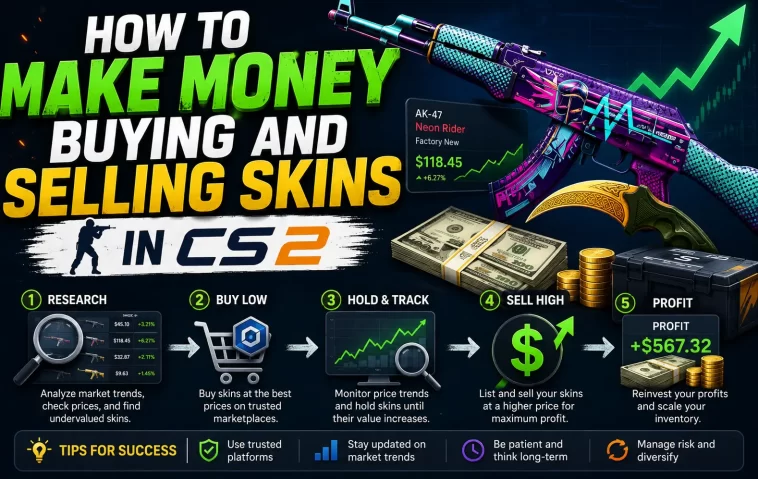
I put $40 into CS2 skins as an experiment in early 2025, mostly out of curiosity, and ended up tracking spreadsheets like it was a part-time job before I admitted I actually cared about the numbers. So if you’re trying to make money buying and selling CS2 skins, the honest answer is: it’s possible, it’s slow at first, and most of the “guaranteed profit” advice you’ll find is wrong.
Why Most People Lose Money Doing This
It’s not bad luck, mostly. There are specific, repeatable mistakes that drain a starting bankroll fast.
People treat case opening as an investment strategy. It isn’t. The math on cases is built so the house wins on average, and chasing a knife pull with real money is gambling dressed up as trading. If your plan to “make money” starts with opening cases, that’s the first thing to drop.
Buying at the top of a hype cycle. Major tournaments, big skin collection drops, and viral clips on social media all spike demand temporarily. Prices jump, casual buyers pile in late, and then the spike deflates over the following weeks. Buying during the spike locks in the worst possible entry price.
Ignoring the 7-day trade hold on new purchases. Anything bought fresh on the Steam Market is untradable for a week. So if your plan depends on flipping something fast, that hold alone can turn a good flip into a stale one once the market moves while you’re stuck waiting.
Not accounting for fees on every leg of a trade. Steam takes roughly 15% off any sale through its own market. People calculate profit off the buy price and the sell price and forget the fee eats a real chunk in between, which quietly turns a “profitable” flip into a wash or a small loss.
Trade-up contracts done on vibes instead of math. The output of a trade-up depends on collection spread and average float, not gut feeling. People dump ten random Mil-Spec skins into a contract hoping for a lucky Classified and walk away with something worth less than what they put in, every time, because they skipped the float calculation entirely.
Common Scenarios
- You’ve got a pile of low-value drops from playing and want to know if they’re worth selling at all
- You’re considering buying a case or skin collection right after a big update because everyone’s talking about it
- You’re eyeing trade-up contracts as a way to turn cheap Mil-Spec skins into something rarer
- You want to hold certain skins long-term, betting that retired cases become scarcer and pricier
- You’re trying to flip items across Steam Market and third-party sites for the price difference
Comparison Table
Here’s how the two main approaches to making money with CS2 skins actually stack up once fees and time are factored in.
| Factor | Flipping (Buy Low, Sell Fast) | Holding (Long-Term Investment) |
|---|---|---|
| Time commitment | High — constant price checking | Low — check in occasionally |
| Capital needed to start | Can start small ($10–$30) | Better with more capital tied up long-term |
| Fee impact | Hits you on every single flip | Hits you once, at final sale |
| Risk of major loss | Lower per-trade, but mistakes compound | Higher if a skin’s collection gets devalued |
| Best suited for | People who enjoy market research daily | People okay locking up money for months/years |
| Realistic monthly return | Small, inconsistent gains | Slower, but historically steadier on blue-chip skins |
What Actually Worked For Me
So the first few weeks were rough, not gonna lie. I bought into a hyped case collection right after release because the float sniping community on Reddit was hyping a specific skin, and within two weeks the price had dropped almost 20% as supply caught up with demand. That stung more than I expected for what was supposed to be a “safe” entry point.
What almost worked, but didn’t quite, was chasing trade-up contracts using a free calculator I found. The math looked solid on paper. But I kept underestimating how much collection spread mattered — feeding in skins from three different collections instead of concentrating on one tanked my odds way below what the calculator’s “expected value” number suggested, because I didn’t fully understand how the output pool actually gets weighted.
The thing that actually turned things around was boring: I stopped chasing hype releases entirely and started buying older, lower-demand skins from collections that had already stabilized, during the slow weeks between major tournaments when nobody’s paying attention. No hype, no spike, just consistent demand and quiet pricing. I held a handful of those for about four months and sold into a small bump when a related tournament brought attention back to that collection. Nothing dramatic, but it was the first time the math actually worked in my favor instead of against me.
Step-by-Step Fixes
- Start by tracking prices, not buying. Use a price-history tool or the Steam Market’s own graph for a week before spending anything.
- Pick a handful of stable, mid-tier skins — not the newest hype release — and note their typical price range over that week. [Image: Steam Market price history graph showing a stable price range over several weeks]
- Buy during a quiet period, ideally a few weeks after any major collection drop or tournament, when prices have settled.
- Remember anything you buy fresh has a 7-day trade hold. Don’t plan a flip around items you just bought.
- If you’re trying trade-up contracts, run the combination through a float calculator first and check the collection spread, not just the total input cost. [Image: Trade-up contract calculator showing input floats, collection spread, and expected value]
- List your sell price slightly under the current lowest active listing if you want a faster sale, or closer to market average if you’re not in a rush.
- Factor the ~15% Steam fee into your target sell price before listing, not after.
- Track every buy and sell in a simple spreadsheet. It sounds excessive, but it’s the only way to know if you’re actually profitable after a few months instead of guessing.
Advanced Fixes / Edge Cases
If you’re trying knife or glove trade-ups, note that the newer Covert-tier contracts use 5 inputs instead of 10, and the odds and float math work differently from the classic 10-skin contracts. Run those through a calculator built specifically for the 5-item format, since older guides and tools often still assume the original 10-skin rules.
If you’re using third-party marketplaces to get around Steam’s fee, check the site’s payout method and any escrow process before listing anything valuable. A site with no clear escrow system and instant “guaranteed” trades is a common setup for scams, especially around high-value knives.
If a skin’s price suddenly crashes and you’re not sure why, check whether a related case got a supply change or a tournament moved a popular skin’s spotlight elsewhere. Price drops in this market are almost always traceable to a specific supply or attention shift, not random noise.
Prevention & Best Practices
- Never buy during the first 48 hours after a hype-driven price spike
- Keep a running log of every purchase and sale price, including fees, so your “profit” number is actually real
- Use Steam Guard Mobile Authenticator and never share trade confirmation codes with anyone claiming to be support
- Set a hard cap on how much real money you’re willing to put into this before you start, and stick to it
FAQ
Can you actually make consistent money doing this, or is it mostly luck? It’s mostly skill and patience, not luck, if you’re flipping or holding stable items. Case opening and chasing hype releases are the parts that are closer to gambling.
How much money do I need to start? You can realistically start with $20–$50 and learn the market mechanics without risking much. Bigger capital just lets you work with pricier, slower-moving items.
Why did my trade-up contract lose value even though the calculator said it was profitable? Calculators are only as good as the inputs you give them, and collection spread or a stale market price can throw the real result off from the projected expected value.
Is it safe to use third-party trading sites instead of Steam’s own market? Reputable sites with clear escrow systems are generally fine, but the space has scam sites that mimic legitimate ones closely. Stick to well-reviewed platforms and never give away your trade confirmation codes.
Why does the same skin sell for different prices depending on where I check? Steam shows prices converted to your account’s local currency, and third-party sites set their own independent pricing, so the same item can look quite different depending on the source and region.
Editor’s Opinion
I’ll be honest, this whole market is more fun than it has any right to be once you stop treating it like a slot machine. The spreadsheet part sounds tedious and it kind of is, ngl, but it’s the only thing that actually separated my wins from my losses after a few months. Case opening still gets me sometimes even though I know better, which is annoying to admit. Anyway, small bets, slow patience, that’s basically the whole game here.
