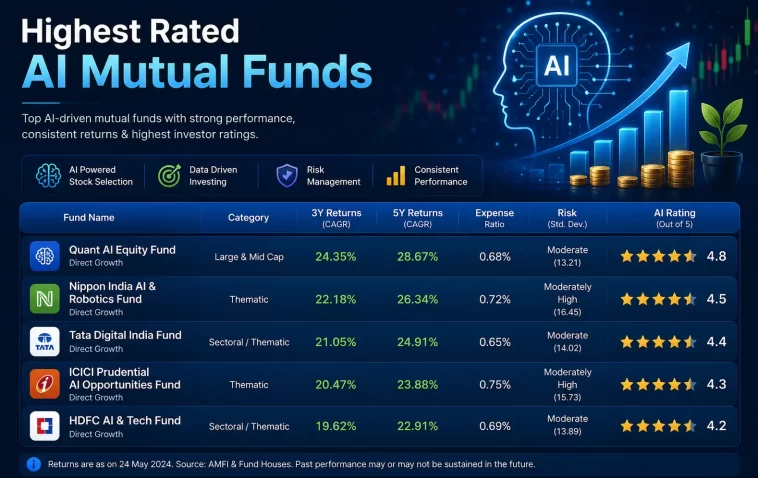
I’ll be honest with you. A few months ago I had some extra cash sitting in my brokerage account and I kept hearing about how AI was the “next big thing” for investors. So I went looking for the highest rated AI mutual funds, thinking I’d just pick the one with the best star rating and call it a day. That was my first mistake.
It turns out picking an AI fund is a lot more confusing than it sounds, mostly because there are far fewer pure AI mutual funds than people assume, and most of what gets called an “AI fund” is actually an ETF. I spent a weekend digging through fund pages, expense ratios, and rating systems before it finally clicked. Here’s everything I figured out, written the way I wish someone had explained it to me.
Quick Answer
The highest rated AI mutual funds in 2026 tend to be broad technology or AI-and-big-data funds with strong multi-year track records, expense ratios under 1%, and exposure spread across chipmakers, cloud companies, and AI software firms rather than just one or two hot stocks. Morningstar’s star rating is the most common benchmark people use, but it only tells part of the story.
AI Mutual Funds vs. AI ETFs: The Mix-Up Nobody Warns You About
This is the part that tripped me up first. A mutual fund and an ETF are not the same thing, even when they both chase the AI theme.
Mutual funds usually:
- Trade once a day, after the market closes
- Are priced at end-of-day net asset value (NAV)
- Tend to be actively managed
- Often carry higher expense ratios than ETFs
ETFs usually:
- Trade all day like a stock
- Can be passive or active
- Generally have lower fees
- Offer more flexibility if you want to buy or sell mid-day
A lot of the “best AI fund” lists you’ll find online are actually ranking ETFs, not mutual funds. So when you’re hunting for the highest rated AI mutual funds specifically, you need to filter carefully or you’ll end up comparing apples to oranges.
How Morningstar Ratings Actually Work
Once I understood the fund type issue, the next thing I had to learn was what the star rating actually measures.
A five-star Morningstar rating means a fund performed in the top 10% of its category over a set period. Four stars means top 32.5%. These ratings are recalculated monthly, so a fund’s rating today might not look the same in six months.
That last part matters more than people think. A fund that was five-star last year could easily slip after one rough quarter. Ratings reflect the past. They don’t guarantee what happens next.
Step-by-Step: How You Should Actually Compare AI Mutual Funds
Once you understand the basics, comparing funds gets a lot simpler. Here’s the process I’d recommend you follow.
Step 1: Check the Star Rating, But Don’t Stop There
Start with the Morningstar rating as a screening tool, not a final answer. Look at the rating across 3-year, 5-year, and 10-year windows if the fund has been around that long. Consistency across time periods matters more than one spectacular year.
Step 2: Look at What’s Actually Inside the Fund
Open the fund’s top 10 holdings. You want to recognize most of the names.
- Funds leaning on established players like Microsoft, Nvidia, or Alphabet usually show less volatility
- Funds loaded with smaller, unproven AI startups can swing harder in both directions
- A fund concentrated in just 10-15 names carries more risk than one spread across 80+ holdings
Step 3: Compare the Expense Ratio Honestly
This is the step most people skip, and it’s the one that quietly eats your returns over time.
Here’s a simple way to think about it: a fund returning 10% with a 1.2% expense ratio nets you 8.8%. A fund returning 9% with a 0.3% expense ratio nets you 8.7%. They’re almost identical after fees, but the second fund took on noticeably less risk to get there.
Step 4: Match the Fund to Your Timeline
You should be honest with yourself about how long this money can sit invested.
- If you’re in your 20s or 30s, you can typically absorb more short-term volatility from an AI-themed fund
- If you’re within 5-10 years of retirement, a heavy AI sector bet is riskier, since a sharp drop leaves less time to recover
- If this is money you might need within 2-3 years, an AI mutual fund probably isn’t the right home for it at all
Step 5: Decide How Much to Actually Allocate
A common approach is to treat AI mutual funds as a sector tilt rather than your whole portfolio. If you’ve got, say, $50,000 spread across accounts, putting $5,000 to $10,000 into AI-focused funds gives you exposure to the theme without betting your whole future on one trend.
Step 6: Set Up Your Purchase the Right Way
Once you’ve picked a fund:
- Confirm the ticker symbol on your brokerage platform
- Decide on a lump sum or a recurring monthly investment
- Remember mutual fund orders execute at end-of-day NAV, not the price you saw that morning
- Set up automatic monthly contributions if you want to dollar-cost average instead of timing the market
What Actually Worked For Me
My first attempt was lazy. I just sorted a fund screener by one-year return and picked whatever was at the top. Three months later that “winner” had cooled off hard, and I realized I’d basically bought the most overheated fund at the worst possible time.
What actually worked was slowing down and checking three things side by side: the 5-year track record, the expense ratio, and the top 10 holdings. Once I stopped chasing the single best recent return and started comparing consistency and cost, my shortlist got a lot smaller, and a lot more sensible.
Advanced Considerations Worth Knowing
A few extra things I wish I’d known earlier:
- Global diversification matters. Some AI funds spread holdings across US, Asian, and European companies. If US tech stumbles, strong performance from Asian semiconductor firms can sometimes offset the loss.
- Tax events happen even if you don’t sell. Mutual funds can generate taxable distributions at year-end even when you haven’t touched your shares, which is different from how most ETFs behave.
- “AI-enhanced” funds are a different category. Some funds use AI algorithms to pick stocks but aren’t actually invested in AI companies. Read the fund description carefully so you know which type you’re getting.
Common Mistakes to Avoid
- Chasing last year’s top performer instead of looking at multiple time periods
- Ignoring the expense ratio because the recent return looked exciting
- Assuming a high star rating guarantees future performance
- Putting too large a percentage of your portfolio into one narrow theme
FAQ
What are the highest rated AI mutual funds right now? Ratings shift monthly, so there’s no fixed answer. The most reliable approach is checking current Morningstar ratings directly on their site or your brokerage platform, then cross-checking 3-year and 5-year performance rather than relying on a single list.
Are AI mutual funds a good investment? They can be a reasonable way to gain sector exposure if you understand the volatility involved. They shouldn’t replace a diversified core portfolio.
What’s the difference between an AI mutual fund and an AI ETF? Mutual funds trade once daily at end-of-day NAV and are usually actively managed. ETFs trade throughout the day like stocks and often carry lower fees.
How much of my portfolio should go into AI mutual funds? Many investors treat AI exposure as a smaller sector tilt, often somewhere in the 10-20% range of their total portfolio, rather than a primary holding. Your right number depends on your age, goals, and risk tolerance.
Do AI mutual funds only invest in tech companies? Mostly, yes. Most holdings are concentrated in semiconductor, software, and cloud computing companies, though some funds add exposure to industrial or healthcare companies using AI.
Is a five-star rating a guarantee of future returns? No. It reflects past performance relative to similar funds. Past results don’t predict future returns, and ratings are updated monthly as performance changes.
This article is for informational purposes only and isn’t financial advice. Fund ratings and performance change frequently, so always check current data on Morningstar or your brokerage before investing, and consider talking to a licensed financial advisor for guidance specific to your situation.
Editor’s Opinion
ok so honestly i think AI funds are kinda exciting but also kinda scary lol. everyone wants in becuase AI is the hot word right now, but hot words dont always equal good returns long term. i’d say dont put all your eggs in one ai basket, check the fees, and just be patient. thats it really, nothing fancy. slow and boring usually wins in investing even tho its not fun to hear that.
