I’ve been carrying the Insta360 Luna Ultra around for the past few weeks instead of my regular camera setup, and it’s genuinely changed how I approach solo content creation. This Insta360 Luna Ultra review covers everything from image quality to battery life, based on real shooting sessions, not a quick unboxing.
Insta360 built this as its answer to DJI’s popular pocket gimbal cameras, and the timing couldn’t be better. With DJI products currently unavailable in the US market, the Luna Ultra has stepped into a gap at exactly the right moment, backed by a genuinely strong feature set.
Quick Answer
The Insta360 Luna Ultra is a dual-lens gimbal camera with a 1-inch main sensor, a dedicated telephoto lens, and a detachable OLED touchscreen that doubles as a remote control. It starts at $760 and delivers image quality that easily outperforms a smartphone.
If you create video content regularly, whether for social media, vlogging, or client work, this camera earns a strong recommendation. The battery life is modest, but fast charging makes up for it in daily use.
Design and Build Quality
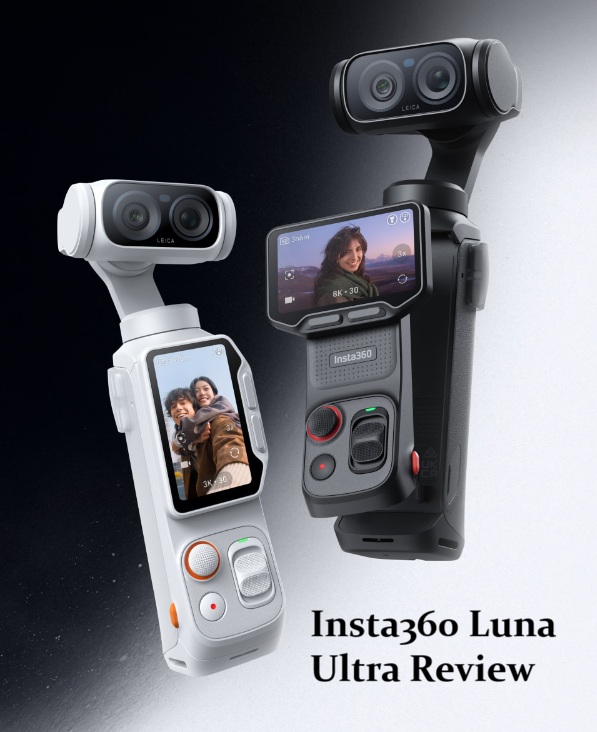
The Luna Ultra feels solid in hand, a bit larger than some competing pocket cameras, but the extra size translates into a more confident grip. It comes in white or black, and the included clamshell case wraps around the entire gimbal for protection during transport.
The standout physical feature is the detachable 2-inch OLED touchscreen. You can pop it off the main body, and it keeps working as a fully functional remote control from up to 65 feet away.
A few design details worth knowing:
- Rotatable touchscreen for easy framing at odd angles
- Built-in microphone above the screen for quick stand-up recordings
- Included handle has a 1/4-inch-20 thread with a built-in kickstand
- 47GB of internal storage, plus support for microSD cards up to 1TB
Camera Hardware
This is where the Luna Ultra genuinely separates itself from typical pocket cameras. It uses two lenses instead of one, giving you real creative flexibility without switching devices.
The main camera uses a 1-inch sensor with a 20mm equivalent focal length and a bright f/1.8 aperture, ideal for vlogging and wide handheld shots. The second camera is a 60mm equivalent telephoto lens with a smaller 1/1.3-inch sensor and an f/2.0 aperture, giving you roughly 3x optical zoom.
Beyond the two physical lenses, you get additional zoom flexibility:
- You can use the 3x optical zoom for lossless close-ups.
- You can push to 6x zoom and still get sharp, artifact-free results in most lighting.
- You can go up to 12x hybrid zoom, though detail softens noticeably at that range.
- You should expect a slight tonal shift when the camera switches between lenses during a zoom.
Video Quality
The Luna Ultra records up to 8K at 30fps, or 4K at up to 120fps for slow motion, with Dolby Vision support and 10-bit I-Log color for professional grading. In everyday shooting, footage comes out bright and slightly saturated by default, though switching to Pro mode gives you a flatter, more cinematic look.
Dolby Vision looks genuinely impressive in a lot of situations, especially handheld street footage. That said, it can occasionally oversaturate bright areas, and I noticed some fuzzy edges around foliage against bright skies during outdoor testing.
What You Should Expect From Video Recording
If video is your main use case, here’s what to expect:
- You’ll get excellent dynamic range, with the sensor rated for around 14 stops.
- You can shoot professional-grade footage using the I-Log color profile for grading in DaVinci Resolve or Premiere Pro.
- You should experiment with Dolby Vision before relying on it, since results vary by lighting condition.
- You won’t need an external mic for casual use, though a dedicated mic setup still improves audio quality for serious projects.
Photo Quality
Most buyers will pick up the Luna Ultra for video, but the photo capabilities are surprisingly capable too. By default, it shoots 9MP photos, but switching to UltraPhoto mode bumps that up to 37MP with full DNG RAW support.
The in-camera panoramic mode is a genuinely fun feature. Set the camera down, hit the shutter, and it automatically captures and stitches together panoramas up to 200 megapixels without any extra editing steps.
Subject Tracking
Insta360’s Deep Track 5.0 tracking system is one of the most refined I’ve used on a pocket camera. You can tap a subject or draw a box around them, and the camera tracks them smoothly through the frame.
What sets it apart is framing control. Instead of forcing your subject into the dead center of the shot, you can position yourself higher, lower, or off to one side, and the camera maintains that framing while tracking. For creators who care about composition, this is a genuinely useful detail most competitors skip.
Battery Life and Charging
Insta360 rates the Luna Ultra’s 1550mAh battery for up to four hours of shooting. That’s respectable for a camera this small, though it’s not going to last through a full day of continuous filming.
What matters more in daily use is charging speed. The Luna Ultra can reach around 80% battery in roughly 23 minutes using fast charging, which makes quick top-ups between shoots genuinely convenient.
Leica Color Profiles
Insta360 partnered with Leica on this camera, and it shows in the color science. You get access to Leica Natural, Leica Vivid, and Leica Chrome color profiles, along with additional filters like Pos Film, Fresh, and Cinematic for quick stylistic looks.
If you prefer full manual control, the I-Log color profile gives you flat, gradable footage that works well in professional color pipelines, including ACES workflows.
A Few Rough Edges
No camera is perfect, and the Luna Ultra has some quirks worth knowing about before you buy.
- Bluetooth pairing with third-party wireless mics, including the DJI Mic 2, does not currently work
- Timecode functionality is essentially time-of-day based, not true jam-sync timecode
- The companion mobile app is functional but occasionally has connection hiccups
- Dolby Vision can introduce oversaturation in specific bright-light scenarios
Insta360 Luna Ultra vs Typical Pocket Cameras
| Feature | Insta360 Luna Ultra | Typical Single-Lens Pocket Camera |
|---|---|---|
| Lenses | Dual: wide + telephoto | Single wide lens |
| Main Sensor | 1-inch, f/1.8 | Often smaller sensor |
| Max Video | 8K/30fps, 4K/120fps | Usually caps at 4K |
| Zoom | 3x optical, up to 12x hybrid | Digital zoom only |
| Screen | Detachable, works as remote | Fixed, non-removable |
| Battery Life | Up to 4 hours | Similar range |
| US Availability | Fully available | Varies by brand |
| Starting Price | $760 | $500 to $800 |
What Actually Worked For Me
I expected the dual-lens setup to be the highlight, and it mostly was, but the detachable screen turned out to be the feature that changed my actual workflow. Being able to walk away from the camera and still monitor and control framing made solo filming dramatically easier.
I did run into one frustrating moment early on. I assumed my existing wireless mic would pair over Bluetooth without issue, and it didn’t. After some troubleshooting, I confirmed the compatibility gap wasn’t on my end, so if you rely on a specific mic brand, it’s worth checking compatibility before you buy.
Who Should Buy the Insta360 Luna Ultra?
You should consider this camera if:
- You create vlogs, social content, or event coverage regularly
- You want real optical zoom instead of relying on digital crop
- You often film yourself solo and need reliable remote framing
- You’re in the US and want a capable alternative while DJI’s newer cameras remain unavailable
You might want to skip it if:
- You need seamless third-party wireless mic compatibility
- You require professional jam-sync timecode for multi-camera shoots
- You want the absolute longest battery life in a pocket camera
Pros and Cons
Pros:
- Excellent dual-lens setup with real optical zoom
- Strong video quality with 8K, Dolby Vision, and 10-bit I-Log support
- Genuinely useful detachable, rotatable touchscreen
- Refined subject tracking with flexible framing control
- Fast charging offsets modest battery life
Cons:
- Limited third-party Bluetooth mic compatibility
- No true professional jam-sync timecode
- Companion app has occasional connection issues
- Dolby Vision needs some trial and error to avoid oversaturation
FAQ
How long does the Insta360 Luna Ultra’s battery last? Insta360 rates it for up to four hours of shooting. Fast charging brings it back to around 80% in roughly 23 minutes, which helps offset the moderate battery life during long shoot days.
Does the Luna Ultra shoot in 8K? Yes. It records up to 8K at 30fps, along with 4K at up to 120fps for slow motion footage, and supports Dolby Vision and 10-bit I-Log color.
Can I use the touchscreen as a remote control? Yes. The 2-inch OLED touchscreen detaches from the main body and continues to function as a remote, letting you pan, tilt, zoom, and navigate menus from up to 65 feet away.
Is the Insta360 Luna Ultra good for photos? Yes, more than expected for a video-focused camera. It shoots 37MP photos with DNG RAW support in UltraPhoto mode, plus an in-camera panoramic mode that stitches images up to 200 megapixels.
Does it work with third-party wireless microphones? Not entirely. Some third-party mics, including the DJI Mic 2, currently fail to pair over Bluetooth. Insta360’s own Mic Air and Mic Pro accessories are the more reliable choice.
Is the Insta360 Luna Ultra worth buying? For most content creators, yes. The dual-lens system, video quality, and detachable screen make it one of the strongest pocket gimbal cameras available, especially with limited competition in the US market right now.
Final Thoughts
The Insta360 Luna Ultra delivers on nearly everything it promises. The dual-lens system genuinely adds creative flexibility, and the detachable screen is one of those features that sounds like a gimmick until you actually use it.
The rough edges around mic compatibility and timecode matter mostly for professional multi-camera setups. For everyday creators, vloggers, and solo shooters, this camera earns its place as one of the best pocket options available today.
Editor’s Opinion
honestly this camera suprised me alot, i wasnt expecting the zoom lens to be this good on something so small. the detachable screen thing is actually really usefull, not just a gimmick like i thought at first. only annoying part was trying to pair my mic and it just wouldnt work. still, for the price its an easy recommend if ur making videos alot like i do.
