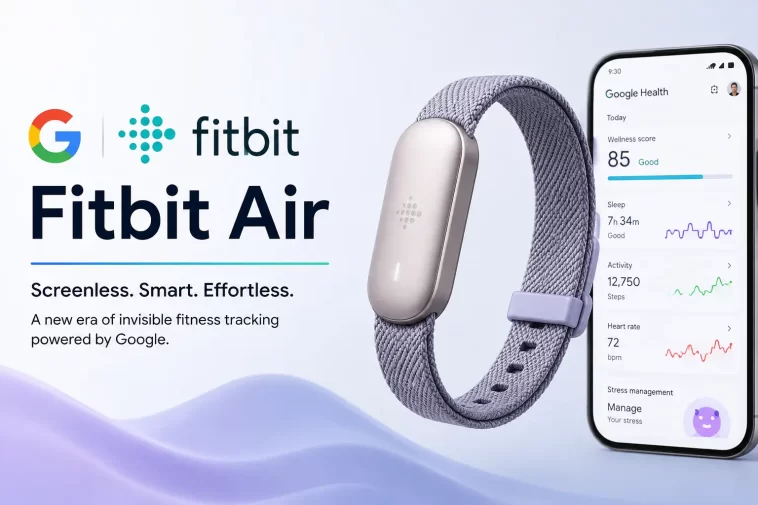
Google Fitbit Air is officially here, and it may become one of the most talked-about wearable devices of the year. Instead of competing directly with smartwatches packed with apps, notifications, and large displays, Google has taken a very different approach. The newly announced Fitbit Air removes the screen entirely and focuses on lightweight health tracking, long battery life, and AI-powered wellness insights.
The move represents a major shift in Google’s wearable strategy. While many technology companies continue adding more features and distractions to smart devices, Google appears to be betting that users now want something simpler, smaller, and easier to wear throughout the day.
The Fitbit Air is designed for people who care more about sleep tracking, heart monitoring, recovery, and overall wellness than checking messages on their wrist every few minutes. Early reactions from the tech community suggest that Google may have identified a growing trend in the wearable market: users are increasingly looking for devices that quietly collect health data without becoming another screen competing for attention.
Google Fitbit Air Takes a Minimalist Approach
The biggest difference between the Google Fitbit Air and traditional smartwatches is obvious immediately: there is no display.
Google describes the device as a lightweight “screenless wearable” created to stay out of the user’s way. Instead of interacting with the tracker directly, users access all their health and fitness information through the Google Health smartphone app.
This minimalist design is intentional. Google says many consumers find smartwatches bulky, distracting, expensive, or unnecessarily complicated. Fitbit Air aims to solve those issues by offering only the core features people actually use most often.
The device weighs just 12 grams with the band attached and roughly 5 grams without it, making it one of the lightest wearable fitness products Google has ever released. Several interchangeable bands are also available, including sport-focused and lifestyle-focused options.
Health Tracking Features Remain the Main Focus
Although the Fitbit Air removes the display, it still includes a surprisingly advanced collection of health sensors.
According to Google, the tracker supports:
- 24/7 heart rate monitoring
- Sleep tracking
- Blood oxygen (SpO2) monitoring
- Heart rate variability tracking
- Skin temperature monitoring
- Activity tracking
- AFib heart rhythm alerts
- Resting heart rate analysis
The device can automatically detect workouts and common physical activities. Users can also manually log exercises through the Google Health app.
Battery life is another major selling point. Google claims the Fitbit Air can last up to seven days on a single charge, which is significantly longer than many modern smartwatches. Fast charging support is also included, with five minutes of charging reportedly providing enough power for a full day of use.
Google Health App and AI Integration
Another major part of the Google Fitbit Air experience is the company’s new Google Health ecosystem.
The wearable is deeply connected to Google Health Coach, an AI-powered wellness assistant built using Google’s Gemini artificial intelligence technology. The system analyzes health data collected from the Fitbit Air and provides personalized recommendations related to exercise, sleep quality, stress management, recovery, and nutrition.
Google says the AI system can eventually understand workout habits, activity patterns, and even meal information to deliver smarter guidance over time.
This strategy places software and AI at the center of the Fitbit Air experience rather than hardware interaction. Instead of users constantly touching or viewing the device itself, Google wants the wearable to quietly collect data in the background while the AI assistant interprets the information.
The approach is very different from traditional smartwatch experiences offered by competitors like Apple and Samsung.
Fitbit Air Competes With Whoop and Oura
Industry analysts immediately noticed that the Google Fitbit Air appears to target companies like Whoop and Oura rather than Apple Watch users.
Whoop has become popular among athletes and fitness enthusiasts because it focuses heavily on recovery tracking and long-term health insights instead of smartwatch features. Oura Ring follows a similar philosophy through a smart ring design.
Google’s advantage could be affordability.
The Fitbit Air launches at approximately $99.99, making it significantly cheaper than many competing wearable products in the same category. Devices like Whoop often require expensive subscriptions, while smart rings and premium fitness trackers can cost several hundred dollars.
Google is clearly trying to position Fitbit Air as a simpler and more accessible alternative.
A Return to Fitbit’s Original Identity
For longtime Fitbit users, the Fitbit Air may feel surprisingly familiar.
Before smartwatches became dominant, Fitbit originally built its reputation around small and unobtrusive fitness trackers. Early Fitbit devices focused on step counting, sleep tracking, and battery efficiency rather than apps and notifications.
Some technology analysts believe Google is now returning the Fitbit brand to those roots after years of uncertainty following Google’s acquisition of Fitbit.
There has been ongoing debate within the wearable technology community about whether dedicated fitness trackers still have a place in a smartwatch-focused market. However, discussions across online communities show that many users still prefer simpler fitness-focused devices because they offer:
- Better battery life
- Less distraction
- Lower prices
- More comfortable sleep tracking
- Easier everyday use
Reddit discussions over recent years consistently showed that many consumers wanted lightweight trackers rather than fully featured smartwatches.
Google’s latest wearable seems designed specifically for those users.
Fitbit Air Could Influence Future Wearable Trends
The launch of the Google Fitbit Air may signal a broader change in the wearable industry.
For years, wearable technology companies competed by adding more screens, more notifications, more apps, and more interactive features. But the growing popularity of minimalist devices suggests some users now prefer “invisible technology” that works quietly in the background.
This trend aligns with wider conversations around digital wellness and reducing screen dependency.
Instead of becoming another device demanding attention, Fitbit Air attempts to blend into everyday life while still collecting useful health information. Google repeatedly emphasizes comfort, simplicity, and distraction-free use throughout its marketing materials.
If the product succeeds commercially, other manufacturers may follow with similar screenless wearable designs.
Pricing and Availability
Google has confirmed that the Fitbit Air starts at $99.99 in the United States. The wearable includes a three-month trial of Google Health Premium, though users can continue using the device without paying for the subscription service.
The product is expected to become available in multiple global markets during the coming weeks.
Several band styles and color options are launching alongside the tracker, including performance-focused designs and limited-edition collaborations.
