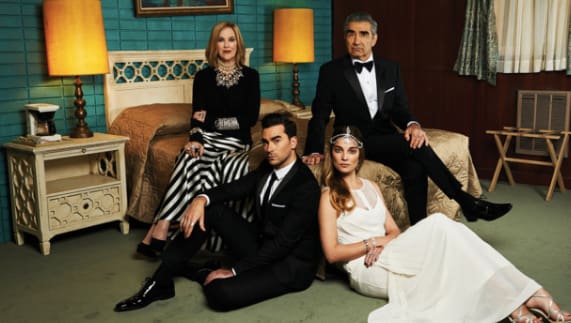
The little-heard Canadian sitcom Schitt’s Creek was able to make its name known to a much wider audience after the Emmy nominations it received with its fifth season, including Best Comedy Series. It is a sitcom about a wealthy family who has lost everything, being confined to a small town in the middle of nowhere, and an emotional growth story of four adults, both as “what I am, not what I will be.”

Schitt’s Creek creator Daniel Levy says that in an interview before he found the idea, he watched a lot of reality shows, asked what the fate of these rich people he watched on television would be if they lost everything and asked himself the question of Schitt’s Creek’s starting point: Kardashians, would there be Kardashians without their money? The series created by Daniel Levy with Eugene Levy, who is known to everyone as the father of American Pie, after his family was defrauded by Johnny Rose (Eugene Levy), the owner of a million-dollar video rental company, and his family, the series starts with a broke-free stay. All they have left is the town called Schitt’s Creek, where they bought their son David as a joke on a birthday because of his tragicomic name. With the proposal of Schitt’s Creek’s generous mayor Roland (Chris Elliott), Johnny, his wife, a former soap opera star Moira (Catherine O’Hara), and their two-year-old children David (Daniel Levy) and Alexis (Annie Murphy). They “temporarily” settle in two rooms of Schitt’s Creek’s only motel. They start living in a town where they certainly don’t belong, among people who have absolutely nothing in common. By longing for what they once had and wishing to get rid of this hell, they were in right away… The conditions do not change, and the Roses learn to adapt to this life they do not belong to, they adapt a little to Schitt’s Creek, they make up a little Schitt’s Creek.
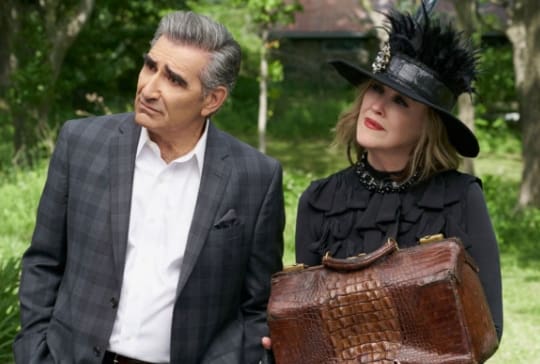
Starting out from a very simple formula, the series doesn’t even repeat itself thanks to its four well-written characters. As the seasons progress, it is understood that this is not just a matter of “what I have to say, but what I will be.” It tells the growth stories of Johnny, Moira, David, and Alexis as a family and as individuals. The past and present of the four characters form the basis of the scenario, as two separate realities that always conflict but complement each other. The most vivid, colorful example of this is Moira Rose, portrayed by Catherine O’Hara with flawless performance: Waxed sentences, words that look like they have been replaced by a top model from thesaurus, wigs, clothing that manages to overdo it in every environment, and full names to people. This is a character that seems to have come to the set of a wrong series with his call, but as time goes by, we witness that he leaves his pride aside, accepts the situation he is in, remembers his sense of motherhood, and opens his feelings. David and Alexis learn to control their future both in career and emotional terms, when they are young people who do not know what to do as soon as they are deprived of the possibilities and money put into their pockets throughout their lives, by trying and making mistakes. They learn to be able to stand on their own feet.

The most surprising thing about Schitt’s Creek is that it’s a series that can keep up with the era with what it doesn’t say more than what it says about gender and sexual identity. The series does not reveal any didactic or exemplary situation and discourse; the events that do not stop the compulsion, which progress in a natural flow, create a pansexual and feminist utopia. Like the people of a town projected to be racist, homophobic, and ignorant in real life, Schitt’s Creek surprises. On the other hand, just like the Roses, Schitt’s Creek people are growing as the chapters move on. Instead of feeling threatened by the presence of their far-fetched and makeshift guests, the townspeople, who embrace them and are generous and sincere, open themselves up to innovation, change, and development. Schitt’s Creek flourishes step by step, evolves, and opens out. As well as Johnny, Moira, David, and Alexis, Mayor Roland, his wife Jocelyn, motel attendant Stevie, vet Ted, auto mechanic Bob, waiter Twyla, and others are growing up, turning into new and better people.
