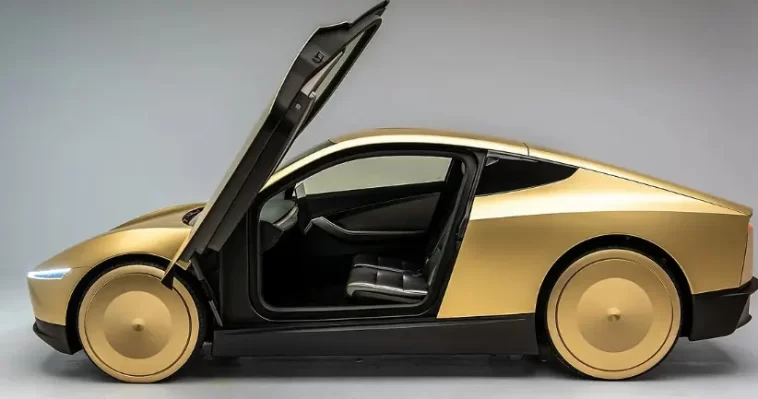
Tesla Cybercab without steering wheel is one of the most talked-about innovations in the automotive world right now. The futuristic vehicle, developed by Tesla after years of research and planning, has recently rolled off the production line at the company’s massive factory in Austin, Texas. What makes this vehicle extraordinary is not just its sleek design or advanced technology, but a radical decision: it has no steering wheel, no accelerator pedal, and no brake pedal.
If everything goes according to plan, Tesla intends to start mass production of this vehicle in April. The company believes it could become the foundation of a fully autonomous transportation future. However, the bold design also raises questions about safety regulations, legal approvals, and whether drivers are truly ready to trust a car that drives entirely on its own.
In many ways, this vehicle could mark a turning point not only for Tesla but for the entire automotive industry.
A New Era of Autonomous Vehicles
For years, Tesla has been working toward a vision of completely autonomous vehicles. While many modern cars include driver-assistance features, Tesla’s long-term goal is far more ambitious: a vehicle that requires no human control at all.
The Tesla Cybercab without steering wheel is designed specifically for that purpose. Unlike traditional vehicles that still allow manual driving, this car is built entirely around Tesla’s Full Self-Driving (FSD) software.
Instead of controlling the vehicle with pedals or a steering wheel, passengers simply enter their destination. The car’s onboard artificial intelligence then handles the entire journey, including navigation, acceleration, braking, and obstacle avoidance.
According to Tesla executives, this approach could dramatically change how people think about transportation. Instead of owning a car for personal use, many people may simply call an autonomous vehicle when they need one.
Production Begins in Austin
The first Tesla Cybercab prototypes recently rolled off the production line at Tesla’s Giga Texas factory in Austin. Workers wearing helmets and safety vests reportedly applauded as the vehicle appeared on the assembly line.
The factory is currently being prepared to produce hundreds of Cybercab vehicles each week once mass production begins.
Tesla’s plan is ambitious. If the project succeeds, the company hopes to scale production dramatically in the coming years. Elon Musk has suggested that the vehicle could eventually reach millions of units per year.
Such numbers would make the Cybercab one of the most significant new vehicles in Tesla’s history.
Elon Musk’s High-Risk Strategy
Tesla CEO Elon Musk is known for taking bold risks, and the Cybercab project may be one of his biggest bets yet.
In fact, Musk has shown so much confidence in the project that Tesla reportedly paused some other vehicle developments to focus resources on autonomous technology. Two potential vehicle projects were even canceled as the company shifted its priorities.
Musk believes the future of Tesla lies not only in manufacturing electric cars but also in becoming a major force in artificial intelligence and robotics.
Speaking to investors earlier this year, Musk summarized the situation with a striking statement:
“There is no Plan B. This vehicle either drives itself, or it doesn’t.”
That comment highlights just how central autonomous driving has become to Tesla’s long-term strategy.
The Vision: A Robotaxi Network
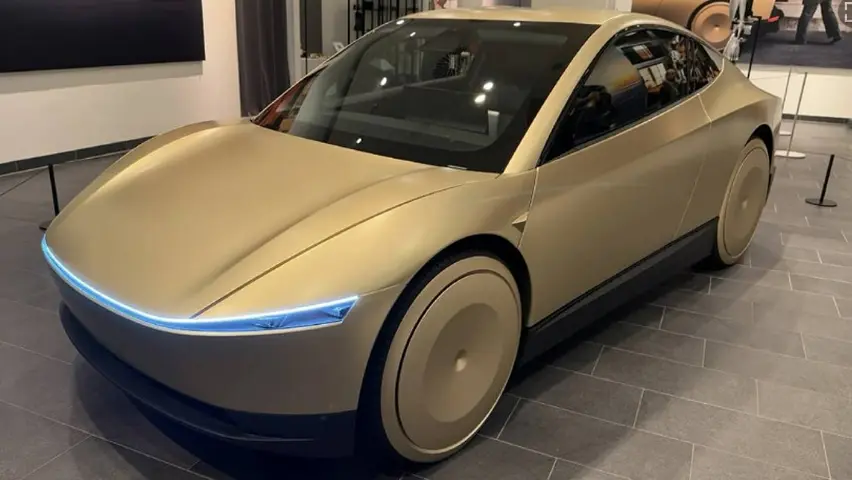
One of the most important goals behind the Tesla Cybercab without steering wheel is the creation of a robotaxi network.
In this model, autonomous Tesla vehicles would operate as self-driving taxis. Users could request a ride through an app, and the nearest available vehicle would arrive automatically.
Tesla believes this system could dramatically reduce transportation costs. Musk has suggested the vehicle might cost under $30,000, making it relatively affordable compared with many electric vehicles today.
The company hopes the vehicle could be sold both to fleet operators and individual owners who want to use their cars in the robotaxi network when they are not driving.
If successful, the concept could transform Tesla from a traditional car manufacturer into a mobility platform company.
Legal and Regulatory Challenges
Despite the excitement surrounding the Tesla Cybercab without steering wheel, the project faces a significant challenge: current safety regulations.
In the United States, vehicle safety standards are overseen by the National Highway Traffic Safety Administration (NHTSA). Under existing federal regulations, cars typically must include basic features such as steering wheels, pedals, and mirrors.
Vehicles that do not meet these standards can sometimes receive exemptions, but the rules limit those exemptions to 2,500 vehicles per year.
So far, NHTSA has stated that Tesla has not yet submitted an official exemption request for the Cybercab.
If regulators determine that the vehicle does not comply with safety standards, Tesla could face serious consequences, including fines or even recalls.
These regulatory issues may ultimately determine how quickly the Cybercab can reach the public.
Will Consumers Accept a Driverless Car?
Even if regulators approve the vehicle, Tesla still faces another challenge: public trust.
For more than a century, drivers have been accustomed to controlling their vehicles. The idea of sitting in a car without a steering wheel may feel uncomfortable for many people.
Automotive analysts believe that consumer adoption could take time. Some experts suggest Tesla might initially deploy the vehicles primarily within its own robotaxi network rather than selling them directly to consumers.
Morgan Stanley analyst Andrew Percoco has noted that it may take years for drivers to fully adapt to the concept of a completely autonomous vehicle.
However, younger generations who are already comfortable with ride-sharing services and advanced technology may be more willing to embrace the idea.
Why Tesla Needs a Breakthrough
Tesla’s push into autonomous vehicles also comes at a critical moment for the company.
Automobile sales still account for roughly 73 percent of Tesla’s total revenue, but those sales have recently shown signs of slowing down. In 2025, Tesla’s car sales reportedly declined by around 10 percent.
Some analysts even predict that sales could decline again in 2026, marking three consecutive years of slowing growth.
The Cybercab project could therefore play a crucial role in Tesla’s future. If the robotaxi vision works, it could open up entirely new revenue streams for the company.
Instead of simply selling vehicles, Tesla could generate income through autonomous ride services, software subscriptions, and fleet operations.
Musk’s Bold Sales Target
Despite the challenges, Elon Musk remains extremely optimistic.
He has suggested that Tesla could eventually produce around 2 million Cybercab vehicles per year once production reaches full capacity.
If those numbers are achieved, the Cybercab would quickly become one of the most widely deployed autonomous vehicles in the world.
Musk also believes the project could begin having a visible impact on Tesla’s financial results by the end of 2026.
However, that timeline depends on multiple factors, including regulatory approval, production scaling, and consumer acceptance.
The Future of Transportation
The Tesla Cybercab without steering wheel represents more than just a new vehicle. It represents a possible shift in the entire transportation model.
For decades, the automobile industry has focused on building better vehicles for individual drivers. Tesla’s vision, however, suggests a future where transportation is automated, shared, and controlled by intelligent systems.
If the Cybercab succeeds, it could inspire other manufacturers to accelerate their own autonomous vehicle programs.
On the other hand, if the project struggles with regulations or public acceptance, it could slow the industry’s transition toward driverless technology.
Either way, the Cybercab is likely to become one of the most closely watched automotive experiments of the decade.
Final Thoughts
The Tesla Cybercab without steering wheel is one of the most ambitious automotive projects ever attempted. With no steering wheel, no pedals, and a complete reliance on artificial intelligence, it challenges the very definition of what a car should be.
Tesla hopes to begin mass production in April, but the road ahead is filled with questions about regulation, safety, and consumer trust.
Still, if Elon Musk’s vision becomes reality, the Cybercab could mark the beginning of a driverless transportation era—one where cars no longer need drivers at all.
For Tesla, the stakes could not be higher.
