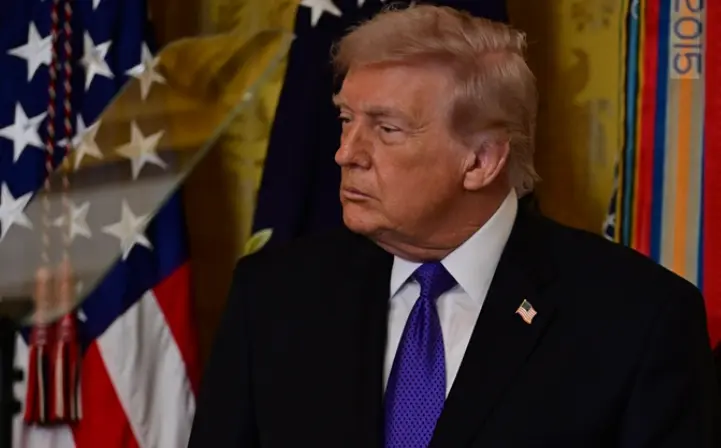
Trump Iran war confusion has become a major topic in international politics as conflicting messages from the White House and the Pentagon leave analysts, markets, and allies uncertain about the direction of the conflict. Over the past few days, statements from President Donald Trump and senior defense officials have painted very different pictures of the war between the United States and Iran.
While the president has suggested that the conflict may already be nearing its end, military officials have indicated that the campaign is only beginning. The contrast between these positions has triggered debate about Washington’s objectives and whether a clear strategy exists at all.
As the situation unfolds, political observers, economists, and foreign policy experts are trying to understand what the administration’s ultimate goal might be.
Trump Suggests the War Is “Nearly Complete”
During a televised interview with CBS News, President Trump appeared to signal that the conflict had already reached a decisive stage.
“I think the war is very complete, pretty much,” the president said when asked about the current military situation.
Later that day, speaking at a press conference, Trump repeated a similar message. He explained that the United States had made “major strides” toward fulfilling its military objectives. According to the president, some observers might already consider those objectives essentially accomplished.
The remarks quickly attracted attention because they suggested that the administration believed the war was close to ending. However, the wording also left significant room for interpretation, creating uncertainty about whether the president was announcing an imminent conclusion or simply describing progress.
Political commentators immediately noted the ambiguity of the statement, comparing it to historical moments when leaders prematurely declared victory in complex military conflicts.
Pentagon Signals the Conflict Is Just Beginning
The Trump Iran war confusion deepened further when the U.S. Department of Defense released a message on social media that appeared to contradict the president’s remarks.
In a post shared on X (formerly Twitter), the Pentagon declared:
“We have only just begun to fight.”
The statement, referencing a famous quote associated with the early history of the U.S. Navy, suggested that military operations were far from finished. Instead, it indicated that American forces were preparing for continued strikes and potentially expanded operations.
The timing of the message raised immediate questions. If the war was nearly complete, as the president implied, why would the Department of Defense emphasize that the fighting had only begun?
Reporters quickly pressed Trump on the apparent contradiction during the press conference.
When asked directly how both statements could be true at the same time, the president responded: “Well, I think you could say both.”
The explanation did little to clarify the situation and instead added to the growing perception that the administration had not presented a consistent narrative about the conflict.
Economic Pressure May Be Driving the Messaging
Some analysts believe the president’s remarks were partly intended to calm economic concerns at home.
The Trump Iran war confusion has emerged at a moment when the American economy is already facing pressure from rising living costs and volatile energy markets. Since the start of the conflict, oil prices have fluctuated significantly, and global financial markets have reacted to the uncertainty.
Higher fuel prices have become a particularly sensitive issue for American voters. Inflation played a significant role in the 2024 election campaign, and economic concerns continue to shape public opinion.
Because of this, some observers believe the president’s suggestion that the war is “nearly complete” may have been aimed at reassuring investors and consumers that the situation will stabilize soon.
Initial market reactions seemed to support that theory. Oil futures briefly dropped after the remarks, and stock markets recovered slightly following several days of turbulence.
However, economists warn that inconsistent messaging could have the opposite effect over time.
Financial markets typically respond best to clear and predictable policy signals. When political leaders appear uncertain about their own strategy, investors may become more cautious.
Military Escalation Still Appears Likely
Despite the president’s optimistic tone, defense officials have indicated that military operations may intensify rather than wind down.
Defense Secretary Pete Hegseth suggested that upcoming operations could represent some of the most significant strikes of the campaign so far. According to defense briefings, U.S. forces are preparing additional air and naval actions targeting Iranian military infrastructure.
If those plans proceed, it would contradict the idea that the conflict is nearing completion.
The difference between political messaging and military planning has therefore become another factor contributing to the Trump Iran war confusion.
Foreign policy experts say such contradictions can create uncertainty not only among investors but also among allies and adversaries.
When a government’s strategy is unclear, other countries may struggle to predict its next move.
Controversy Over the School Missile Strike
Another issue adding to the debate involves a controversial missile strike in Iran that reportedly hit a girls’ school located near a naval facility.
Iranian authorities claim that roughly 175 people died in the incident, many of them children. The attack drew widespread international criticism and calls for an independent investigation.
Initially, President Trump suggested that the damage may have been caused by Iranian “friendly fire.” According to the president, Iran’s missile accuracy was poor and could have been responsible for the strike.
However, later reports indicated that the missile used in the attack may have been a Tomahawk cruise missile, a weapon produced in the United States.
When asked about this discrepancy, the president stated that Tomahawk missiles are “generic” and could be used by other countries as well.
Military analysts quickly pointed out that only a limited number of close U.S. allies are known to operate Tomahawk systems, including the United Kingdom and Australia.
When confronted with those facts during a press briefing, Trump acknowledged that he did not have complete information about the incident.
“Because I just don’t know enough about it,” he said. “Whatever the report shows, I’m willing to live with that report.”
A Rare Moment of Presidential Uncertainty
The statement was notable because President Trump rarely admits uncertainty about policy matters.
In most situations, the president has expressed strong confidence in his decisions and often claims to have a better understanding of events than critics or advisers.
Observers therefore interpreted the comment as a rare moment in which the president publicly acknowledged a lack of detailed knowledge about a major development in the conflict.
Political scientists note that modern presidents rely heavily on teams of advisers and intelligence agencies to gather accurate information during wartime. No single leader can be expected to know every detail of a rapidly evolving situation.
However, critics argue that the administration’s broader communication strategy has made the Trump Iran war confusion more pronounced.
Questions About the War’s Goals
Beyond the conflicting statements, a larger issue remains unresolved: What exactly is the United States trying to achieve in the war with Iran?
Since the beginning of the conflict, different explanations have been offered by officials and commentators. Some have described the campaign as a limited operation aimed at deterring Iranian aggression. Others have suggested broader goals related to regional security or regime pressure.
According to several policy analysts, the administration provided numerous different justifications during the first week of the conflict alone.
This lack of a single, clearly defined objective has fueled ongoing debate in Washington.
Members of Congress from both parties have asked for more detailed explanations regarding the legal authority for the military action and the long-term strategy behind it.
Decision-Making Centered in the White House
Another notable aspect of the situation is how strongly the president has emphasized his personal role in determining the course of the war.
When asked when the conflict might end, Trump suggested that the decision ultimately rests with him.
“Wrapping up is all in my mind,” he said during an interview. “Nobody else’s.”
Such remarks highlight the degree to which strategic decisions appear concentrated in the Oval Office.
In theory, U.S. war policy involves input from a wide range of institutions, including the Cabinet, the Department of Defense, intelligence agencies, and Congress. These bodies are intended to provide oversight and expertise in complex national security matters.
Critics worry that sidelining these processes could lead to unpredictable outcomes.
Global Observers Watching Closely
As the conflict continues, governments around the world are closely monitoring developments in Washington.
Allies are seeking reassurance about the long-term stability of U.S. strategy, while geopolitical rivals are trying to assess how the situation might evolve.
The Trump Iran war confusion has therefore become more than a domestic political issue. It now influences global energy markets, diplomatic relations, and the broader security landscape in the Middle East.
Whether the war is truly nearing its end or entering a new phase remains uncertain.
What is clear, however, is that the mixed signals coming from Washington have created an environment where questions remain far more numerous than answers.
