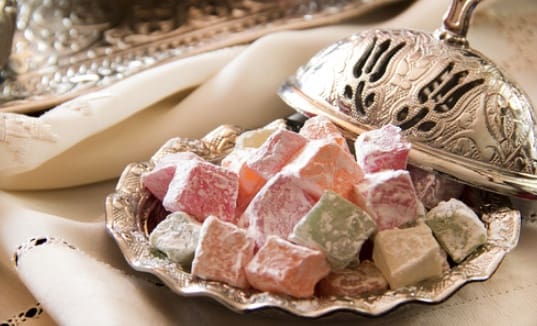
It is the sweetest member in Turkish cuisine, it is a beautiful gift to be given, it is the best friend of coffee, it is a nostalgia from childhood, and it is the reason to love religious festivals: yes, that’s true! We mention about Turkish delight. Its history is very long and it is an important part of Ottoman cuisine. Here are the things you need to know about Turkish delight. Turkish delight is prepared with different kinds such as sugar, starch and dried fruits for its kinds or dried nuts. This Turkish dessert that seems like gel is added rose water or lemon to >preserve its characteristic taste. After it is cut in cubic form, its every side is covered with castor sugar or coconut. The best nuts that are good with it are pistachio, walnut and hazelnut.

THE HISTORY OF TURKISH DELIGHT
Turkish delight which is an important part of court kitchen at Ottoman period has centuries old history. Sasanians, which prevailed at the Persian Empire 226 and 652 B.C., mostly consume dessert called as ‘abhisa’. It is not certainly known but it is mentioned that Abhisa is the origin of Turkish delight. This dessert firstly called as ‘rahat ul-hulküm’ that means ‘settling throat’. After time is passed, it is known as ‘rahat lokum’. And finally, it is named ‘lokum’ with modern Turkish. Turkish delight came to be known in Anatolia at 15 th century. It was the most popular at 17 th century. When it was 18 th century, tripper took Turkish delight away to Europe and introduce as ‘Turkish delight’. It became famous there. Mass production started at Ottoman Empire in 1777. Firstly, it is produced with honey, glucose syrup and flour mixture. With the invention of starch and white refined sugar, its taste has been changing. Turkish delight was started to be known in Europe with an English traveler at 18 th century. He took it away. At this time, it was liked mostly by aristocrats and it is valued at whole Europe with trade ships. Turkish delight is one of the most popular desserts that do not lose its taste in Balkan States such as Greece, Bulgaria and Romania. Moreover, it is famous at the cuisine of England, Brazil, North America, Iran and Middle East countries. Today, Nestle launch to the market at Canada with the name of ‘Big Turk’ for Turkish delight and it is very popular. The famous painter Pablo Picasso said that he ate Turkish delight before painting to concentrate more. In addition, Winston Churchill and Napoleon mostly like Turkish delight with pistachio. Those are the reality that are on the books from past to present.
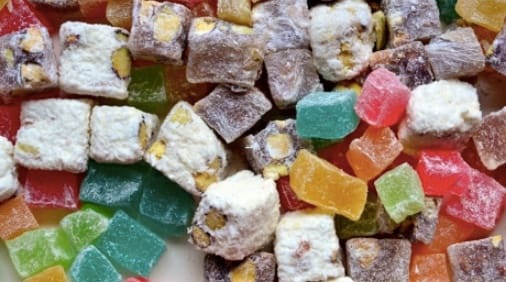
HOW TO MAKE TURKISH DELIGHT? Turkish delight is made from citric acid, sugar, starch, food colouring and aroma. Sugar is boiled with water until it melts entirely. Citric acid and starch are waited at different plates to
dissolve. Then, citric acid and starch are mixed with sugared water. This mixture is boiled for a while. When a spoon is stuck, its consistence is controlled whether it is adhesive or not. It is waited approximately 20 hours at plates that are starchy. Finally, it is shaped at hard pan and it is packed.
HOW TO SERVE? >In Turkish cuisine, meals and desserts have lots of presentation models. This situation is valid for Turkish delight. Turkish delight can be served in the handkerchief. Furthermore, it can be served with Turkish coffee with sugar, medium coffee and plain coffee by absorbing until Turkish coffee finishes.
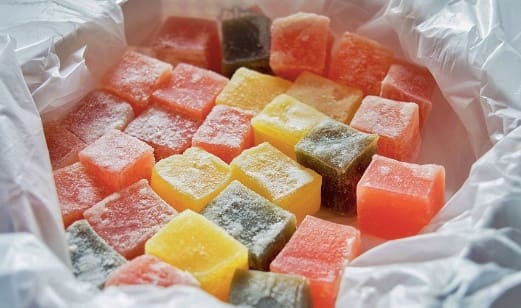
TYPES OF TURKISH DELIGHT There are different kinds of Turkish delight according to its taste, mode of production and production site. Some types are: birds delight, Turkish delight with hazelnut, walnut, double roasted delight, pistachio delight, Turkish delight with coconut, skin, mixed fruit, lemon, mint pomegranate, croquant, special mixed, saffron, rose petal, and chocolate.
NUTRITIONAL VALUE OF TURKISH DELIGHT Although its nutritional value changes with reference to its types, there are average values. 100 gram Turkish delight consists of 89.28 gram carbohydrates, 0.12 gram protein, 0.19 gram fat, 0 gram fiber, 0 milligram cholesterol, 19 milligram potassium, 5 milligram calcium, and 0.1 milligram iron.
THE GENERAL BENEFITS OF TURKISH DELIGHT There are many benefits that are known. The well-known characteristics are: It helps to reduce faucial tonsil. It is beneficial for kidney patients because it has carbohydrate. It is a powerful cure for boil and injury.
OTHER APPARENT BENEFITS OF TURKISH DELIGHT Turkish delight is a source of energy because it includes starch and sugar. It is a member of carbohydrate group that is one of the building blocks of body. Like other foods that contain carbohydrate, Turkish delight is burned soon afterwards it is eaten. However, the important point is that it should not be consumed so much because body has trouble to digest. As you know, carbohydrates that are indigestive and are not used as energy is storaged as fat at livers. That causes gaining extra weight. But if it is consumed carefully, it is beneficial. When we compare carbohydrates such as Turkish delight and protein such as meat, we can easily
say that carbohydrates are not dangerous so much. In other words, while foods that contain protein are burned in body and support to have muscle, at that time that protein is transformed to energy, the matters like creatinin, urea and uric acid are accumulated at body as waste. These matters raise the functions of liver and kidney in blood value. If these waste matters are accumulated in blood, it is an indicator that liver and kidney have trouble to make functions. Turkish delight is a magnificent food for kidney patients. Doctors offer them to consume it. Especially, Turkish delight with vanilla and cacao help to remove these waste matters from body without gaining calorie. Moreover, it is used for healing injury and boil since old times. You can be skeptical in which extent it is healthy. It is normal but well preserved people still continue this application as an alternative. Turkish delight which is a necessary taste at religious festivals is also served with Turkish coffee. When it is consumed reasonably, it is healthy and nutritious. Because over consumption of Turkish delight leads to put on weight, it is highlighted that it must be careful about the quantity which is consumed. Finally, let’s touch some probable harm that Turkish delight may cause for our body. If it is not sold in the package, this situation may threaten your health. Turkish delight that is corny and cheap or its matters are not known is harmful for stomach. Furthermore, it is not beneficial in terms of health or it is produced with artificial sweetener. This Turkish delight can cause ill not only stomach but also nausea, burning sensation. That is why, when it is consumed, it should be preferred from well known brand or producer.
THE NUTRITIONAL VALUE OF TURKISH DELIGHT One simple Turkish delight equals 32 calories. Consuming 2 Turkish delight equals consuming 1,5 times of a medium fruit. Even though pistachio or walnut raises its calorie level, it gives more energy. According to dietician, 3 Turkish delights that each of them is 41 gram are assumed a portion. Here the nutritional value of proverbial Turkish delight! For one piece of 100 gram Turkish delight: 89.28 gram carbohydrates 0.12 gram protein 0.19 gram fat 0 gram fiber 0 milligram cholesterol 19 milligram potassium 5 milligram calcium 0.1 milligram iron
