I spent about four years jumping between frontend frameworks for client work before I settled into a stack I actually trust, and honestly, the biggest mistake I made early on was picking based on Twitter hype instead of what the project actually needed. If you’re trying to figure out which front-end framework is worth your time in 2026, you’re not alone — this question shows up in every dev Discord I’m in. So let’s go through the ones that are actually worth learning right now, not the ones that were cool three years ago.
Quick Answer
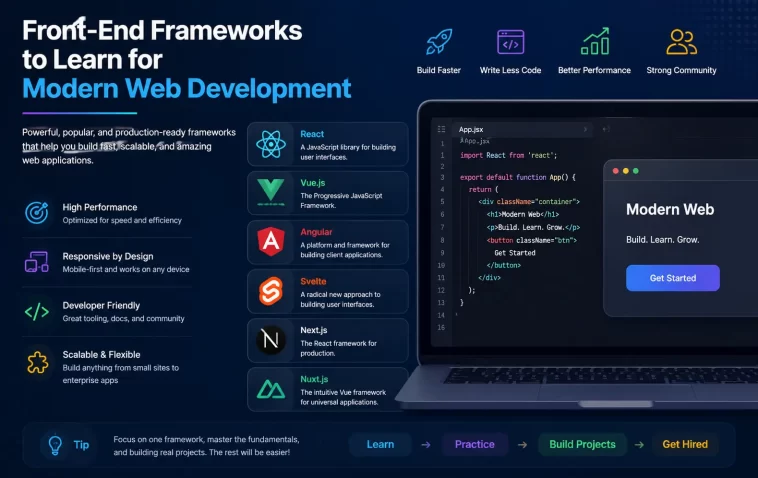
- React (with Next.js) — still the safest bet for jobs and AI-assisted coding tools
- Vue (with Nuxt) — gentlest learning curve, great documentation
- Angular — best for large enterprise teams that want structure enforced
- Svelte / SvelteKit — less boilerplate, compiles away a lot of the framework overhead
- Astro — best pick for content sites and blogs where you don’t want to ship JS you don’t need
If you only read one section, that’s the one. Everything below explains the “why.”
Why Framework Choice Actually Matters (Not Just Hype)
Picking a framework isn’t like picking a text editor. It’s a decision that follows you around for years, and getting it wrong has real costs.
Hiring pool size. React has the deepest pool of developers who already know it. That matters a lot less if you’re a solo dev, but if you’re building a team, it’s not a small thing.
AI-assisted development quality. This one surprised me the first time I noticed it — <cite index=”5-1″>React and Next.js have the largest training data corpus, so AI coding tools tend to generate more accurate code for them because they’ve seen more of it</cite>. If you’re leaning on Copilot, Cursor, or Claude for a chunk of your workflow, that’s a real, measurable advantage for React-based stacks.
Meta-frameworks are the default now, not an add-on. This is the part that trips up a lot of people learning frontend in 2026 — <cite index=”5-1″>you don’t just pick React anymore, you pick Next.js; you don’t just pick Vue, you pick Nuxt</cite>. Raw framework usage without the meta-framework layer is increasingly a niche choice for small widgets, not full applications.
TypeScript is basically assumed. <cite index=”6-1″>TypeScript became the most-used language on GitHub by contributor count in August 2025</cite>, and most serious framework decisions now get made alongside a TypeScript-first workflow, not after the fact.
And here’s the thing nobody tells beginners: the “best” framework depends entirely on what you’re building, not on some universal ranking. A landing page and a real-time dashboard have almost nothing in common technically, but people compare them like they’re the same category of problem.
The Top 10 Front-End Frameworks to Learn in 2026
1. React
React is still the center of gravity for frontend work. It’s a UI library rather than a full framework on its own, which is why almost nobody uses plain React for production apps anymore without pairing it with something else.
Learn React first if you’re new. Not because it’s the “best,” but because so much of the ecosystem — component patterns, hooks, state management concepts — gets reused across other frameworks once you understand it.
2. Next.js
Next.js is technically a React framework, not a separate framework, but in practice it’s treated as its own category because so many teams saying “we use React” actually mean “we use Next.js.” <cite index=”6-1″>It adds server-side rendering, static generation, route-based code splitting, image optimization, and hybrid rendering patterns, which saves teams from stitching together several separate tools themselves</cite>.
The trade-off, and this is something I learned the hard way on a client project: <cite index=”6-1″>Next.js introduces its own rules about rendering, data fetching, caching, and deployment assumptions, and those rules need to be accepted deliberately rather than inherited without thinking about it</cite>. I didn’t think about it on that project. Cost me a weekend untangling a caching bug that was really just me not understanding the App Router’s assumptions.
3. Vue.js (with Nuxt)
Vue has the reputation of being the framework you recommend to your friend who’s scared of JavaScript frameworks, and that reputation is mostly earned. The documentation is genuinely good, the template syntax feels close to plain HTML, and the learning curve is real — not marketing.
Nuxt does for Vue what Next.js does for React: routing, SSR, and data loading handled for you instead of assembled by hand.
4. Angular
Angular gets a bad reputation from developers who tried it once in 2017 and never went back, but the current version is a genuinely different beast. <cite index=”4-1″>Angular 2+ is the current version and it’s different from the original AngularJS, which came out in 2010 and is no longer supported</cite>. <cite index=”4-1″>It’s built with routing, state management, forms, and HTTP communication handled out of the box, and companies like BMW and Forbes run it in production</cite>.
If you’re on a large team where you want the framework to enforce structure rather than let ten developers invent ten different patterns, Angular is genuinely the right call. It’s opinionated on purpose.
5. Svelte / SvelteKit
Svelte flips the usual approach — instead of shipping a runtime framework to the browser, it compiles your components into plain JavaScript at build time. Less code shipped, less overhead at runtime. SvelteKit adds the routing and SSR layer on top, the same pattern as Next.js and Nuxt.
I’ll be honest, I underestimated Svelte for a long time because the ecosystem felt smaller. That’s changed a lot. It’s not going anywhere.
6. Astro
<cite index=”2-1″>Astro is one of the fastest-growing frontend frameworks for content-focused sites, built around an “islands architecture” that ships zero JavaScript to the browser by default and only hydrates the interactive components that actually need it</cite>. <cite index=”2-1″>That makes Astro sites noticeably faster than traditional single-page-app frameworks for blogs, marketing pages, documentation, and product pages</cite> — basically, anything where most of the page is static content and only a small part needs interactivity.
If you’re building content sites (which, given what I do for a living, is most of what I touch), Astro is worth learning specifically for this reason. You stop paying a JavaScript tax for pages that don’t need it.
7. SolidJS
SolidJS gets compared to React constantly because the syntax looks familiar, but the reactivity model underneath is completely different — no virtual DOM, fine-grained updates instead. The performance numbers are genuinely strong. The trade-off is ecosystem size and hiring risk, which matters more for teams than for solo projects or side work.
8. Qwik
Qwik’s whole pitch is “resumability” instead of hydration — the app can pick up exactly where the server left off without re-running a bunch of setup code on the client. It’s a newer idea and it’s technically impressive, but adoption is still smaller than the established players, so treat it as something to learn for the concepts rather than a safe default for a client project you need to hand off to another team later.
9. Preact
<cite index=”2-1″>Preact is a fast, lightweight alternative to React with a similar API and ecosystem but a much smaller footprint, which makes it a strong pick for performance-focused projects</cite>, especially on slower networks or lower-end devices. If you already know React, picking up Preact takes an afternoon, not a month.
10. Lit
<cite index=”8-1″>Lit is built for lightweight web components using modern platform standards — tagged template literals for HTML, reactive properties, and shadow DOM encapsulation, all in around 5KB</cite>. <cite index=”8-1″>Components built with it are true custom elements that work across React, Angular, Vue, Svelte, or plain HTML without needing wrapper code</cite>. It’s a popular choice inside larger companies for shared design systems where multiple teams use different frameworks but need the same components.
Comparison Table
| Framework | Best For | Learning Curve | Ships Own JS Runtime? |
|---|---|---|---|
| React / Next.js | General apps, jobs, AI-tool support | Medium | Yes |
| Vue / Nuxt | Beginners, small-to-mid teams | Low | Yes |
| Angular | Large enterprise teams | High | Yes |
| Svelte / SvelteKit | Performance-conscious apps | Medium | Minimal (compiled away) |
| Astro | Content sites, blogs, marketing pages | Low-Medium | No (by default) |
I didn’t fill in every row for every framework here — SolidJS, Qwik, Preact, and Lit didn’t fit neatly into this particular comparison without forcing it, so I left them out of the table and covered them in the list above instead.
How to Actually Pick One (Step-by-Step)
Step 1: Figure out what you’re actually building. A content-heavy site points toward Astro. A dashboard-heavy internal tool points toward React or Angular. A small team that wants speed of development over raw performance probably wants Vue.
Step 2: Check your hiring reality, if this is for a company. Solo project, doesn’t matter. Team project, matters a lot. React’s hiring pool is still the deepest by a wide margin.
Step 3: Decide if you need a meta-framework. So — almost always, yes, unless you’re building a tiny embedded widget. Pick Next.js with React, Nuxt with Vue, SvelteKit with Svelte.
Step 4: Prototype the riskiest part of your app first, not the easiest part. This is the step people skip, and it’s the one that actually catches problems. If your app depends heavily on real-time data, prototype that in your top two framework candidates before committing to either one.
Step 5: Commit and stop second-guessing. Framework indecision costs more than a slightly-wrong framework choice. Almost every framework in this list can build almost every kind of app — the differences are in developer experience and performance ceiling, not capability.
What Actually Worked For Me
When I was picking a stack for a client’s content site last year, I went in assuming I’d use Next.js because that’s what I always reach for. Set up the project, got routing working, started building out the blog templates — and about two days in I realized I was fighting the framework to avoid shipping JavaScript for pages that were 95% static text.
So I stopped, scrapped what I’d built, and moved the whole thing to Astro instead. Not a fun conversation to have with myself after two days of setup work. But the site’s Lighthouse scores went from “fine” to “actually good” almost immediately, and the client never had to know I’d gone down the wrong path first. That’s not 100% the framework’s fault — I probably should’ve thought it through before I started typing — but it’s a good example of how the “safe default” pick isn’t always the right pick for the specific job.
Advanced Considerations
Hydration cost is a real, measurable thing. If you’re shipping a React or Vue SPA, every interactive component needs to “hydrate” on the client before it’s actually usable, and that takes CPU time on the user’s device — which matters a lot more on a mid-range Android phone than it does on your M-series laptop. Astro and Qwik both exist specifically to sidestep this problem, just with different approaches.
Server Components change the calculus for React. React Server Components let parts of a page render on the server and never ship their JavaScript to the client at all, which narrows the gap between React and content-focused frameworks like Astro. Not 100% sure this fully closes the gap yet, but it’s moving in that direction.
TypeScript adoption isn’t optional anymore for serious projects. Every framework on this list has solid TypeScript support now, but the quality of that support varies — Angular built TypeScript in from day one, while some of the newer frameworks bolted it on later. Worth checking before you commit if type safety matters to your team.
Prevention Tips (Avoiding a Bad Framework Choice)
- Don’t pick a framework because it’s trending on Hacker News that week — check if it’s still being maintained a year later before betting a real project on it
- Don’t skip the meta-framework layer just because it feels like “extra” — you’ll probably end up rebuilding it yourself anyway
- Don’t ignore your team’s existing skills just to chase a “better” framework — the ramp-up cost is real
- Do prototype the hardest part of your app before locking in a framework, not the easiest part
- Do check hiring data for your region if this is for a company, not just global trends
FAQ
Is React still worth learning in 2026? Yes. It’s still the deepest hiring pool and the best-supported by AI coding tools, and that’s not close to changing yet.
Should beginners start with React or Vue? Vue, if you want the gentlest curve. React, if you want to match the job market immediately. Both are fine starting points — this isn’t a make-or-break decision for a beginner.
Is Angular dead? No, and this question comes up constantly because of AngularJS confusion. Current Angular is actively maintained and heavily used in enterprise settings, not the same thing as the deprecated AngularJS from 2010.
Do I need to learn a meta-framework too, or is the base framework enough? For real projects, learn the meta-framework. Raw React or Vue without Next.js or Nuxt is increasingly rare outside of small widgets.
Is Astro only good for blogs? Mostly, yes, but “mostly” covers a lot — marketing sites, documentation, and e-commerce product pages all fit the same pattern of mostly-static content with occasional interactive pieces.
What’s the biggest mistake people make picking a framework? Picking based on raw performance benchmarks instead of what the team can actually maintain long-term. A framework nobody on your team understands well isn’t fast, it’s just broken slower.
Editor’s Opinion
honestly? just pick react/next or vue/nuxt and move on unless you have a specific reason not to. i see ppl spend weeks “evaluating frameworks” for a project that any of the top 5 couldve handled fine. astro is the one exception imo, if ur building a content site its genuinely worth the switch. everything else is mostly personal preference dressed up as a technical decision, dont overthink it
