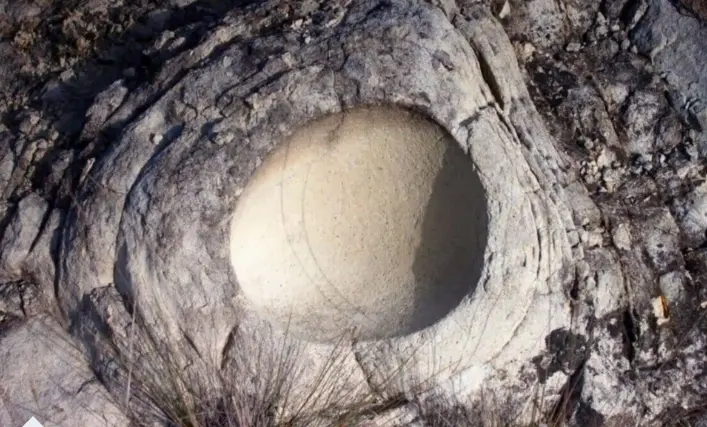
68-million-year-old dinosaur egg discoveries are rare, but scientists examining a fossil clutch from India have uncovered something even more unusual: one egg preserved with a second egg forming inside it. The unexpected structure has drawn attention from paleontologists because it could reshape scientific understanding of how some dinosaurs reproduced.
The remarkable fossil, discovered in central India, dates back roughly 68 million years to the Late Cretaceous period. While fossilized dinosaur eggs have been found around the world, this particular specimen contained an internal structure never clearly documented before in a non-avian dinosaur. Researchers believe it may represent a condition known as “ovum-in-ovo,” where an egg forms around another developing egg inside the reproductive system.
If confirmed, the discovery suggests that certain dinosaurs may have had reproductive traits closer to birds than previously thought.
Discovery in India’s Lameta Formation
The unusual fossil was first uncovered during a 2017 field survey in central India within the well-known Lameta Formation. This geological layer has long been recognized as one of the richest dinosaur fossil sites in the region, preserving bones, nests, and eggs from the Late Cretaceous era.
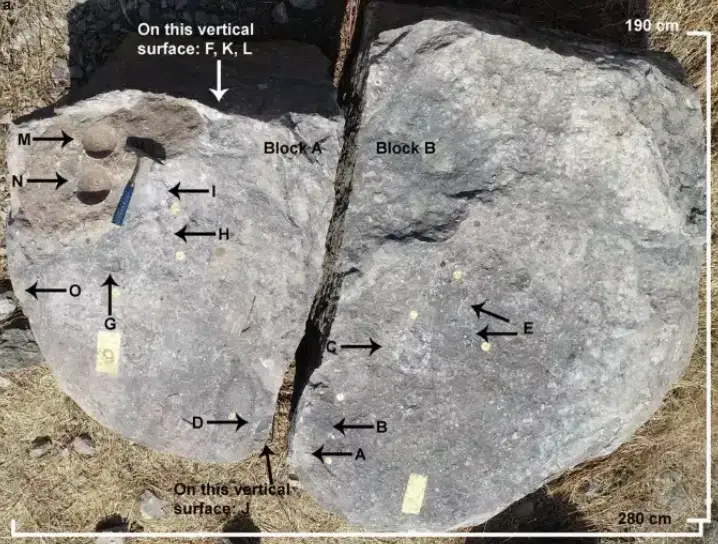
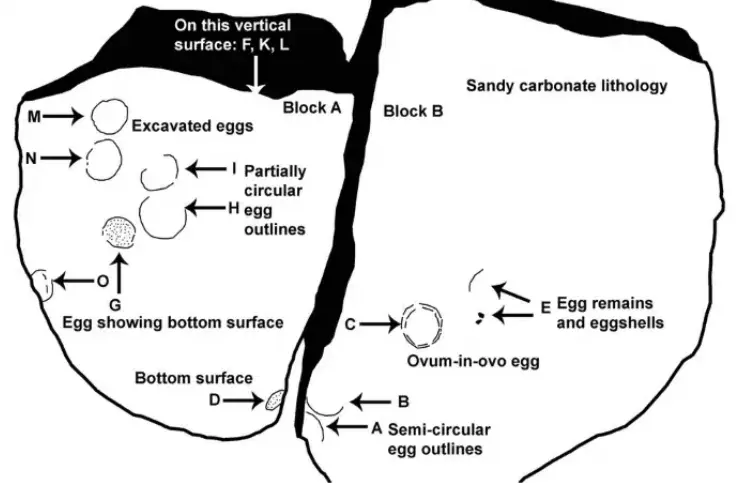
During the survey, scientists identified a shallow nesting depression containing 11 fossilized eggs arranged in a cluster. The eggs were carefully documented in place before being removed for laboratory study.
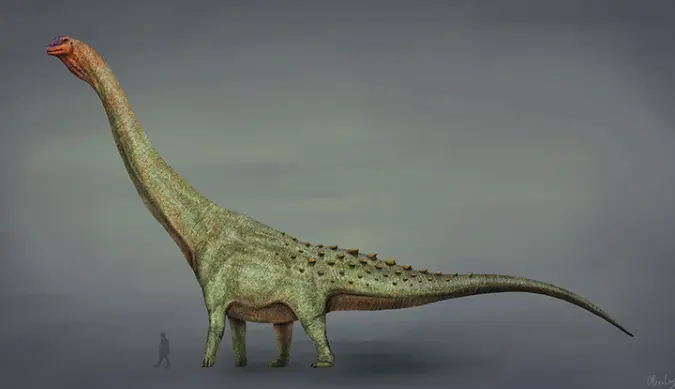
Each egg measured about 15 centimeters (around 6 inches) in diameter and displayed a consistent spherical shape. Their surface texture strongly suggested they belonged to titanosaurs, a group of enormous plant-eating dinosaurs that roamed much of the southern continents millions of years ago.
At first glance, the eggs appeared typical. However, one specimen displayed a faint curved shadow beneath the shell when exposed to certain lighting conditions. That subtle feature would later lead to a major discovery.
A Hidden Structure Inside the Fossil
Once the eggs were transported to the laboratory, researchers began scanning them using high-resolution CT imaging. This technique allows scientists to examine the internal structure of fossils without damaging them.
During the scanning process, the unusual egg revealed something unexpected: a second arc-shaped layer inside the outer shell.
Initially, scientists suspected the feature might simply be the result of damage or compression caused by millions of years of burial. Fossil eggs often collapse or crack under geological pressure, creating curved fragments that can mimic internal layers.
However, further scans told a different story.
The inner arc was smooth and continuous rather than jagged or folded. Its shape suggested it was a second developing shell, not a damaged fragment.
To confirm their suspicions, the research team increased the scanning resolution and analyzed the structure in greater detail.
Evidence of an “Egg Within an Egg”
Closer examination revealed two distinct curved layers separated by a thin band of sediment. This separation strongly indicated that the inner structure formed independently rather than being the result of fossil deformation.
The outer shell measured roughly 2.6 millimeters thick, while the inner shell measured around 2 millimeters—both within the expected range for titanosaur eggs.
Researchers also examined the mineral orientation in the shells. The microscopic structure showed patterns of biological growth, meaning both shells formed naturally inside the dinosaur’s reproductive tract.
This discovery pointed toward a phenomenon known as ovum-in-ovo, a rare reproductive condition previously observed mainly in birds.
In birds, ovum-in-ovo occurs when a developing egg reverses direction inside the oviduct and becomes enclosed within another shell before being laid. Modern reptiles do not produce eggs this way.
Because dinosaurs are evolutionary relatives of birds, the finding provides intriguing new clues about how some dinosaurs may have reproduced.
Why This Discovery Matters
The presence of a possible ovum-in-ovo dinosaur egg is significant for several reasons.
First, it represents one of the clearest examples of a dual-layer eggshell structure in a non-avian dinosaur. Prior to this discovery, such structures were only confidently known in bird eggs.
Second, the finding suggests that titanosaurs may have had a more complex reproductive system than previously believed.
Birds possess segmented reproductive tracts that allow multiple stages of egg formation. Reptiles, by contrast, generally produce eggs through a simpler system that does not allow one egg to be encapsulated within another.
If titanosaurs had a reproductive anatomy similar to birds, it could reveal new evolutionary connections between dinosaurs and modern birds.
Detailed Microscopic Analysis
To better understand how the double shell formed, scientists analyzed the fossil using scanning electron microscopy. This allowed them to examine the eggshell microstructure at extremely high magnification.
The results were revealing.
Both shells showed columnar calcite crystal growth, a structure typical of biological eggshell formation. The two layers were separated by a narrow mineral gap, indicating that they developed at different times.
If the structure had been caused by compression, the shells would likely appear crushed together or smeared. Instead, the clear separation supported the idea that the shells formed sequentially.
The sediment trapped between the two layers also offered clues. The grains were finer than the surrounding sediment, suggesting the internal shell formed before the egg was fully buried.
This detail helped researchers reconstruct the sequence of events:
- An egg began forming normally inside the dinosaur’s reproductive tract.
- The developing egg reversed direction inside the oviduct.
- A second shell began forming around it.
- The partially encapsulated egg was eventually laid and later fossilized.
Comparing the Fossil With Other Eggs
The research team examined the other 10 eggs from the same nest for comparison. None displayed the unusual internal layering seen in the unique specimen.
All of them had typical single-shell structures consistent with titanosaur eggs.
This comparison helped scientists rule out the possibility that geological forces caused the internal shape. If pressure or deformation had produced the structure, similar patterns would likely appear in other eggs from the nest.
Instead, the double shell appears to be the result of a rare biological event.
What Titanosaur Nests Reveal
Titanosaurs were among the largest land animals ever to live, yet their eggs were relatively small compared with their massive body size.
Fossil nests discovered across India, South America, and Europe show that these dinosaurs often laid eggs in large communal nesting sites. Dozens of eggs could be arranged in shallow pits or depressions, sometimes forming clusters across large areas.
This behavior resembles nesting strategies seen in some modern reptiles and birds.
The discovery of a potential ovum-in-ovo structure adds another piece to the puzzle of how titanosaurs reproduced and cared for their eggs.
A Rare Glimpse Into Dinosaur Biology
Fossilized dinosaur eggs are already rare finds, but eggs that preserve detailed internal structures are even more uncommon. The conditions required to fossilize such delicate features are extremely specific.
Scientists estimate that hundreds of titanosaur eggs have been discovered in the Lameta Formation over the years. Yet among more than 250 studied specimens, none have shown the same dual-shell structure as this one.
This rarity highlights how unusual the specimen is.
Even after 68 million years buried underground, the fossil preserves a moment of biological activity that would normally leave no trace in the fossil record.
Continuing Research
High-resolution scans of the fossil have now been archived so that other research institutions can study the specimen in detail.
Future comparisons with other dinosaur eggs may reveal whether similar structures exist but have simply gone unnoticed. As imaging technology continues to improve, scientists may uncover more evidence of complex reproductive behaviors in dinosaurs.
For now, the 68-million-year-old dinosaur egg stands as one of the most fascinating fossil discoveries of recent years—offering a rare window into how some of the largest creatures to ever walk the Earth may have reproduced.
