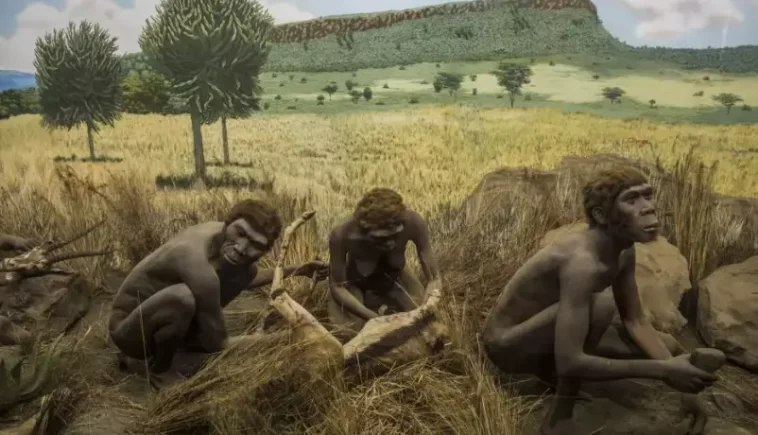
Origin of Human Language may be far older than scientists once believed, according to new genetic research that pushes humanity’s first capacity for speech deep into African prehistory. By examining patterns in human DNA rather than tools or fossils, researchers now argue that the biological foundations of language were already in place at least 135,000 years ago.
This finding reshapes one of the most enduring questions in human evolution: when did humans first learn to speak?
For decades, the origin of language has remained elusive because speech leaves no direct trace in the archaeological record. Words do not fossilize. Grammar does not imprint itself onto bone. Even the most sophisticated stone tools offer only indirect hints of communication. Now, scientists say genetics provides a new and more reliable clock for estimating when language became possible.
A Genetic Shortcut to the Origin of Human Language
The new study, published in Frontiers in Psychology, takes a radically different approach from earlier research. Instead of relying on symbolic artifacts such as cave engravings or decorative shells, the researchers examined genetic divergence among early populations of Homo sapiens.
Led by linguist Shigeru Miyagawa of the Massachusetts Institute of Technology, the research team focused on a key moment in human evolutionary history: the first major population split among modern humans.
Genetic data indicate that early human populations in Africa began to diverge from one another approximately 135,000 years ago. From that point onward, these groups followed separate evolutionary paths, accumulating genetic differences over tens of thousands of years.
Yet despite this long separation, every known human population today shares the same basic capacity for complex language.
That universality, the researchers argue, is the critical clue.
Why Population Splits Matter
When a species divides into distinct populations, inherited traits present before the split are shared by all descendant groups. Traits that evolve later appear only in some branches. This principle allows geneticists to estimate when a particular ability must have existed.
Language ability is universal among humans. No modern society has ever been documented without structured grammar, symbolic vocabulary, and the ability to generate limitless expressions. If language had emerged after the earliest population split, some groups would lack it entirely or display a fundamentally different communicative system.
That is not what we see.
Because all modern humans share the same underlying language capacity, the study concludes that the biological foundation for language must predate the first genetic divergence. This places the origin of human language at no later than 135,000 years ago.
Importantly, this date represents a minimum age, not the exact moment language emerged. The true origin could be even earlier.
Separating Language Biology from Culture
One of the most significant contributions of the study is its distinction between biological readiness for language and visible cultural expression. The researchers emphasize that they are not claiming humans 135,000 years ago spoke like people do today.
Instead, they argue that the mental architecture required for language—specifically, the integration of grammar and meaning—was already present.
This architecture allows humans to:
- Combine words into hierarchical structures
- Create new meanings from limited elements
- Communicate abstract ideas across time and space
Other animals communicate, sometimes in complex ways. But no other species has demonstrated this open-ended, rule-based system.
According to Miyagawa, language is defined not by sound or vocabulary alone, but by the ability to merge structured rules with symbolic meaning. That combination appears to be a shared biological inheritance among all humans.
Culture, by contrast, evolves rapidly. Languages change, diversify, and disappear. Vocabulary expands. Pronunciations shift. Writing systems emerge much later. None of those developments are required for the basic capacity to exist.
Why Archaeology Alone Was Not Enough
Before genetic studies became this precise, researchers relied almost entirely on archaeology to estimate when language began. Symbolic artifacts such as engraved stones, beads, and painted ochre were often treated as indirect evidence of speech.
Many of these objects become more common around 100,000 years ago at African sites like Blombos Cave. Some scholars interpreted this as a sign that language emerged around the same time.
Others pushed the timeline even later, linking language to a burst of cultural innovation roughly 50,000 years ago. This period saw rapid changes in toolmaking, art, and long-distance migration.
The new genetic findings challenge those assumptions.
Material culture does not always appear immediately after a biological capacity evolves. Humans may have possessed language long before they began leaving behind durable symbols. Spoken communication disappears instantly, leaving no physical trace.
The absence of early artifacts, therefore, does not imply the absence of language.
Africa as the Cradle of Language
The study reinforces the view that Africa is not only the birthplace of modern humans, but also the birthplace of human language. Because the earliest population splits occurred within Africa, the researchers conclude that the biological foundations of speech evolved there as well.
This aligns with genetic, fossil, and archaeological evidence pointing to Africa as the center of early human development. It also underscores the deep antiquity of language as a defining human trait.
By the time humans eventually migrated out of Africa, they already carried the mental framework required for speech. As populations spread across the globe, that shared capacity diversified into thousands of distinct languages, all built on the same underlying structure.
Implications for Human Evolution
Pushing the origin of human language back to at least 135,000 years ago has far-reaching implications. It suggests that language did not suddenly appear alongside art or advanced tools, but instead developed gradually as part of human cognitive evolution.
Language may have played a role in:
- Strengthening social bonds
- Coordinating group activities
- Transmitting knowledge across generations
- Supporting complex cooperation
If early humans possessed language long before major cultural shifts, it may have quietly shaped behavior for tens of thousands of years before leaving visible archaeological traces.
This perspective also reframes debates about what makes humans unique. Language is not a late cultural invention, the study suggests, but a deeply rooted biological trait that emerged early in our species’ history.
A New Baseline for Future Research
By grounding the timeline in genetics rather than artifacts, the study provides a firmer lower boundary for the origin of human language. Future discoveries may push the date even further back, but it is unlikely to move forward again.
Researchers can now explore how language interacted with early social structures, migration patterns, and environmental pressures across Africa. The findings also encourage closer collaboration between geneticists, linguists, and archaeologists.
Rather than asking when language suddenly appeared, scientists may now focus on how it evolved, diversified, and shaped humanity long before written history began.
The DNA Verdict
The evidence is clear: language is older than civilization, older than art, and older than many of the cultural markers once thought to define humanity.
According to the genetic record, the origin of human language lies deep in Africa’s past, at least 135,000 years ago, embedded in the shared biology of our species. Long before the first stories were written or symbols carved into stone, humans already carried the capacity to speak.
