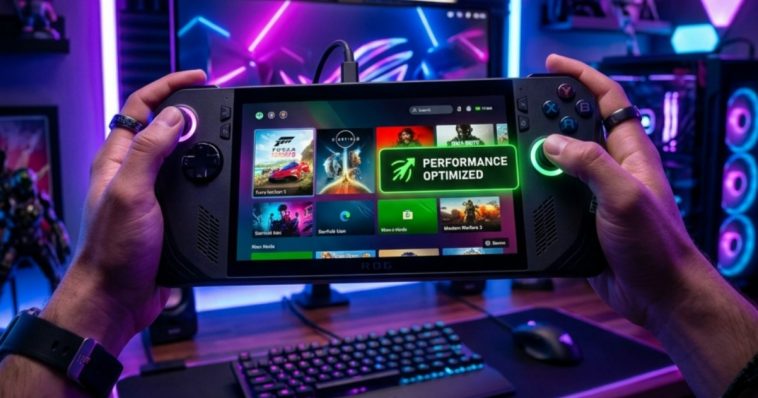
Windows 11 Handheld Gaming Optimization has become the primary focus for millions of PC gamers in 2026. With the release of the May 2026 update, Microsoft has finally acknowledged that the desktop interface isn’t enough for the growing market of portable gaming PCs like the ROG Ally, Steam Deck, and Legion Go. Whether you’re trying to squeeze out more battery life or looking for that elusive 60 FPS in the latest AAA titles, this guide will walk you through every critical step to transform your Windows 11 device into a lean, mean, gaming machine.
1. Enabling the New “Xbox Mode” Shell
The cornerstone of Windows 11 Handheld Gaming Optimization in 2026 is the native Xbox Mode. This isn’t just a skin; it’s a full system shell that replaces the traditional Explorer.exe with a controller-friendly dashboard.
How to enable it:
- Open Settings: Use your touchscreen or controller to navigate to
Settings > Gaming. - Xbox Mode Toggle: Locate the “Handheld Shell Interface” (officially branded as Xbox Mode). Toggle this to On.
- Boot to Shell: For a true console experience, enable “Launch Xbox Mode on Startup.” This bypasses the desktop entirely when you turn on your device.
- Automatic Login: To make it even more seamless, go to
Accounts > Sign-in optionsand disable the “Windows Hello” requirement for waking up, allowing you to jump straight into your library.
2. Tuning the Kernel for Performance (Low Latency Profile)
As we discussed in our previous news analysis, the May 2026 update introduced the Low Latency Profile (LLP). This is a game-changer for Windows 11 Handheld Gaming Optimization, as it reduces input lag between your physical buttons and the on-screen action.
How to configure it:
- System Power Settings: Go to
System > Power & Battery. - Power Mode: Select “Best Performance.”
- Advanced Latency Controls: Under the Display settings, look for the “High-Priority Input Thread” option. Ensure this is enabled. This tells the Windows kernel to prioritize controller inputs over background system tasks like Windows Update or OneDrive syncing.
3. Screen and Resolution Optimization
One of the most common mistakes in Windows 11 Handheld Gaming Optimization is running at the wrong native resolution. Most handhelds have 1080p or 1600p screens, which are too demanding for integrated graphics in modern games.
The “Sweet Spot” Strategy:
- Resolution: Set your Windows desktop resolution to 720p or 800p.
- RSR/FSR Setup: Enable AMD Radeon Super Resolution (RSR) or Nvidia Image Scaling in your GPU control panel. This allows the system to upscale a 720p image to your screen’s native resolution with minimal blurriness.
- Refresh Rate: Set your refresh rate to 60Hz or 120Hz. If your device supports it, enable “Dynamic Refresh Rate” to save battery when you’re just browsing your game library.
4. Maximizing Battery Life: The Efficiency Tweak
Portable gaming is only “portable” if your battery lasts more than an hour. Windows 11 Handheld Gaming Optimization includes a specific set of rules for energy management.
Steps to follow:
- Energy Saver: Go to
Settings > System > Power & Batteryand set “Energy Saver” to turn on automatically at 40%. - Background App Limits: This is crucial. Go to
Apps > Installed Apps, sort by size, and for every non-gaming app (Chrome, Spotify, Discord), click the three dots and select “Never” for background permissions. - NPU Offloading: If your handheld has a modern NPU (Neural Processing Unit), ensure that “System Voice Typing” and “Noise Cancellation” are offloaded to the NPU in the Sound settings. This saves valuable CPU cycles for your games.
5. Controller and Overlay Management
Nothing ruins a gaming session like a Windows notification popping up or the touch keyboard appearing at the wrong time.
The “Ghost Mode” Setup:
- Focus Mode: Enable “Focus” whenever a game is launched. This silences all notifications.
- Virtual Keyboard: In
Settings > Time & Language > Typing, disable the option that says “Show the touch keyboard when no keyboard is attached.” This prevents the keyboard from randomly appearing during controller gameplay. - Game Bar Optimization: Press
Win + Gand go to settings. Disable “Record in the background while I’m playing games” unless you are a streamer. This single setting can boost your 1% low frame rates by 10-15%.
6. Managing the Secure Boot Update for Handhelds
As we approach the June 2026 deadline, handheld users need to be particularly careful. Many handheld devices use custom BIOS versions that might not play well with the new Secure Boot DBX update.
How to stay safe:
- Backup Your Saves: Use a cloud service (Steam Cloud, Xbox Play Anywhere) or manually copy your
AppDatafolder to an SD card. - Manufacturer Updates: Before the end of May, check the official app of your device (e.g., Armoury Crate for ASUS, Legion Space for Lenovo) for a “BIOS Firmware Update.” Do not rely solely on Windows Update for this critical security transition.
Conclusion: The Future of Portable PC Gaming
Windows 11 Handheld Gaming Optimization is an ongoing process. Microsoft has finally provided the tools, but it’s up to the user to sharpen them. By following these steps—especially the new Xbox Mode and the Low Latency Profile—you can achieve a console-like experience with the power and flexibility of a full PC.
The portable revolution is here, and with these optimizations, your Windows 11 handheld is ready to lead the charge.
