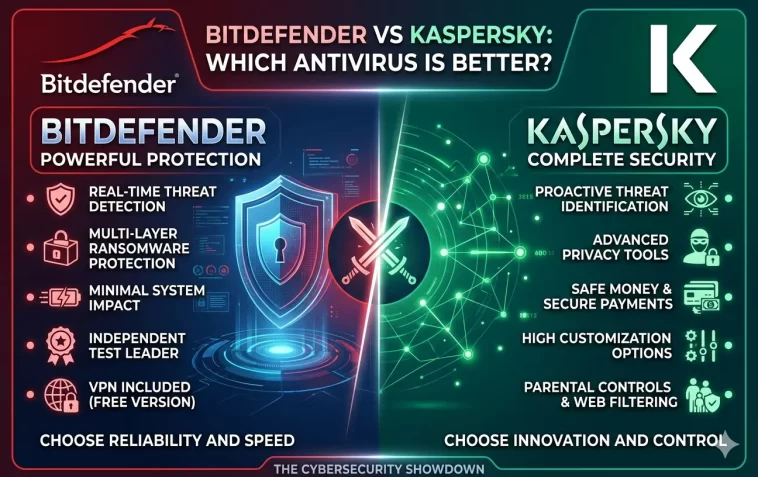
Bitdefender vs Kaspersky is one of the most searched antivirus comparisons online — and for good reason. Both are consistently ranked among the top security products in the world. Both score near-perfect in independent lab tests. And both offer far more than just virus scanning.
But they’re not identical. One is better for performance. One has a complicated political backstory. And depending on where you live or what you need, one may be the smarter choice.
This guide covers everything: protection, performance, features, privacy, pricing, and more — so you can make a confident decision.
About the Companies
Bitdefender
Bitdefender was founded in 2001 in Romania. It’s a privately held company that has grown into one of the most respected names in cybersecurity. Bitdefender’s technology is actually used under the hood by several other security products — a strong sign of industry trust.
It has no ties to any government and has never been subject to a national security controversy.
Kaspersky
Kaspersky was founded in 1997 in Russia by Eugene Kaspersky. For many years, it was considered one of the gold standards in antivirus software — genuinely excellent technology with top-tier detection rates.
However, in 2022, the FCC added Kaspersky to its list of companies posing a national security risk to the United States. In June 2024, the U.S. Department of Commerce banned Kaspersky from selling its products in the United States. Several European governments have also issued warnings against its use in government systems.
This doesn’t mean Kaspersky’s software is malicious. But it does mean there are legitimate geopolitical concerns that users — especially in the U.S. and EU — should be aware of before purchasing.
Bitdefender vs Kaspersky: Malware Protection
Independent Lab Results
Both products regularly score at the top of independent antivirus testing:
- AV-TEST consistently gives both products perfect or near-perfect scores for protection, performance, and usability.
- AV-Comparatives regularly awards both “Advanced+” ratings — the highest available.
- SE Labs ranks both in the AAA category.
In terms of raw malware detection, it is genuinely difficult to separate these two. Both catch essentially everything.
If you’re choosing based on protection alone, you cannot go wrong with either one.
Zero-Day and Ransomware Protection
Zero-day threats — new malware that hasn’t been seen before — are the hardest to catch. Both Bitdefender and Kaspersky use machine learning and behavior-based detection to handle these.
Bitdefender’s Advanced Threat Defense module monitors running processes in real time and blocks suspicious behavior before damage occurs. It’s one of the best behavioral detection systems available.
Kaspersky’s System Watcher does something similar — it monitors all activity and can roll back ransomware changes if an attack slips through. That rollback feature is genuinely useful and not something every antivirus offers.
Bitdefender vs Kaspersky: System Performance
Light system impact is critical. Nobody wants antivirus software that slows their computer to a crawl.
Bitdefender’s Performance
Bitdefender is widely regarded as one of the lightest antivirus products available. It offloads much of its threat analysis to the cloud, which means less processing happens on your local machine.
In AV-TEST performance benchmarks, Bitdefender consistently scores at or near the top — meaning it has minimal impact on everyday tasks like opening files, launching apps, or browsing the web.
Kaspersky’s Performance
Kaspersky is also lightweight, but it runs slightly more processes locally. In most benchmarks, the difference is small — you won’t feel it on a modern computer.
On older hardware or low-spec machines, Bitdefender’s cloud-based approach tends to have a smaller footprint.
Winner for performance: Bitdefender, but only marginally.
Bitdefender vs Kaspersky: Features
Bitdefender Total Security — What You Get
- Real-time malware protection
- Advanced Threat Defense (behavior monitoring)
- Ransomware remediation
- VPN (200 MB/day on standard plan; unlimited on Premium)
- Password manager
- Parental controls
- Webcam and microphone protection
- Anti-phishing and anti-fraud
- File shredder
- SafePay — a locked-down browser for online banking
- Anti-theft tools for laptops
Kaspersky Premium — What You Get
- Real-time malware protection
- System Watcher with ransomware rollback
- VPN (unlimited on Premium plan)
- Password manager
- Parental controls (Kaspersky Safe Kids)
- Webcam protection
- Anti-phishing
- Data leak checker
- Identity protection tools
- PC optimization tools
- 24/7 premium support
Both products are feature-rich. Kaspersky’s identity protection and data breach monitoring tools are particularly strong. Bitdefender’s SafePay browser is excellent for anyone who does a lot of online banking.
Bitdefender vs Kaspersky: VPN
Both products include a VPN, but the details matter.
Bitdefender VPN:
- Based on Hotspot Shield technology
- 200 MB/day on standard plans
- Unlimited on Bitdefender Premium Security
- Servers in 30+ countries
Kaspersky VPN:
- Based on Hotspot Shield technology (same underlying technology)
- Limited on lower plans
- Unlimited on Kaspersky Premium
- Servers in 100+ countries
If VPN coverage matters to you, Kaspersky offers more server locations. But given the geopolitical concerns around Kaspersky, routing your internet traffic through a Russian-founded company’s VPN is something to think carefully about.
Bitdefender vs Kaspersky: Privacy and Trust
This is the most important section for many users.
Bitdefender’s Privacy Standing
Bitdefender is headquartered in Romania, which is a member of the European Union. It is subject to GDPR and EU privacy regulations. It has no known ties to any government intelligence agency and has never been the subject of a national security investigation.
Its privacy policy is straightforward and its data practices are well-documented.
Kaspersky’s Controversies
Kaspersky’s story is more complicated.
- In 2017, the U.S. Department of Homeland Security banned Kaspersky from all federal government systems.
- In 2022, the FCC designated Kaspersky as a national security risk.
- In June 2024, the U.S. Commerce Department issued a final rule banning Kaspersky from selling software in the United States.
- Germany’s BSI (Federal Office for Information Security) advised against using Kaspersky products in critical infrastructure.
Kaspersky has always denied any wrongdoing and has taken steps to address concerns — including moving its data processing infrastructure to Switzerland and launching a “Global Transparency Initiative.”
For regular home users outside the U.S., this may feel like a distant political issue. But for anyone in government, defense, healthcare, or sensitive industries — and for U.S. residents in general — these are serious considerations.
Bitdefender vs Kaspersky: Pricing
Pricing varies by region and changes frequently, but here’s a general picture for 2026:
Bitdefender
| Plan | Devices | Price (Approx/Year) |
|---|---|---|
| Antivirus Plus | 3 PCs | ~$30 |
| Internet Security | 3 PCs | ~$42 |
| Total Security | 5 devices | ~$45 |
| Premium Security | 10 devices | ~$90 |
Kaspersky
| Plan | Devices | Price (Approx/Year) |
|---|---|---|
| Standard | 5 devices | ~$38 |
| Plus | 5 devices | ~$52 |
| Premium | 5 devices | ~$70 |
Both brands frequently offer first-year discounts of 50% or more. Renewal prices are typically higher. Always check the current pricing on their official websites before purchasing.
Bitdefender vs Kaspersky: Ease of Use
Bitdefender’s Interface
Bitdefender’s dashboard is clean and modern. Most users can install it and essentially forget about it — the default settings are sensible and require little tweaking.
The interface can feel slightly overwhelming at first due to the sheer number of features, but day-to-day use is simple. Scans run quietly in the background.
Kaspersky’s Interface
Kaspersky’s interface is also clean and well-designed. It’s easy to navigate, and the main dashboard gives you a clear overview of your protection status.
Kaspersky is generally considered slightly more beginner-friendly. Its setup wizard and recommendations during installation are helpful for non-technical users.
Bitdefender vs Kaspersky: Customer Support
Bitdefender offers:
- 24/7 live chat
- Phone support
- Email support
- Extensive knowledge base
Kaspersky offers:
- 24/7 live chat and phone on Premium plans
- Community forums
- Detailed knowledge base
Both offer solid support. Kaspersky’s 24/7 support is available on all plans, not just premium tiers, which gives it a slight edge here.
Side-by-Side Comparison
| Feature | Bitdefender | Kaspersky |
|---|---|---|
| Malware Detection | Excellent | Excellent |
| Performance Impact | Very Low | Low |
| Ransomware Rollback | Yes | Yes |
| VPN Included | Yes (limited/unlimited) | Yes (limited/unlimited) |
| Password Manager | Yes | Yes |
| Parental Controls | Yes | Yes (Safe Kids) |
| Webcam Protection | Yes | Yes |
| Banking Browser | Yes (SafePay) | No |
| Identity Protection | Basic | Strong |
| Privacy / Trust | High | Controversial |
| U.S. Availability | Yes | Banned (2024) |
| HQ Country | Romania (EU) | Russia |
| Price | Competitive | Competitive |
Who Should Choose Bitdefender?
Bitdefender is the better choice if:
- You live in the United States (Kaspersky is banned)
- Privacy and data sovereignty matter to you
- You want the lightest possible system impact
- You do a lot of online banking (SafePay is excellent)
- You want a trusted product with no geopolitical baggage
Who Should Choose Kaspersky?
Kaspersky may still work for you if:
- You live outside the U.S. and EU restrictions don’t apply to your use case
- You’re a home user unconcerned with the political context
- You want strong identity protection tools
- You’re looking for 24/7 support without paying for a premium plan
- You want a larger VPN server network
That said, given the 2024 U.S. ban and ongoing European warnings, recommending Kaspersky broadly has become difficult — even for personal use.
FAQ: Bitdefender vs Kaspersky
Which is better, Bitdefender or Kaspersky?
Both are technically excellent antivirus products. In pure protection tests, they’re nearly identical. However, Bitdefender has a clear advantage in trust and privacy — it has no government bans or national security controversies. For most users, especially in the U.S. and Europe, Bitdefender is the safer overall choice.
Is Kaspersky still safe to use in 2026?
This is complicated. Kaspersky’s software itself has not been proven to be malicious. However, it has been banned in the U.S. and flagged by several European governments due to its Russian origins and potential government ties. For personal home users outside the U.S., the risk may feel minimal. For business, government, or sensitive use, avoiding Kaspersky is strongly recommended.
Is Kaspersky banned in the USA?
Yes. In June 2024, the U.S. Department of Commerce issued a final rule prohibiting Kaspersky from selling its antivirus software and related products to U.S. customers. Existing users were advised to switch to alternative products.
Does Bitdefender slow down your computer?
Bitdefender is one of the lightest antivirus products on the market. It offloads much of its analysis to the cloud, resulting in very low CPU and memory usage. Most users experience no noticeable slowdown during everyday tasks.
Which antivirus is best for Windows in 2026?
For Windows users, Bitdefender Total Security is one of the best all-around options available. It combines excellent malware protection, minimal performance impact, and a strong feature set including VPN, parental controls, and SafePay banking protection.
Do I need antivirus if I have Windows Defender?
Windows Defender has improved dramatically and provides decent baseline protection. However, third-party antivirus products like Bitdefender still outperform it in independent lab tests — particularly for zero-day threats, ransomware, and phishing protection. For users who store sensitive data or do online banking, a dedicated antivirus is worth it.
Is Bitdefender free?
Bitdefender offers a free version — Bitdefender Antivirus Free — that covers basic malware protection. The paid plans add features like VPN, parental controls, webcam protection, and the SafePay banking browser.
How do Bitdefender and Kaspersky compare for families?
Both offer solid parental controls. Kaspersky Safe Kids is a dedicated parental control app with strong content filtering, screen time management, and location tracking. Bitdefender’s parental controls are built into Total Security and are effective but slightly less feature-rich than Kaspersky Safe Kids. For families, Kaspersky’s parental tools are arguably the better option — if the geopolitical concerns aren’t a factor for you.
Final Thoughts
Technically, Bitdefender and Kaspersky are the two best antivirus products you can buy. Their malware detection, feature sets, and performance are all world-class.
But the decision has become clearer in recent years.
Bitdefender is the recommendation for most people. It’s just as powerful, lighter on your system, backed by a trusted EU company, and has zero geopolitical controversy. It protects you from online threats without raising questions about who else might have access to your data.
Kaspersky remains technically impressive, but the 2024 U.S. ban and European government warnings are hard to ignore. For personal users outside the U.S. who understand the context and accept the tradeoff, it’s still a capable product. For everyone else, Bitdefender is the smarter, safer pick.
