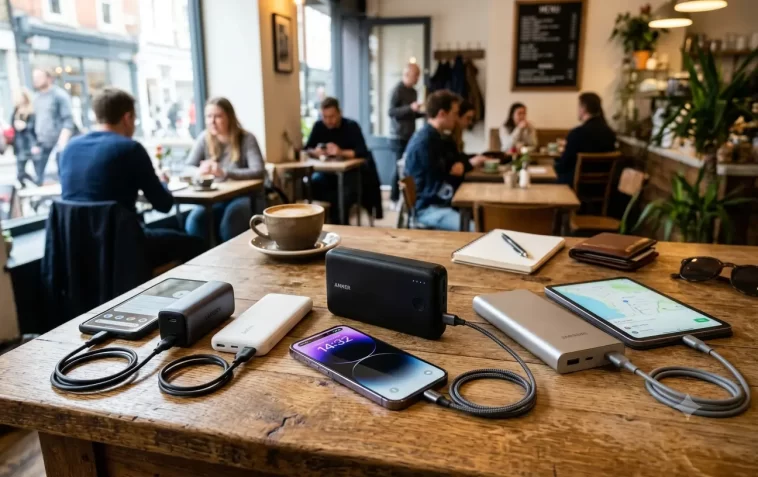
If you’ve ever watched your phone hit 5% battery in the middle of nowhere, you already know why a good portable charger matters. The best portable chargers in 2026 have gotten faster, smaller, and smarter — and picking the right one can genuinely change how you move through your day.
This guide covers the top power banks worth your money right now, what to look for before buying, and answers to the most common questions people have before pulling the trigger.
Why Portable Chargers Matter More Than Ever
We’re carrying more devices than ever. Phones, earbuds, smartwatches, tablets — they all need power, and wall outlets aren’t always close by. Whether you’re commuting, hiking, traveling, or just stuck in a long meeting, having a reliable power bank in your bag is one of those things you stop noticing until you don’t have it.
The good news is that the portable charger market in 2026 is genuinely competitive. Prices are reasonable, capacities are higher, and fast charging support has become the norm rather than a premium feature.
What to Look for in a Portable Charger
Before jumping into the picks, here’s what actually matters when choosing a power bank:
- Capacity (mAh): Higher mAh means more charges. A 10,000mAh bank will charge most smartphones about 2–3 times. A 20,000mAh unit can handle multiple devices over a full travel day.
- Wattage (W): This determines how fast the charger works. Anything under 18W feels slow by today’s standards. Look for 30W or higher if you want genuinely fast charging.
- Number of ports: If you’re charging more than one device at a time, two or three ports are a must.
- Size and weight: High capacity usually means heavier. Find the balance that fits how you actually carry things.
- Pass-through charging: This lets you charge the bank and your device at the same time using one wall plug — handy when outlets are scarce.
- USB-C PD support: USB-C Power Delivery is now the standard for fast charging laptops and phones. If your devices are modern, make sure your power bank supports it.
Best Portable Chargers in 2026
1. Anker 737 Power Bank (PowerCore 26800)
Anker has been the go-to name in power banks for years, and the 737 keeps that reputation intact. It packs 26,800mAh and delivers up to 140W of output — enough to charge a MacBook Air or a power-hungry Android flagship at full speed.
It has two USB-C ports and one USB-A port, so you can run three devices simultaneously without slowing to a crawl. The built-in display shows exact battery percentage, which is far more useful than the vague LED dot systems on cheaper banks.
Best for: Power users, frequent travelers, anyone charging laptops on the go.
2. Baseus Blade 2 100W
The Baseus Blade 2 is one of those products that looks like it costs more than it does. It’s slim, aluminum-finished, and holds 20,000mAh with 100W max output. It fits in a jacket pocket, which is genuinely impressive for the capacity.
It supports USB-C PD charging and charges itself quickly too — roughly 1.5 hours to full with the right adapter. Two USB-C ports and one USB-A port give you solid flexibility.
Best for: People who want a premium feel without paying premium prices.
3. Ugreen Nexode 20000mAh 130W
Ugreen has been pushing hard into the power bank space, and the Nexode 130W is their strongest offering yet. The 130W output puts it in laptop-charging territory without the bulk of older high-wattage banks.
It has three ports and handles simultaneous high-speed charging across all of them without throttling noticeably. The build quality feels solid, and the charging performance matches what’s advertised — which isn’t always the case in this category.
Best for: Multi-device users who need reliable fast charging across everything.
4. Zendure SuperTank Pro
If you fly regularly and carry multiple devices, the Zendure SuperTank Pro is worth looking at. It holds 26,800mAh and outputs up to 100W. What sets it apart is its TSA-compliance — it clears airline carry-on rules without any issue, which matters if you’ve ever had a charger confiscated at security.
The body is hard-shell polycarbonate, which handles the kind of rough bag-tossing that comes with constant travel. Four ports, a clean display, and consistent performance make this a serious travel companion.
Best for: Frequent flyers, heavy travelers, road warriors.
5. Xiaomi 33W Power Bank 20000mAh
Not everyone needs to charge a laptop or power through three days of travel. If you just want a reliable, no-fuss bank for your phone and earbuds, the Xiaomi 33W is hard to beat at its price point.
It charges a modern smartphone in well under two hours through the USB-C port, handles two devices at once, and the build quality is better than what you’d expect at this price. It’s a sensible pick if you don’t need anything extreme.
Best for: Everyday users who want solid performance without paying for features they’ll never use.
6. Mophie Powerstation Pro XL 20K
Mophie targets iPhone users specifically, and the Powerstation Pro XL shows that. The Apple-certified 20,000mAh bank integrates cleanly into an iOS workflow — it shows up as a connected device in your battery widget, which is a small but genuinely useful detail.
Output is 30W USB-C PD, which won’t win any speed records against the Anker or Ugreen options above, but it’s more than adequate for phones and tablets. The design is premium, the size is manageable, and it just works.
Best for: Apple ecosystem users who want seamless integration.
Comparing the Top Picks at a Glance
| Model | Capacity | Max Output | Ports | Best For |
|---|---|---|---|---|
| Anker 737 | 26,800mAh | 140W | 2C + 1A | Laptops, heavy travel |
| Baseus Blade 2 | 20,000mAh | 100W | 2C + 1A | Slim design, value |
| Ugreen Nexode | 20,000mAh | 130W | 3 ports | Multi-device charging |
| Zendure SuperTank Pro | 26,800mAh | 100W | 4 ports | Air travel |
| Xiaomi 33W | 20,000mAh | 33W | 2C + 1A | Everyday phone use |
| Mophie Pro XL | 20,000mAh | 30W | 1C + 1A | Apple users |
How Many Charges Do You Actually Get?
This is the question most buyers have, and the honest answer is: it depends on your phone, but here’s a rough guide.
A typical modern smartphone battery is between 4,000–5,000mAh. Here’s what you can expect from each capacity tier:
- 10,000mAh: 1.5–2 full charges for most smartphones
- 20,000mAh: 3–4 full charges, or 1 laptop charge + a couple phone charges
- 26,800mAh: 5–6 phone charges, or multiple partial laptop charges
Keep in mind that no power bank delivers 100% of its listed capacity — energy is lost as heat during charging. Real-world output is typically 80–90% of the advertised number.
Tips for Getting the Most Out of Your Power Bank
- Charge it before a trip, not the morning of. Most banks need 2–4 hours to reach full capacity.
- Match the cable to the port. A USB-C cable rated for 100W makes a real difference over a basic charging cable.
- Don’t drain it to zero regularly. Lithium batteries last longer when kept between 20–80% when possible.
- Store it at partial charge. If you’re not using it for a few weeks, a 50–60% charge is better for long-term battery health than storing it full or empty.
- Check airline rules before you fly. Most power banks up to 100Wh (around 26,800mAh at 3.7V) are allowed in carry-on luggage but not in checked bags.
FAQ: Best Portable Chargers in 2026
Q: What is the best portable charger overall in 2026? A: The Anker 737 is the most capable option for most people — it combines high capacity, fast charging, and reliable build quality. If you want something slimmer, the Baseus Blade 2 is a very close second.
Q: How many mAh do I need in a power bank? A: For casual use (phone top-ups throughout the day), 10,000mAh is enough. For travel or multi-device charging, 20,000mAh is the practical sweet spot. Go for 26,800mAh if you’re charging laptops or need backup power for extended trips.
Q: Are power banks allowed on airplanes? A: Yes, with limits. Most portable chargers up to 100Wh are permitted in carry-on bags. They cannot go in checked luggage. Always verify the Wh rating on your specific bank before flying.
Q: What does ‘pass-through charging’ mean? A: Pass-through charging means you can charge the power bank and connected devices at the same time using a single wall adapter. It’s useful when outlets are limited.
Q: Is USB-C better than USB-A for charging? A: For modern devices, yes. USB-C with Power Delivery supports much higher wattage and therefore faster charging speeds. USB-A is still useful for older devices, but USB-C should be your primary port.
Q: How long does a power bank last before it degrades? A: Most quality lithium-ion power banks are rated for 500–1,000 charge cycles before capacity noticeably degrades. With normal use (a few charges per week), that’s several years of reliable performance.
Q: Can a power bank charge a laptop? A: Yes, but only if the bank outputs enough wattage. Most laptops need at least 45W to charge, and some require 65–100W. Check your laptop’s USB-C charging requirement and match it to the bank’s output spec.
Q: What’s the difference between power banks with and without a display? A: Banks with a display show exact remaining capacity as a percentage. Those without use LED indicator dots, which only give you a rough range. Displays are more useful but add slight cost and a small amount of weight.
