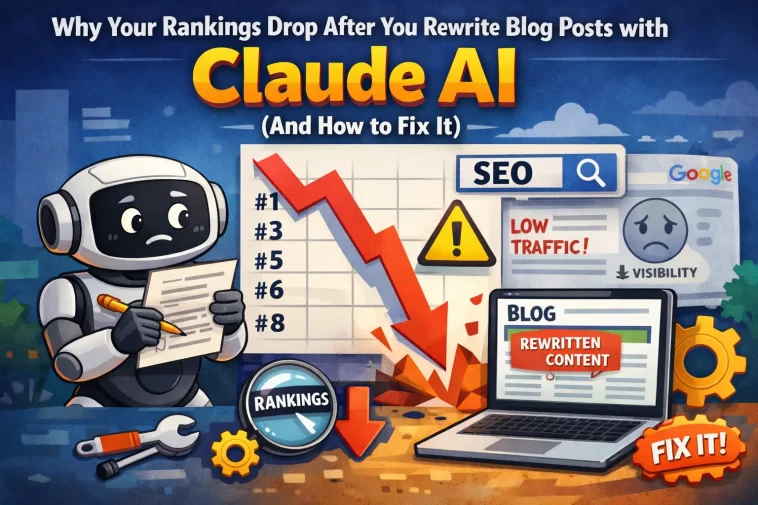
I rewrote one of my old blog posts using Claude last month, expecting a quick SEO refresh. Three days later, my Search Console graph showed a clear dip in impressions for that exact URL. That scared me enough to dig into why it happens — and how to rewrite blog posts with Claude AI without losing the rankings you already worked hard to earn.
If you’re refreshing old content with AI, this isn’t just a “be careful” warning. There are specific, traceable reasons rankings drop after an AI rewrite, and most of them are fixable in under an hour once you know where to look.
Why It Fails: The Real Technical Reasons
Rankings don’t drop because “Google hates AI content.” That’s a myth. The actual causes are far more mechanical, and understanding them changes how you approach every rewrite.
1. Keyword Dilution from Over-Rewriting
When you ask Claude to “make this sound more natural” or “improve the flow,” it often rewords sentences containing your exact-match or partial-match keywords. The semantic meaning stays close, but the literal keyword instances drop. Google’s ranking signals for that page were built around specific phrase patterns — remove them, and the page can lose relevance for the queries it used to rank for.
2. Content Score Reset Confuses the Optimization Loop
If you use Rank Math’s content analysis, a full rewrite resets your content score calculation. Rank Math re-scans density, length, and heading structure as if it’s a brand-new draft. If you don’t immediately re-check the score and adjust, you can accidentally under-optimize a page that was previously well-tuned.
3. Structural Changes Break Internal Linking Context
Claude often reorganizes headings and paragraph order for readability. If your old H2s matched anchor text from internal links pointing to that page (from other posts on your site), restructuring breaks that contextual relevance. Google uses surrounding link context as part of relevance scoring — shuffle the structure, and that signal weakens temporarily.
4. Sudden Semantic Drift Triggers Re-Crawl Re-Evaluation
If the rewritten version differs too much in tone, sentence length, or topical depth from the original (especially if you change word count significantly), Google treats it almost like a new page during re-crawl. This causes a short re-evaluation window where rankings fluctuate before settling — sometimes lower than before if the new version is thinner on specifics.
Problem Explanation: When This Actually Happens
This isn’t a rare edge case. It shows up in very specific, repeatable scenarios:
- You paste an old post into Claude and ask for a full rewrite “in a more engaging tone” without preserving keyword placement.
- You’re refreshing content across multiple posts in a batch and skip checking each one individually in Rank Math afterward.
- You rewrite a post that was ranking on page 1 for a competitive keyword, and the new version is noticeably shorter than the original.
- You change the introduction structure (first-person to third-person, or vice versa) in a way that removes early keyword mentions.
- You republish the rewritten content and the URL/slug also changes, even slightly.
If any of these match your situation, the fix isn’t “stop using AI to rewrite.” It’s tightening the process around it.
Step-by-Step Fixes That Actually Work
Step 1: Lock the Focus Keyword Before You Prompt Claude
Before sending your draft to Claude, write down your current focus keyword and 2–3 secondary keywords from your existing Rank Math settings. Include this directly in your prompt:
- “Rewrite this post but keep the phrase ‘[exact keyword]’ appearing naturally at least 4 times.”
- “Preserve the keyword ‘[exact keyword]’ in the first paragraph and at least one H2.”
This single step prevents most keyword dilution issues outright.
Step 2: Rewrite in Sections, Not the Whole Post at Once
Instead of pasting the entire post and asking for a full rewrite, do it section by section (intro, then each H2 block). This keeps Claude’s edits contained and makes it far easier to spot where a keyword or important phrase got dropped.
Variation for long posts (2000+ words): Split into 3–4 chunks and rewrite across multiple messages. This also avoids Claude compressing or summarizing sections to save space, which sometimes happens with very long single-prompt rewrites.
Variation for short posts (under 800 words): Full-post rewrite is usually fine here since there’s less structure to lose track of.
Step 3: Re-Run Rank Math Analysis Immediately After Pasting
Don’t trust your memory of the old score. Paste the new content into your editor and re-check:
- Focus keyword density (aim to match or slightly exceed the original).
- Keyword in title, slug, and meta — these often get accidentally dropped if you also asked Claude to rewrite your meta description.
- Readability flags — Claude sometimes shortens sentences so much that paragraph structure changes, which can affect Rank Math’s readability score either way.
Step 4: Keep the URL Identical
This is non-negotiable. Even if Claude suggests a “better” title, do not change the slug. A new URL means starting your ranking history over. If you genuinely need a new title, update the SEO title field only and leave the permalink untouched.
Step 5: Preserve or Improve Word Count, Don’t Shrink It
If your original post was 1,800 words and ranking, and your rewrite comes back at 1,100 words, that’s a red flag. Ask Claude explicitly: “Keep this at approximately the same length or longer, and add more specific detail rather than condensing.”
Advanced Fixes and Edge Cases
If you’ve followed the steps above and still see ranking drops after a rewrite, the issue is usually deeper than prompt phrasing.
Advanced Path 1: Diagnose with Search Console Query-Level Data
Go into Search Console, filter by the specific URL, and compare the query list from before and after the rewrite (use the date comparison feature). Look specifically for:
- Queries that disappeared entirely — this points to a phrase or term that got rewritten out completely.
- Queries where impressions stayed flat but clicks dropped — this usually means your meta description changed and is less compelling, not a ranking issue.
- A broad drop across all queries at once — this is more likely a temporary re-crawl evaluation window (see Cause #4 above) and often recovers within 1–2 weeks without further action.
This data tells you whether you have a content problem or a patience problem — and they need completely different fixes.
Advanced Path 2: Check for Self-Cannibalization Across Your Site
If you run multiple content sites or have published several similar posts (common when scaling content across niches), a Claude rewrite can sometimes make one post’s wording drift closer to another post you already have targeting a related keyword. Search Google directly for site:yourdomain.com "exact phrase from new content" to check if you’ve accidentally created near-duplicate phrasing across two URLs competing for the same query. If you find overlap, differentiate the angle of one post (different subtopic, different keyword variant) rather than just rewording it again.
Edge Case: Rewrites That Change First-Person to Second-Person (or Back)
If your workflow uses first-person intros switching to second-person instructions (a common content pattern), and Claude’s rewrite flattens this into one consistent voice throughout, you can lose the engagement structure that was contributing to lower bounce rates — which indirectly affects rankings over time. Explicitly tell Claude to preserve the voice shift if your original post used it intentionally.
Edge Case: Batch Rewrites Across Dozens of Posts
If you’re refreshing content at scale, don’t rewrite everything in one sitting and publish all at once. Stagger publication over several days. This makes it much easier to isolate which specific rewrite caused a ranking change if something does drop, instead of having ten variables changing simultaneously.
Tips for Preventing This Next Time
- Always save a backup of the original post text before rewriting, so you can compare side by side.
- Ask Claude to list which keywords it preserved and which it removed, as a final step in the same conversation.
- Avoid rewriting top-performing posts (top 10% of traffic) unless there’s a clear, specific reason — outdated info, broken steps, or a confirmed ranking decline already happening.
- Treat AI rewrites as a structural improvement tool, not a “make it sound better” tool. Vague prompts produce vague keyword handling.
- Re-submit the URL in Search Console after publishing the rewrite to speed up re-crawling and shorten the evaluation window.
FAQ
Does Claude AI rewriting count as duplicate content if I keep the same structure? No. Rewritten content with new phrasing is treated as unique by Google, even if the structure and headings stay similar. Duplicate content issues come from copy-pasting the same text across multiple URLs, not from rewording.
Should I tell Claude it’s writing for SEO, or just ask for a general rewrite? Always specify SEO requirements explicitly, including your exact focus keyword. A general “make this better” prompt optimizes for readability, not for the keyword signals your rankings depend on.
How long should I wait before judging whether a rewrite hurt my rankings? Give it 10–14 days minimum. Short-term fluctuation right after republishing is normal re-crawl behavior, not a sign of failure.
Can I ask Claude to check the rewrite against my original for keyword loss? Yes — paste both versions in the same conversation and ask it to compare keyword placement directly. This catches most dilution issues before you even publish.
Is it better to rewrite the whole post or just refresh the outdated parts? If the post is still ranking reasonably well, refresh only the outdated sections (old stats, old screenshots, broken steps) instead of a full rewrite. Full rewrites are best reserved for posts that have already lost rankings or never performed.
Editor’s Note
honestly this one bit me personally lol, thats why i wrote it. rewrote a post thinking id “improve” it and watched the graph dip and panicked a bit ngl. turns out i just got lazy with the prompt and didnt tell claude to keep my keyword in there enough times. lesson learned the annoying way. anyway works fine now, just don’t rush the prompt like i did.
