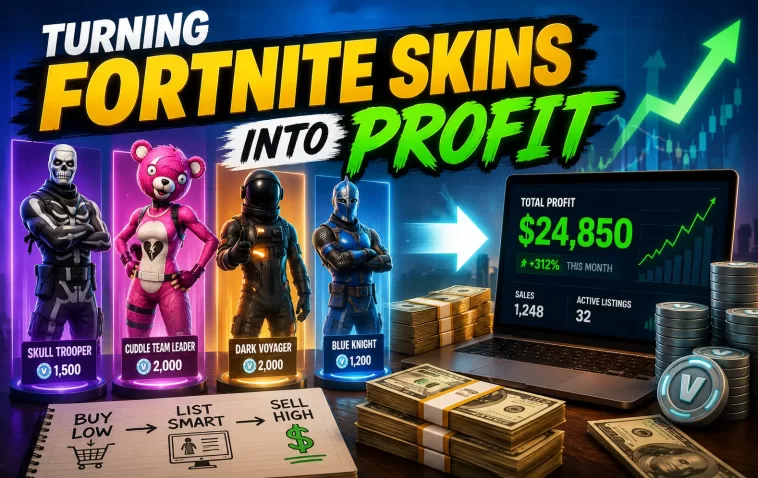
Watched a guy in my Discord try to flip a “fully loaded” Fortnite account for $400 last month, and he genuinely had no idea Epic could ban it the second the buyer complained. So before we get into what actually works for turning Fortnite skins into profit, let’s be straight about what’s legitimate, what’s gray-area, and what’s just asking for a banned account and an empty wallet.
Quick Answer
- Epic’s terms of service prohibit selling accounts or individual skins directly — there’s no official trading system, full stop
- Despite that, a real third-party market exists for full account sales, and OG accounts with early-Chapter-1 skins can sell for hundreds, sometimes over a thousand dollars
- The actual value driver isn’t skin count, it’s rarity and “never coming back” status — Season 2 battle pass exclusives like Black Knight and Sparkle Specialist consistently outsell everything else
- Safer, ToS-compliant money paths exist too: creator codes, content creation around your locker, and account value calculators that help you decide whether selling is even worth the risk
- If you do sell an account anyway, understand you’re accepting real ban risk in exchange for real money — that trade-off is the whole game here
That’s the honest summary. So let’s break down why some skins are worth real money and others aren’t, because “rare-looking” and “actually valuable” are not the same thing.
Why Some Fortnite Skins Are Worth Money and Most Aren’t
There’s no official secondary market for individual Fortnite skins. You can’t list a single skin for sale the way you’d flip a CS2 weapon skin on the Steam Market — Fortnite cosmetics are tied to the account, not transferable as standalone items. So when people talk about “selling skins,” what they almost always mean, whether they realize it or not, is selling the whole account those skins live on.
Scarcity from permanent removal drives almost all the value. A skin that’s still in the item shop rotation, even if it looks great, isn’t worth anything on the resale side — anyone can just buy it themselves for a few bucks in V-Bucks. The skins that actually move money are ones tied to a specific season’s battle pass or a limited shop run that Epic has never brought back. Once something’s gone for good, the only way to get it is to buy an account that already has it.
Battle pass exclusives outperform shop skins, pretty consistently. From the data floating around skin-value trackers, Season 2 battle pass rewards like Black Knight and Sparkle Specialist sit well above the market average for account value — multiple times the average, not just a little. Shop skins from the same era still carry value, but the “you had to grind a battle pass during a specific season” requirement adds a layer of scarcity that a shop purchase never had.
Collaboration skins tied to real-world licensing are a different beast entirely. Travis Scott’s skins are the clearest example — the collaboration hasn’t returned because, as far as anyone can tell, the licensing relationship just isn’t active anymore. That’s not a “rare drop,” that’s a skin frozen in time because of something entirely outside the game, and it commands a real premium because of it.
V-Bucks balance and account progression add value, but they’re not the main event. A chunk of unspent V-Bucks bumps the price a little since the buyer can use it right away. Account level signals time invested. But neither of those moves the needle the way one genuinely rare OG skin does.
Account age by itself means very little without the right cosmetics attached. I’ve seen people assume an old account is automatically valuable just because it’s old. It isn’t. Plenty of Chapter 1 accounts have nothing but the default skin and a couple of common items, and those aren’t worth more than a newer account with a decent locker.
What Actually Works
Account sales (the gray-area route most people mean)
This is genuinely the only way money changes hands over Fortnite cosmetics, since there’s no item-level trading. Third-party marketplaces handle these sales constantly, and the going range is wide — some sources put it anywhere from a dollar or two for a barebones account up to $500 and beyond for something stacked with OG skins, with true Renegade Raider or Black Knight accounts pushing past $1,000 in the right listing.
But — and this matters — Epic’s terms explicitly forbid this. Marketplaces operate in a space where enforcement is inconsistent rather than nonexistent. Most transactions go through without issue. Some don’t. The risk isn’t theoretical; it shows up most often when a buyer contacts Epic support directly, or when login activity from a new device and location trips a security flag on the account.
Skin refunds (legitimate, but limited)
Fortnite allows refunding a skin purchase back to V-Bucks under narrow conditions — within 30 days of purchase, and capped at three lifetime refunds total. This isn’t really a profit method, it’s closer to “undo a purchase mistake,” but it’s worth knowing because some people confuse it with being able to cash out skins for real money. You can’t. V-Bucks aren’t refundable to actual currency through Epic, ever.
Creator codes and content around your locker
If you’ve got a genuinely impressive collection, especially OG skins that newer players have never seen in action, there’s real audience interest in seeing them used. A creator code tied to your content (streaming, clips, locker showcases) generates a small cut of V-Bucks purchases made by people who support you — not life-changing money for most people, but it’s fully within the rules and compounds over time if you build any kind of following around it.
Account value calculators, used correctly
These tools (PlayerAuctions, iGV, and similar sites all run versions of them) estimate what your locker is theoretically worth based on skin rarity, V-Bucks balance, and progression. Worth running one before you decide whether selling is even worth the ban risk — if the number comes back low, that risk-reward math gets a lot easier to walk away from.
Common Scenarios
- OG players sitting on Chapter 1 skins — highest-value position by far, especially Season 2 battle pass exclusives and early shop rarities like Renegade Raider
- Newer players with a big skin count but nothing old — usually overestimate their account’s worth; quantity doesn’t substitute for the right scarcity
- Collaboration-skin holders — Travis Scott, Marvel, and similar licensed items carry premiums tied to whether that license is still active, which can shift independently of anything in-game
- Console-exclusive bundle owners — codes like the Royale Bomber PS4 bundle hold value specifically because the physical bundle that unlocked them is discontinued
What Tends to Get Overestimated (and What Rarely Pays Off)
People consistently overvalue total skin count and undervalue specific rarity. A locker with 80 common shop skins is worth less than a locker with five genuinely rare Season 2 exclusives, and that surprises a lot of first-time sellers.
The other thing that rarely pays off: trying to sell individual skins outside of a full account transfer. There’s no functioning market for that because there’s no way to transfer a single cosmetic — buyers know this, and listings that try it tend to get ignored or flagged as scam attempts.
Risk Management If You Go the Account-Sale Route
If you decide the trade-off is worth it anyway, a few things reduce (not eliminate) the risk:
- Use an established third-party marketplace with buyer/seller protection and dispute handling rather than a random Discord DM deal
- Document the account’s contents thoroughly before listing — screenshots of the full locker, V-Bucks balance, and level
- Be upfront about platform availability (PC, console, mobile) since restricted accounts reach a smaller buyer pool and that affects both price and how smoothly the sale goes
- Understand that even a clean transaction doesn’t guarantee Epic won’t eventually flag the account if the buyer does something that draws attention to it later
FAQ
Can I sell individual Fortnite skins instead of a whole account? No, not really. There’s no transfer mechanism for single cosmetics, so what looks like a “skin sale” online is functionally always an account sale.
Is it actually illegal to sell a Fortnite account? Not illegal in a legal sense, but it violates Epic’s terms of service, which means Epic can ban the account at their discretion — there’s no law being broken, just a platform rule.
What’s the single most valuable thing I can have in my locker? Genuinely rare, permanently unavailable battle pass exclusives from early seasons — Season 2 rewards in particular consistently outperform almost everything else in resale value data.
Are V-Bucks worth anything if I want to cash out? Not directly. Epic doesn’t convert V-Bucks back to real money under any official process; the only thing close is refunding a recent skin purchase back into V-Bucks, not cash.
Will my account get banned for sure if I sell it? Not for sure — plenty of sales go through without any issue. But it’s a real possibility, not a scare tactic, and it tends to happen more around buyer complaints or unusual login activity than anything else.
Editor’s Opinion
the honest version of this topic is that theres no clean, fully-safe way to “turn skins into profit” because epic never built a system for it — every method here is either gray-area account selling or a slow-burn creator code grind, nothing in between. if you’ve got real OG stuff like black knight or renegade raider, your locker is worth more than you probably think, just go in knowing the ban risk is real and not just internet paranoia.
