I’ve been running the Sennheiser Momentum 5 Wireless daily for a few weeks now, and the battery life is genuinely one of the best things about these headphones — but I still managed to shave hours off mine before I figured out what was actually draining it. So if you’re getting less than the advertised numbers, this is the actual breakdown of what helps, what doesn’t, and why your real-world results will land lower than Sennheiser’s marketing figure no matter what you do.
Quick Answer
- Sennheiser rates the Momentum 5 Wireless at up to 57 hours with ANC on at moderate volume — real-world testing lands closer to 53-54 hours.
- Battery protection mode in the Smart Control Plus app caps charging around 80% to slow long-term degradation, at the cost of some max runtime per charge.
- Bluetooth codec choice matters: aptX Lossless and hi-res streaming pull more power than AAC or SBC.
- The battery is user-replaceable with a basic Phillips-head screwdriver, so this isn’t a “buy new headphones” situation once it eventually wears down.
- Source device matters too — iPhones in testing drained the battery somewhat faster than Android devices did, for reasons that aren’t fully documented anywhere.
Why Your Battery Life Doesn’t Match the Box
Three things, mainly, separate Sennheiser’s headline number from what you’ll actually see.
Codec and bitrate choice changes power draw. The Momentum 5 Wireless supports six codecs total — AAC, SBC, aptX, aptX Adaptive, aptX HD, and aptX Lossless — and that’s a real range from low to high power demand. Streaming lossless or hi-res content from services like TIDAL or Qobuz over aptX Lossless is going to draw noticeably more than a standard AAC stream from a regular music app.
Your source device affects drain in ways that aren’t fully predictable. In independent testing, iPhones burned through the charge somewhat faster than a comparable Android phone did, even with otherwise similar settings. Not 100% sure why, but the difference showed up consistently enough across multiple iPhone models to not be a fluke.
ANC level and volume both pull power, obviously, but not equally. Running ANC at its highest setting at high volume is the worst-case combination, and it’s also what Sennheiser’s own 53-hour-plus internal test used. Moderate volume with ANC engaged gets you closer to that 57-hour ceiling.
Step-by-Step: Settings That Actually Extend Runtime
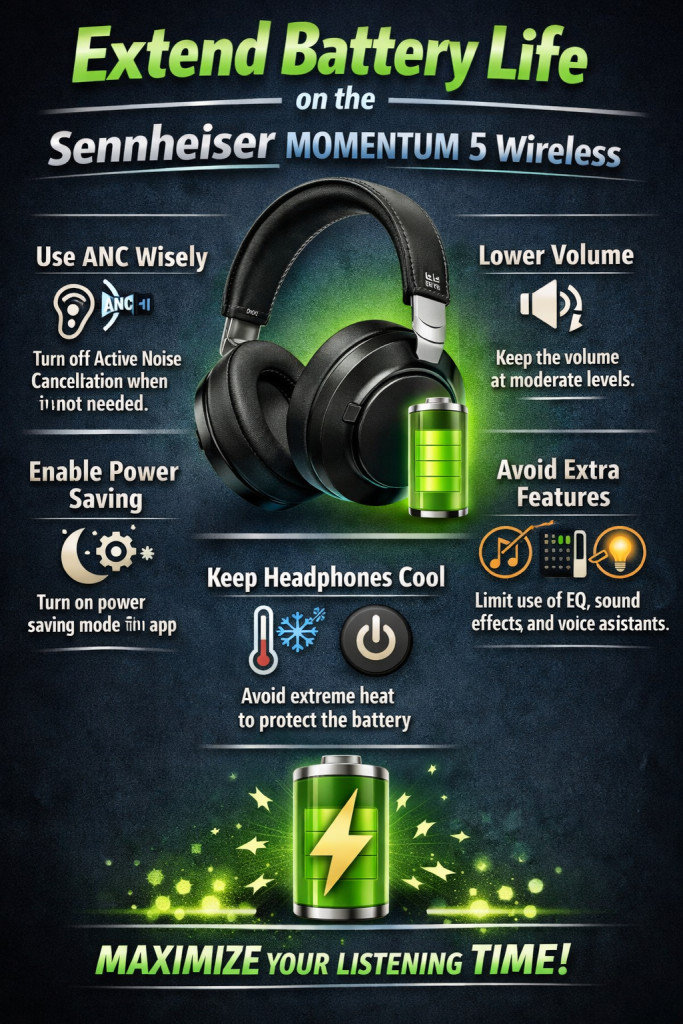
- Turn on battery protection in Smart Control Plus. This caps the charge at a lower ceiling than 100%, which slows long-term battery wear — the same logic as iPhone’s optimized battery charging. It does mean slightly less total playback time per charge, but the tradeoff is worth it if you’re keeping these for years.
- Drop to a lighter codec when battery matters more than fidelity. If you’re not critically listening — commuting, working, background music — switching from aptX Lossless to AAC or standard aptX meaningfully reduces the power draw.
- Use moderate ANC instead of maximum unless you actually need it. Save the highest ANC setting for flights or genuinely loud environments, and dial it back for everyday use.
- Turn off automatic headphone detection when you’re setting them down for a while. If proximity-based auto-pause/auto-resume is enabled, the headphones may briefly reactivate sensors every time they’re moved, which adds up over a day.
- Disconnect Bluetooth fully rather than just powering down nearby. Leaving Bluetooth searching for a reconnect in the background drains more than a clean disconnect.
What Actually Worked For Me
I started by assuming ANC was the main culprit, since that’s the obvious guess. Turning it off helped some, but not as much as I expected — maybe an extra few hours over a week of testing. The bigger change came from switching my default streaming codec down from aptX Lossless to plain aptX for everyday listening and saving lossless mode for when I actually sat down to listen critically. That’s the fix that actually moved the needle, not the one I assumed would going in. Battery protection mode in the app helped too, though that’s more of a long-term health thing than something you’ll notice day to day.
Advanced Notes: The Replaceable Battery and What That Means Long-Term
Here’s the thing most battery-life guides for other headphones don’t get to mention: the Momentum 5 Wireless has a genuinely user-replaceable 700mAh battery. Pull the ear cushions off the left cup, undo four Phillips-head screws, and the whole speaker unit comes out as one piece, giving you direct access to swap the battery with nothing more than a basic screwdriver.
This matters for two reasons. First, it means the eventual capacity loss that happens to every lithium battery over a few years of charge cycles isn’t a death sentence for the whole headphone — you can replace just the battery instead of replacing the entire product. Second, it’s part of Sennheiser getting ahead of an EU directive taking effect in mid-February 2027 that will require manufacturers to let consumers replace batteries in headphones themselves, so this design choice isn’t purely altruistic, but it’s still a real practical benefit either way.
If your battery life has dropped noticeably below what it used to deliver when new — not just “lower than the box claims,” but a real decline from your own baseline — a replacement battery is the actual fix, not another round of settings tweaks.
Common Fixes That Sound Helpful But Rarely Move the Needle
A lot of generic battery-saving advice circulating for Bluetooth headphones doesn’t apply much here, or barely matters. Closing background apps on your phone, for instance, has basically no effect on headphone-side battery drain — that’s a phone battery tip that got copy-pasted into headphone advice where it doesn’t really belong. Similarly, “turn off the screen on your phone while listening” doesn’t meaningfully change anything on the headphone side, since the headphones aren’t drawing power based on your phone’s display state.
Prevention Tips
- Charge fully before long trips, but use battery protection mode for daily routine use rather than always topping off to 100%.
- Don’t let the battery sit fully depleted for extended periods — like most lithium batteries, that’s worse for long-term capacity than regular partial charging.
- Keep firmware updated. Sennheiser has signaled a future update bringing Bluetooth 6.0 and LE Audio support, which is specifically expected to improve battery efficiency alongside latency.
- If runtime drops sharply and suddenly rather than gradually, check for a firmware update before assuming it’s a hardware issue.
FAQ
Does turning off ANC really extend battery life that much? Some, but less than most people expect. Codec choice and volume level make a bigger practical difference in day-to-day use.
Is the 57-hour claim accurate? It’s achievable under specific conditions — moderate volume, ANC on, lighter codec. Heavier use with high volume and lossless streaming brings that down into the low-to-mid 50s.
Can I replace the battery myself? Yes. It’s a 700mAh battery accessible behind four screws in the left ear cup, replaceable with a standard Phillips screwdriver.
Does multipoint connection to two devices drain the battery faster? It can add some overhead since the headphones are maintaining two active Bluetooth connections, though it’s not a dramatic difference for most users.
Why does my iPhone drain the battery faster than my Android phone did? Not fully clear from available testing — it showed up consistently in independent reviews, but Sennheiser hasn’t published a technical explanation for the gap.
Editor’s Opinion
honestly the battery life on these is so good that “extending it” feels almost unnecessary most weeks, but the codec thing genuinely surprised me once i actually tested it side by side. battery protection mode is the easy win nobody talks about enough, just turn it on and forget about it. the replaceable battery is the real long game tho — that’s the feature that’ll matter most two or three years from now
