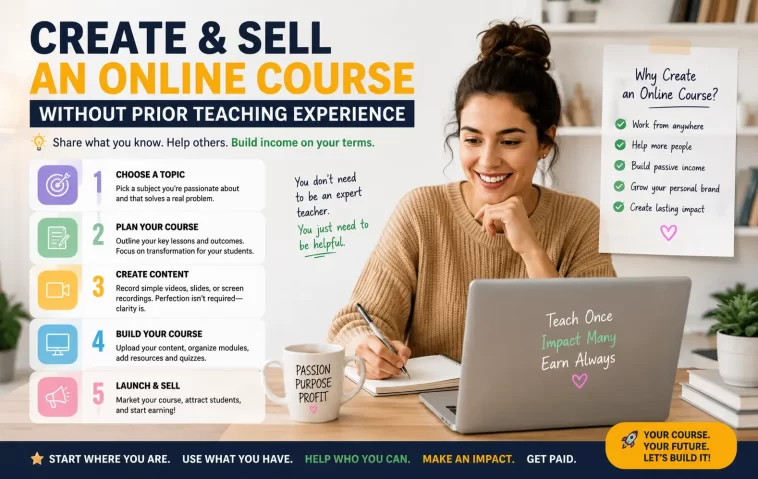
I almost didn’t make my first course because I kept thinking “who am I to teach this.” Turns out that’s basically everyone’s first thought, and it’s usually wrong. You don’t need to be the world’s leading expert — you need to be maybe ten steps ahead of the person you’re teaching, and willing to actually show your work.
Quick Answer
- Validate demand before building anything — ask, survey, or pre-sell before you record a single lesson
- Pick one specific outcome to teach, not a broad topic you’d need years to fully cover
- Start with a lightweight version (3-5 hours of content) that gets a real result, not a 40-module monster
- Choose between a marketplace (built-in traffic, lower cut for you) or an all-in-one platform (more control, more setup)
- Price based on the result delivered, not on how experienced you feel — underpricing usually hurts more than overpricing
Why “I’m Not an Expert” Isn’t a Real Blocker
This is the thing that stops more people than any technical problem ever will, and it’s worth addressing directly instead of skipping past it.
Being ahead of your student is enough. If you learned something the hard way over the last year and know exactly which mistakes cost you time, that knowledge has value to someone starting from zero. You don’t need a decade of teaching experience to save someone else six months of trial and error.
The market doesn’t actually check credentials the way people assume. Buyers care about whether the course gets them to a specific result, not whether the creator has a teaching certificate. That said, testimonials and a track record do help once you have them — which is exactly why validating and launching to a small group first matters so much.
Perfectionism kills more first courses than lack of expertise does. Waiting until you feel “ready enough” usually just means waiting forever. The honest fix here isn’t confidence, it’s shrinking the scope until the course is something you can genuinely deliver well right now.
Common Situations New Course Creators Run Into
People with a skill but no audience often assume they need thousands of followers before selling anything. A marketplace platform with built-in discovery can get a first sale without an existing audience, even if the revenue split is worse.
People with some audience but a vague topic tend to struggle more than beginners with zero audience, oddly enough — a broad “everything I know about marketing” course is harder to sell than a narrow “how to get your first 100 email subscribers” course, even with the same follower count behind it.
People who’ve taught informally (answering questions in a community, mentoring coworkers) usually have more raw material than they realize. Those repeated questions are basically a course outline that’s already been market-tested.
Platform Comparison
| Platform Type | Example | Revenue Cut | Traffic | Best For |
|---|---|---|---|---|
| Marketplace | Udemy | You keep roughly 37% on organic sales, less on subscription plays | Built-in student base | No existing audience, fast first sale |
| All-in-one platform | Teachable, Thinkific, Kajabi | You keep nearly all of it, minus platform fee | You drive it yourself | Creators wanting full branding and pricing control |
| Simple digital product tool | Gumroad | Low flat fee | You drive it yourself | Fastest possible path to a first sale, minimal setup |
Marketplaces trade a big revenue cut for an existing audience. All-in-one platforms trade more setup work for keeping control of pricing, branding, and the actual customer relationship. Neither is wrong — it depends on whether you have any audience to launch to yet.
Step-by-Step: Building Your First Course
Step 1: Validate before you build anything. Ask people directly, post about the idea, or even open pre-orders before recording a single lesson. If nobody’s willing to say “yes I’d pay for that,” building the full course won’t fix the underlying demand problem.
Step 2: Narrow the topic to one specific outcome. “Learn photography” is too broad. “Take better photos of your food for Instagram using just your phone” is something you can actually deliver in a few hours and someone can actually finish.
Step 3: Outline the shortest real path to that outcome. Skip the comprehensive version for now. A structure like foundation, two or three core skills, then a final project pulling it together is usually enough for a first course — something in the 3-5 hour range.
Step 4: Use AI tools for structure, not for your actual expertise. Drafting an outline or tightening a script is a reasonable use of AI assistance. But the specific mistakes you made, the stories, the “here’s what actually tripped me up” moments — that has to come from you, because that’s the part students are actually paying for.
Step 5: Record in short chunks. Five to ten minute segments are easier to keep energy in than trying to record a continuous hour. And it makes editing far less painful when something goes wrong halfway through.
Step 6: Choose your platform based on your current audience size, not the platform’s reputation. If you have zero audience, a marketplace’s built-in traffic might get you your first sale faster than a beautifully branded standalone site nobody visits yet.
Step 7: Price based on outcome, not on your own confidence level. A course that saves someone real time or money can justify a real price. Pricing too low as a hedge against feeling like an imposter tends to backfire — it can actually signal lower quality rather than accessibility.
Step 8: Launch to a small group first. Founding members at a discounted price, in exchange for feedback and (hopefully) a testimonial, give you real proof before a wider launch. That proof becomes the thing that sells your second batch of students.
What Actually Worked For Me
I built my first course backwards, and it worked out mostly by accident. I recorded the whole thing before asking anyone if they’d actually pay for it, which is exactly the mistake every guide tells you not to make. It sat unsold for almost three weeks. What finally moved it wasn’t a marketing trick — I posted honestly in a niche forum about what I’d built and why, more as a “does this look useful” post than a sales pitch, and a handful of people bought it directly from that thread.
Looking back, I got lucky that the topic happened to have real demand despite skipping validation. I wouldn’t recommend testing that particular shortcut. The one thing that consistently worked, though, was keeping the course short. I’d planned an ambitious ten-module version originally and cut it down to five out of sheer time pressure, and the shorter version actually had a better completion rate than I expected.
Advanced Considerations and Edge Cases
Subscription-based marketplace deals can change your actual take-home more than the sticker percentage suggests. Some marketplaces pay differently depending on whether a sale comes through their subscription plan versus a direct organic purchase, and the difference can be significant — worth checking the current terms before assuming a flat percentage.
Legal disclaimers matter more in certain topics. Course content in areas like finance, health, or legal advice may need disclaimers or even certifications depending on your location, even though most general skill-based courses don’t require any license at all.
Completion rate matters more than enrollment count for long-term sales. A course with low completion tends to generate fewer referrals and testimonials, even if the initial sales numbers look fine. Shorter, tightly scoped courses often outperform ambitious ones specifically because more people actually finish them.
Prevention Tips
Don’t skip validation just because you’re excited about the topic — excitement doesn’t predict whether people will pay. Keep your first version lean on purpose rather than trying to make it comprehensive from day one; you can always add an advanced track later once you know the core sells. And collect feedback from your first small batch of students actively, since their specific language about what helped them becomes your best marketing copy for the next launch.
FAQ
Do I need any certification to sell an online course? Generally no, unless your topic is in a regulated area like finance or healthcare, where certain disclaimers or credentials might be legally required.
How long should my first course actually be? Somewhere around 3-5 hours of real content is a common sweet spot — enough to deliver a genuine result without becoming a project nobody finishes.
Should I build my own website or use a marketplace first? If you have no existing audience, a marketplace’s built-in traffic often gets you a faster first sale, even with a lower revenue share.
What if nobody buys my course after launch? Go back to validation. A quiet launch usually means the topic wasn’t tested with real people before you built it, not that the content itself is bad.
Editor’s Opinion
the imposter feeling never really goes away completely, i just stopped waiting for it to. your first course doesnt need to be perfect it needs to actually help the specific person its for, thats basically the whole bar. also please dont build the whole thing before checking if anyone wants it, learn from my dumb luck instead of testing your own.
