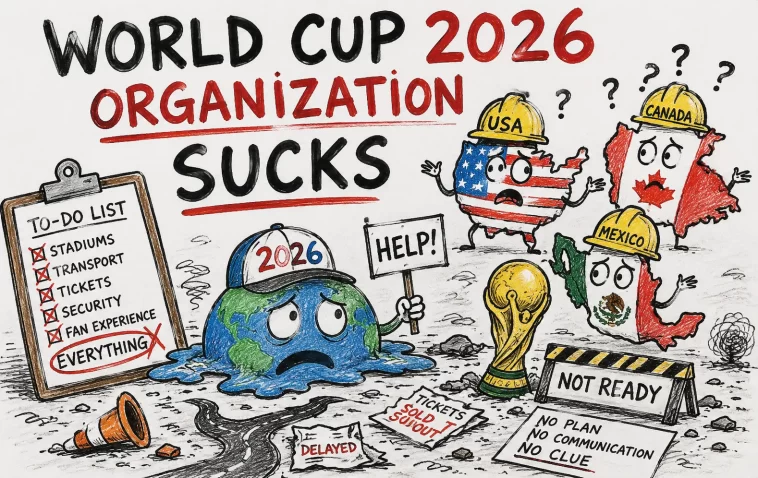
FIFA World Cup 2026 organization is supposed to be the biggest celebration in football history. Three host countries, 48 teams, and a record number of fans were promised the smoothest World Cup ever. Instead, a lot of people on the ground are saying the opposite, and the complaints started long before the opening match in Mexico City.
This isn’t just internet noise either. Local governments, scientists, players, and even US state attorneys general have all raised red flags about how this tournament is being run. So let’s actually break down what’s going wrong, city by city and issue by issue.
A Quick Answer Before We Dig In
If you only have a minute, here’s the short version. FIFA World Cup 2026 organization has run into trouble in four main areas:
- Ticket prices that have climbed to record highs, including an $11,000 price tag for a single final ticket
- A split, decentralized hosting structure across 11 US cities, plus Canadian and Mexican venues, with no single body managing local logistics
- Heat and player safety concerns that scientists warned about more than a year before kickoff
- Travel and visa headaches for fans trying to move between three different countries during the tournament
None of these are small side issues. They’re shaping how millions of people are experiencing the tournament right now.
Why Ticket Prices Became the First Big Scandal
Let’s start with money, because that’s where most of the anger began. Tickets for the final at MetLife Stadium reportedly hit $11,000 for a single seat. That’s not a typo, and it’s not even close to what previous finals have charged.
USMNT midfielder Timothy Weah said publicly that the prices were “too expensive.” When his own national team manager brushed off the criticism, American fans pushed back even harder online.
FIFA president Gianni Infantino defended the pricing by saying the organization simply applied “market rates.” That explanation hasn’t satisfied many people, especially since dynamic pricing means ticket costs can swing wildly depending on demand at any given moment.
It got serious enough that New York and New Jersey opened a formal investigation into whether FIFA was exploiting fans with what they called “impossibly high” prices. When two state governments start asking those questions, it’s not a minor PR issue anymore.
The Real Cost of Going to a Game
Buying a ticket is only step one. Getting to the stadium and finding somewhere to sleep tells its own story.
Take New York City as an example. None of the actual matches are played in Manhattan. Games are across the river in New Jersey, so fans still need transport on top of everything else.
Bus and train fares to reach the stadium reportedly jumped to around $98 for a trip that normally costs about $13. Add two nights in a hotel, and a single game can easily cost a fan close to $2,000 before they’ve bought a hot dog.
The Decentralized Hosting Problem Nobody Talks About Enough
Here’s something that doesn’t get as much attention as ticket prices but probably should: this World Cup doesn’t have one central organizing body running the show on the ground.
Past tournaments were typically run by a single national organizing committee. This time, each of the 11 US host cities negotiated its own separate deal with FIFA. That means each city is handling its own:
- Security funding and staffing
- Infrastructure upgrades
- Transportation planning
- Local legal responsibilities
This sounds fine on paper until you see what happened in Foxborough, Massachusetts. The town’s Select Board refused to issue an entertainment license for matches at Gillette Stadium because FIFA wanted $7.8 million in security funding paid upfront. Foxborough has about 18,000 residents. Asking a town that size to front millions of dollars and wait for reimbursement later is simply not realistic for most local governments.
That single example shows the bigger pattern. FIFA World Cup 2026 organization pushed a huge share of financial and legal risk down to local communities, and some of those communities are pushing back.
Heat Warnings That Were Raised Over a Year Early
This part is hard to ignore once you see the numbers. Back in January 2025, researchers at Queen’s University Belfast warned that wet-bulb globe temperatures in several host cities could actually be higher than what players faced in Qatar during the 2022 tournament, even though Qatar was widely criticized for its heat.
During the 2025 Club World Cup, a kind of dress rehearsal held in the same country, several matches saw temperatures between 90 and 102°F, along with weather delays. That should have been a clear warning sign.
FIFA’s response was to introduce a mandatory three-minute hydration break in each half of every match. Scientists who signed an open letter on the topic argued that three minutes wasn’t nearly enough and pushed for at least six.
Then there’s the part that actually annoyed fans during live matches: the breaks apply everywhere, even in stadiums with air conditioning or roofs. During the Ghana vs Panama match, fans booed the hydration break because it was happening in the middle of heavy rain, not heat. A one-size-fits-all rule applied without much thought for actual conditions on the day.
Travel, Visas, and Moving Between Three Countries
Hosting across the United States, Canada, and Mexico sounded exciting when it was first announced. In practice, it’s created real headaches for fans, journalists, and even some team delegations trying to move between host nations.
Several reports pointed to visa delays and extra screening as ongoing problems throughout the buildup to the tournament. For fans without strong travel documents, jumping between countries to follow their team through different rounds has been genuinely difficult.
On top of that, political tension between the host nations hasn’t helped. US relations with both Canada and Mexico have been strained over trade and immigration policy, a noticeable shift since the three countries originally agreed to co-host the tournament back in 2017 under very different circumstances.
The Environmental Cost Nobody Asked For
There’s also a quieter controversy building around the tournament’s carbon footprint. Expanding to 48 teams and spreading games across 16 cities in three countries means a massive amount of additional air travel.
An independent study by carbon accounting firm Greenly estimated the tournament’s total footprint at roughly 7.8 million metric tons of CO2. For comparison, that’s more than double the official figure reported for the 2022 Qatar World Cup, which was already criticized heavily for its own environmental impact.
A separate report from Scientists for Global Responsibility reached a similar conclusion, calculating emissions nearly double the average of the last four World Cups combined. That’s a tough number to defend for an organization that has publicly committed to sustainability goals.
The 48-Team Format Itself Is Dividing Opinion
Even the structure of the tournament has critics. Expanding from 32 to 48 teams means 72 total matches, more games than the entire Qatar World Cup had from start to finish.
Supporters of the change say it gives more nations a real shot at the world stage. Critics argue it dilutes quality, drags out the schedule, and puts extra physical strain on players who already have packed club seasons.
FIFA frames the expansion as a move toward inclusion. Skeptics see it differently, pointing out that more matches also means more inventory to sell to broadcasters and sponsors.
What Actually Surprised Me Looking Into This
Going into this research, I expected the ticket prices to be the main story. They’re bad, no question. But the part that genuinely surprised me was the Foxborough situation.
I assumed FIFA, as the organizing body, would carry most of the financial risk for security and infrastructure. Instead, individual towns are being asked to front millions of dollars themselves. That’s a structural decision, not just bad luck, and it explains a lot of the local frustration that doesn’t always make international headlines.
I’ll admit I originally planned to focus mostly on the heat issue since it gets the most media coverage. After digging through the actual reports, the decentralized hosting model turned out to be just as important, maybe more so, since it’s the root cause behind several of the other problems.
Practical Tips If You’re Still Planning to Attend
If you’re heading to a match despite all of this, a few things can save you real money and stress:
- Book accommodation outside the immediate stadium zone. Prices spike hardest right next to venues.
- Check transit options early. Some host cities have limited public transport directly to stadiums, so research alternatives in advance.
- Confirm visa requirements months ahead, especially if your itinerary crosses between the US, Canada, and Mexico.
- Bring your own water and sun protection. Hydration breaks exist, but they’re short, and conditions can be extreme.
- Watch ticket marketplaces closely. Resale prices have swung dramatically in both directions for past matches in the same venues.
Prevention Tips for Future Tournaments
For FIFA and future hosts, a few lessons seem obvious at this point:
- Set up one centralized organizing body instead of leaving cities to negotiate separately
- Lock in security funding arrangements years in advance, not months before kickoff
- Adjust heat protocols by actual conditions rather than a blanket rule for every stadium
- Cap ticket price increases or introduce stronger anti-scalping measures earlier in the sales process
Whether FIFA actually applies any of these lessons before the next expanded tournament remains to be seen.
Frequently Asked Questions
Why is FIFA World Cup 2026 organization getting so much criticism?
The criticism centers on high ticket prices, a decentralized hosting structure that shifts financial risk to local cities, heat safety concerns, and travel difficulties across three host nations.
How much do World Cup 2026 final tickets cost?
Reports indicate that a single ticket for the final at MetLife Stadium reached around $11,000, prompting an official investigation by New York and New Jersey officials.
Why did Foxborough refuse to host World Cup matches at first?
The town’s Select Board declined to approve an entertainment license because FIFA required $7.8 million in upfront security funding, an amount considered too heavy for a town of 18,000 residents to cover without prior reimbursement.
Is the heat a real danger for players and fans?
Yes. Researchers warned over a year before the tournament that several host cities could see wet-bulb globe temperatures exceeding those recorded in Qatar in 2022. FIFA introduced mandatory hydration breaks in response.
Why does the 48-team format matter for organization issues?
More teams mean more matches, more travel between cities, and more logistical coordination across three countries, which adds pressure to an already complicated hosting structure.
Is the World Cup 2026 bad for the environment?
Independent estimates put the tournament’s carbon footprint at roughly double that of the 2022 Qatar World Cup, largely due to increased air travel between host cities and countries.
Editor’s Opinion
honestly i think fifa got too greedy this time. three countrys, 48 teams, sounds big and exciting on paper but on the ground its just messy. cities are left to pay for security themselves, tickets cost more than a months rent, and they still tell us its all “market rates.” i get that big events cost money but when a small town like foxborough has to fight for its own stadium deal, somthing is just wrong with how this whole thing was planned. football should bring people togther, not make them choose between a ticket and rent money.
