Silver amulet discovery is changing what historians believed about the spread of Christianity in Europe. What began as an ordinary archaeological excavation near Frankfurt has now become one of the most important religious finds of recent decades, forcing scholars to rethink how early Christian beliefs moved through the Roman world.
An Ordinary Grave With an Extraordinary Secret
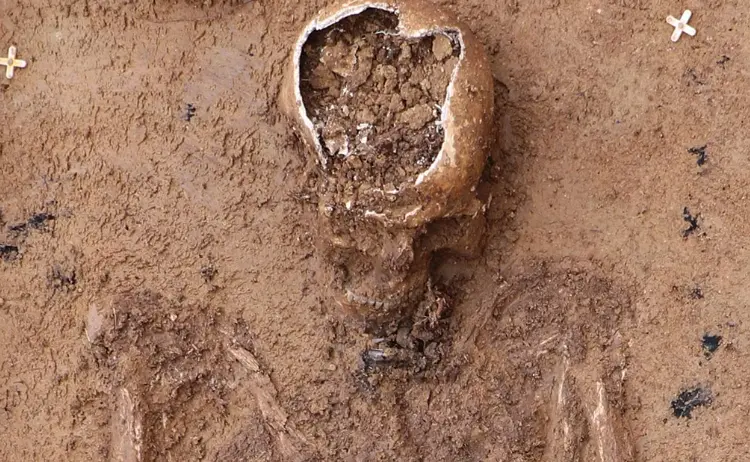
Silver amulet discovery stories rarely begin with drama. In 2018, archaeologists were working at a Roman-era cemetery in the ancient settlement of Nida, located roughly 2.5 kilometers outside modern Frankfurt. The team examined more than 100 burial plots, many containing small personal items such as jewelry, tools, or coins.
Grave 134 did not initially stand out.
Inside was the skeleton of a man estimated to have died between the ages of 35 and 40. His bones showed no signs of violent trauma or serious disease. By all appearances, he had lived a relatively healthy life for his era. Resting beneath his chin was a small necklace—an object so common in Roman burials that it raised little curiosity at first.
That assumption changed quickly.
A Silver Amulet Unlike Any Other
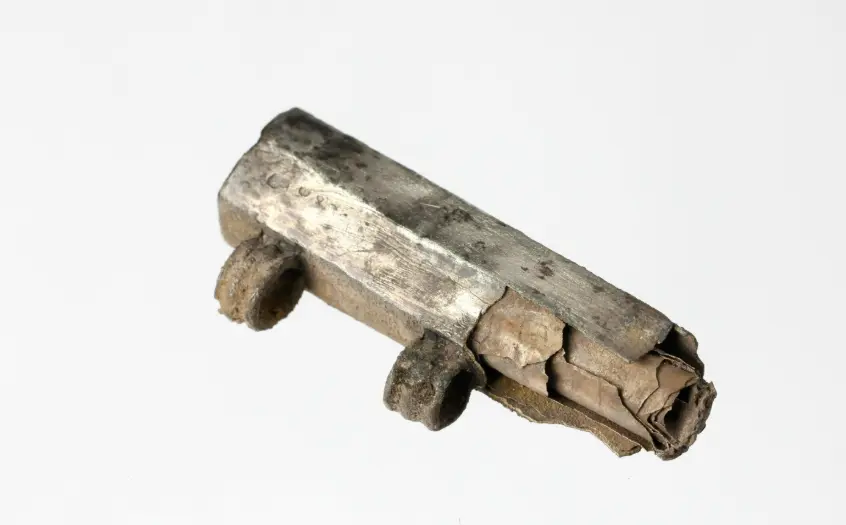
The necklace held a small, inch-long silver capsule. Inside was a tightly rolled and badly damaged piece of silver foil. At first glance, it looked too fragile to examine. But closer inspection revealed faint markings—lines that appeared to be Latin text.
Archaeologists soon realized they were dealing with a phylactery, a type of protective amulet believed to carry religious or spiritual power. What made this example extraordinary was its age: nearly 1,800 years old.
According to Markus Scholz, a professor at Goethe University who took part in the excavation, physically opening the foil was impossible.
“It quickly became clear that unrolling the scroll would destroy it completely,” Scholz explained.
Years of Technology Unlock a Hidden Message
For several years, the inscription remained unreadable. Early attempts using microscopes and X-ray imaging revealed the presence of 18 lines of text, but not enough clarity to understand the message.
In 2024, the research team turned to computed tomography (CT) scanning—a technology more commonly used in medical diagnostics. By digitally “unrolling” the foil layer by layer, researchers finally saw legible text emerge on their screens.
Scholz recalled the moment vividly.
“I couldn’t believe my own eyes,” he said.
What appeared on the scan stunned historians.
The Frankfurt Silver Inscription
The text, now known as the Frankfurt Silver Inscription, contains explicit Christian references. Among the translated passages are invocations of Jesus Christ, declarations of faith, and phrases emphasizing salvation and protection through belief.
One translated section reads, in part:
- “Holy, holy, holy!”
- “In the name of Jesus Christ, Son of God!”
- “Every knee shall bow… and every tongue confess Jesus Christ.”
This language leaves little doubt: the man buried in grave 134 was a Christian.
Why This Silver Amulet Discovery Matters
The silver amulet discovery carries enormous historical weight. Until now, most scholars believed Christianity reached regions north of the Alps much later, becoming widespread only after Emperor Constantine legalized the religion in the 4th century.
This amulet dates to the early 3rd century—possibly even earlier.
That means a practicing Christian was living, worshiping, and openly carrying a faith-based protective charm in Roman-controlled Germania at a time when Christians were still persecuted.
In the Roman Empire, public identification as a Christian could result in imprisonment, torture, or execution. Wearing such an amulet suggests extraordinary devotion—or extraordinary risk.
A Dangerous Faith in a Hostile World
At the time of the burial, Christianity was far from accepted. Roman authorities often viewed Christians as threats to public order, accusing them of rejecting traditional gods and imperial authority.
The man in grave 134 may have relied on the amulet not only for spiritual comfort but also for perceived divine protection in a hostile society.
Researchers are still debating whether the amulet was worn openly or concealed beneath clothing. Either way, its presence in the grave suggests that Christian identity mattered deeply to the deceased—or to those who buried him.
The Role of Chance in Archaeology
Scholz emphasizes that this find was largely a matter of luck.
“It remains an absolute stroke of luck,” he said. “Archaeology often works like a giant puzzle, where most pieces are missing.”
Had the foil degraded further, or had the burial been disturbed centuries earlier, the inscription might have been lost forever.
Other Accidental Discoveries That Changed History
The silver amulet discovery joins a long list of chance finds that reshaped historical understanding.
Civil War Gold Found in a Cornfield
In June 2023, a Kentucky farmer stumbled upon more than 700 gold coins while working his land. The near-mint condition of the Civil War–era coins shocked numismatists and historians alike, raising questions about secret wealth, wartime finance, and forgotten personal fortunes.
A Dentist Deciphers Da Vinci’s Geometry
In 2025, British dentist Rory Mac Sweeney identified hidden geometric structures in Leonardo da Vinci’s famous anatomical drawing, revealing mathematical relationships that had puzzled scholars for centuries. His discovery bridged dentistry, art history, and classical geometry in unexpected ways.
A Plumber’s Basement Treasure
During a renovation in Vienna, an Austrian plumber uncovered a hidden chest containing 66 pounds of gold coins stamped with the image of Wolfgang Mozart. Buried before World War II, the hoard is now valued at nearly $2.7 million.
A New Chapter in Christian History
Among these discoveries, the silver amulet discovery stands apart for its impact on religious history. Unlike treasure or art, it reshapes our understanding of belief, identity, and risk in the ancient world.
It suggests Christianity was not just present but practiced with conviction far beyond its assumed borders—decades earlier than previously documented.
What Researchers Are Still Trying to Learn
Scholars continue to analyze the inscription’s phrasing, grammar, and theological implications. Some lines remain open to interpretation, and debate continues over whether the text reflects local Christian practices or ideas imported directly from Rome or the eastern Mediterranean.
Another unanswered question remains the man himself.
Who was he? A merchant? A soldier? A convert traveling through the empire? Without additional records, his identity may remain unknown—but his faith is now unmistakably documented.
Why This Discovery Will Be Remembered
The silver amulet discovery proves that even the smallest objects can carry enormous historical weight. A fragile strip of silver foil, hidden for nearly two millennia, has given historians a rare, intimate glimpse into the private faith of an early Christian living under Roman rule.
As new technologies continue to unlock the past, archaeologists believe more discoveries like this may still lie beneath our feet—quietly waiting to rewrite history once again.
