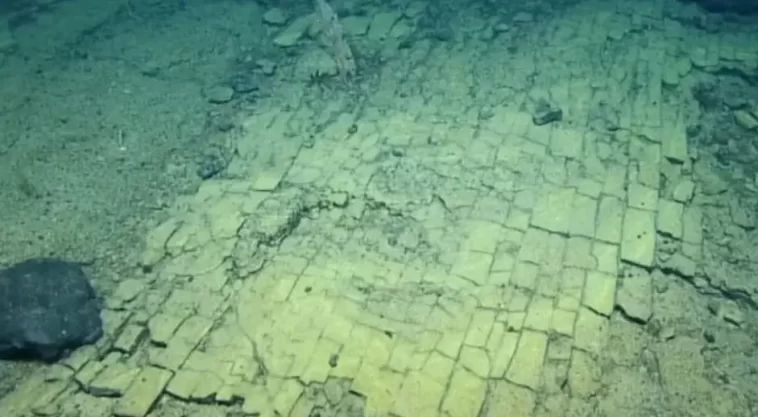
Yellow brick road seafloor discoveries are rare, but scientists exploring the deep Pacific Ocean have captured footage of a strikingly geometric rock formation nearly 3,000 meters below the surface—one so unusual that it left researchers audibly stunned during a live expedition.
The discovery was made during a remotely operated vehicle (ROV) dive aboard the exploration vessel Nautilus, where cameras revealed a cracked volcanic surface resembling a paved road made of neatly arranged stone slabs. The footage, recorded deep within a protected marine region north of Hawaiʻi, quickly gained attention for its uncanny resemblance to a man-made structure—despite lying far beyond human reach.
Yellow Brick Road Seafloor Found Nearly 3,000 Meters Deep
The yellow brick road seafloor formation was documented at approximately 3,000 meters (nearly 10,000 feet) beneath the Pacific Ocean. It lies along the Liliʻuokalani Ridge, a chain of underwater volcanic mountains located inside the vast Papahānaumokuākea Marine National Monument.
This immense protected area spans more than 580,000 square miles, making it larger than all U.S. national parks combined. Despite its size, scientists estimate that only a tiny fraction of its seafloor has ever been visually explored.
The formation itself sits atop Nootka Seamount, an ancient underwater volcano formed during the Cretaceous period, between roughly 66 and 145 million years ago.
Live Expedition Reactions Capture the Moment of Discovery
During the live-streamed dive, researchers monitoring the ROV feed could be heard reacting in real time as the camera passed over the formation.
“It looks like a road,” one scientist said.
“The yellow brick road?” another replied.
“This is bizarre,” a third voice added.
The moment lasted only about 20 seconds, but it quickly became one of the most talked-about visuals from the expedition. The rock surface appeared flat, fractured into near-perfect right angles, and laid out in a pattern that closely resembled stone paving.
What Is the Yellow Brick Road Seafloor Made Of?
While the formation looks artificial at first glance, scientists emphasize that the yellow brick road seafloor is entirely natural. According to expedition logs and geologists onboard, the structure is made of hyaloclastite, a volcanic rock formed when lava erupts into water.
Hyaloclastite forms during high-energy volcanic events, especially underwater eruptions. When hot lava rapidly cools upon contact with seawater, it shatters into angular fragments. Over time, these fragments settle and cement together on the seafloor.
The distinctive brick-like pattern comes from thermal contraction. As the lava cools, it shrinks and fractures. In certain conditions, these fractures occur at near-90-degree angles, producing shapes that resemble tiles or bricks.
Scientists refer to this environment as a “baked margin,” meaning the rock experienced repeated heating and cooling from multiple volcanic events.
youtube.com/watch?v=TID2kc8yb9Q&embeds_referring_euri=https%3A%2F%2Fdailygalaxy.com%2F
A Rare Look at an Almost Unknown Seafloor
Only about 3% of the Papahānaumokuākea monument has been visually explored, according to published estimates. On a global scale, the numbers are even smaller.
A 2025 study published in Science Advances calculated that, despite 67 years of deep-sea exploration, humans have visually observed between 0.0006% and 0.001% of the world’s deep ocean floor.
This means discoveries like the yellow brick road seafloor are not just unusual—they represent some of humanity’s first direct glimpses into vast, hidden landscapes that have existed undisturbed for millions of years.
First Visual Survey of Ancient Seamounts
The discovery occurred during the Luʻuaeaahikiikekumu expedition, which marked the first time scientists visually surveyed parts of the Liliʻuokalani Seamounts.
An earlier mission in 2021 used multibeam sonar to map the region, revealing summit depths that were far shallower than expected for such ancient geological features. The follow-up expedition aimed to confirm those findings visually and collect physical samples.
The expedition also had a cultural dimension. Native Hawaiian cultural liaisons participated throughout the mission, marking the first time Hawaiian language and traditional knowledge were formally integrated into exploration activities in this region.
The expedition’s name, Luʻuaeaahikiikekumu, references the Kumulipo, a traditional Hawaiian origin chant that links natural features to ancestral creation stories.
Why the Yellow Brick Road Seafloor Matters to Science
Beyond its visual impact, the yellow brick road seafloor formation offers valuable insight into underwater volcanic processes and the geological history of the Pacific Ocean.
Scientists collected rock samples from the site, including basalt coated with ferromanganese crusts—mineral layers that accumulate extremely slowly, sometimes over millions of years. These crusts host unique microbial communities that can reveal how life survives in extreme deep-sea environments.
By studying these microbes and the chemical makeup of the rocks, researchers hope to establish baseline data for managing and protecting seamount ecosystems.
Limits of the Current Research
Despite the excitement, researchers caution that many questions remain unanswered.
The expedition operated under several constraints:
- ROV dives followed fixed paths, limiting coverage
- Sampling was restricted to exposed rock surfaces
- The precise age of the formation has not yet been determined
Laboratory analysis of collected samples is still ongoing at multiple research institutions. Until those results are complete, scientists cannot say exactly when the formation formed or how many eruption cycles contributed to its structure.
Who Funded and Managed the Expedition
The research was funded by NOAA Ocean Exploration through the Ocean Exploration Cooperative Institute, with additional support from the NOAA Office of National Marine Sanctuaries.
Papahānaumokuākea Marine National Monument is jointly managed by:
- The U.S. Department of Commerce
- The U.S. Department of the Interior
- The State of Hawaiʻi
- The Office of Hawaiian Affairs
Findings from the expedition will contribute to a scheduled 2026 review of deep-sea habitat management strategies within the monument.
A Reminder of How Much We Haven’t Seen
The yellow brick road seafloor discovery serves as a powerful reminder that Earth’s most mysterious landscapes are not on distant planets—but right here, hidden beneath our oceans.
As deep-sea technology improves and exploration expands, scientists expect many more surprising formations to emerge from the darkness. For now, this strange, brick-like pathway beneath the Pacific stands as one of the clearest examples of how nature can imitate design—and how little of our own planet we truly know.
