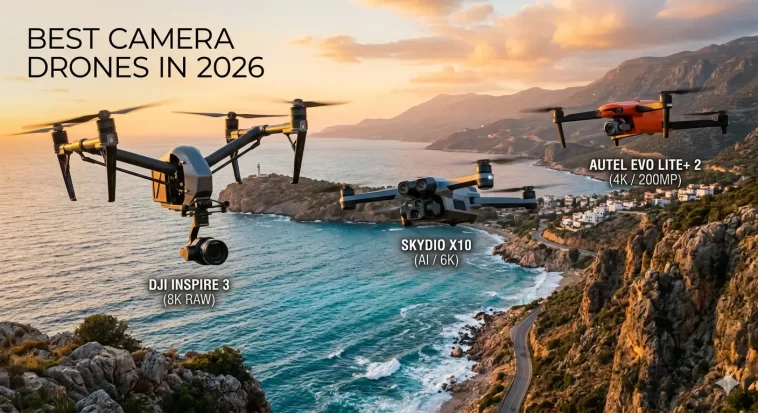
Camera drones have completely changed the way we capture the world. What once required a helicopter, a crane, or a professional film crew is now achievable with a device that fits in a backpack — or even your jacket pocket. Whether you are a landscape photographer, a travel content creator, a real estate videographer, or simply someone who wants to capture stunning aerial footage, 2026 has never had a better selection of drones to choose from.
This guide covers the 10 best camera drones available right now, organized from professional powerhouses down to beginner-friendly budget picks, with clear specs and honest advice on who each drone is actually best suited for.
What to Look for in a Camera Drone
Before diving into the list, here are the key specs that actually matter:
- Sensor size — Larger sensors (1-inch or 4/3-inch) capture more light and detail, especially in low light. This is the single biggest factor in image quality
- Video resolution — 4K is the minimum for serious work; 6K and above is increasingly common in pro models
- Flight time — Most consumer drones offer 30–50 minutes per battery charge
- Obstacle avoidance — Omnidirectional sensing is the safest, especially for beginners
- Weight — Drones under 250g often fall outside strict registration requirements in many countries
- Gimbal stabilization — A 3-axis mechanical gimbal is non-negotiable for smooth, professional footage
- Transmission range — How far the drone can fly while maintaining a stable video feed
1. DJI Mavic 4 Pro — Best Overall / Best for Professionals
Price: ~$2,199 | Weight: 1,630g | Flight Time: ~51 min
The DJI Mavic 4 Pro is the most capable consumer drone on the market in 2026. It is the benchmark against which every other drone is measured, and it earns that position in every meaningful way.
The camera system is built around a Hasselblad-tuned triple-lens setup: a 100MP 4/3-inch main sensor (wide), a telephoto lens, and a medium telephoto lens. The main sensor delivers outstanding dynamic range, cinematic color science, and stunning low-light performance. Video tops out at 6K on the main camera with a new 360-degree gimbal that opens up creative angles not previously possible on a consumer drone.
The 51-minute flight time is the longest in its class — a genuine game-changer for photographers who need extended time over a location during golden hour. Obstacle avoidance uses LiDAR on the front, making it extremely reliable in complex environments.
This is not a casual weekend toy. At $2,199 for the base model, it is a professional tool for aerial photographers and videographers who need the absolute best image quality available without chartering a helicopter. If you are earning money with your drone, this is the obvious choice.
Best for: Professional photographers, commercial videographers, real estate cinematography, landscape aerial work
2. DJI Air 3S — Best All-Rounder
Price: ~$1,099 | Weight: ~723g | Flight Time: ~45 min
If the Mavic 4 Pro is overkill for your needs and budget, the DJI Air 3S hits the sweet spot that most creators should actually buy. It offers a 1-inch main sensor with dual cameras — a wide-angle and a medium telephoto — delivering outstanding stills and 4K video in a much more portable and affordable package.
45 minutes of flight time is excellent for this class, and the camera’s low-light performance is genuinely impressive. Omnidirectional obstacle avoidance is included, making it safe enough for confident beginners while offering enough control and image quality to satisfy experienced pilots.
For the vast majority of content creators, travel photographers, and serious hobbyists, the Air 3S delivers 85–90% of the Mavic 4 Pro experience at roughly half the price. It is not a compromise — it is a deliberate choice to prioritize portability and value without sacrificing image quality.
Best for: Serious hobbyists, content creators, travel photography, anyone who wants professional results without the Mavic 4 Pro price tag
3. DJI Mini 5 Pro — Best for Travel and Portability
Price: ~$799–$900 | Weight: ~249g | Flight Time: ~35 min
The DJI Mini 5 Pro made headlines as the first sub-250g drone to feature a genuine 1-inch sensor — a combination that was considered impossible just a few years ago. At 249g, it falls under the weight threshold that exempts it from mandatory registration and stricter flight regulations in most countries, making it the most hassle-free drone to travel with internationally.
The 1-inch sensor with an f/1.8 aperture produces photos and 4K video that are genuinely difficult to distinguish from the larger Air 3S in good light. Dynamic range is excellent, color science is Hasselblad-tuned, and the 50MP stills give you meaningful cropping latitude.
One feature that stands out for social media creators: the Mini 5 Pro physically rotates its gimbal to true vertical orientation for native 9:16 portrait shooting — no cropping required for Instagram Reels or TikTok. For any creator whose primary platform is vertical video, this alone is worth the upgrade.
It is not quite as wind-resistant as heavier drones, and the single-camera setup lacks the telephoto of the Air 3S, but for travel, hiking, and everyday shooting, it is the most practical professional-quality drone available.
Best for: Travelers, hikers, social media creators, pilots in countries with strict sub-250g regulations
4. DJI Mini 4 Pro — Best Value Mid-Range
Price: ~$759 | Weight: ~249g | Flight Time: ~34 min
The DJI Mini 4 Pro remains one of the best-value drones in the entire market even after the arrival of the Mini 5 Pro. It was the first Mini-series drone to include omnidirectional obstacle avoidance and true vertical shooting, and it packs these features into the sub-250g form factor at a price that undercuts newer models significantly.
Its 1/1.3-inch CMOS sensor produces 4K/60fps video and 48MP stills — genuinely impressive for a drone in this size and price range. Active Track 360° (intelligent subject tracking) works reliably and is excellent for solo creators who need to film themselves.
If the Mini 5 Pro’s 1-inch sensor isn’t a priority for your use case, the Mini 4 Pro saves you $100–$150 and loses almost nothing meaningful in real-world use. For most beginner-to-intermediate pilots, this is still one of the smartest buys available.
Best for: Beginners and intermediates, solo content creators, those wanting the sub-250g benefits at a lower price
5. DJI Avata 2 — Best FPV Drone
Price: ~$620–$1,000 (depending on bundle) | Weight: ~377g | Flight Time: ~23 min
The DJI Avata 2 is a completely different kind of drone — an FPV (First Person View) camera that you fly through goggles, experiencing the flight in real time as if you were riding the drone itself. The footage it produces is cinematic, fast, and unlike anything a standard drone can capture.
It shoots 4K/60fps video and uses a wide-angle 155-degree lens that captures sweeping, immersive shots. The drone is designed to be flown manually using motion controllers, making the flying experience as much of the product as the footage itself.
Battery life is shorter than standard drones at around 23 minutes, and the learning curve is steeper than a standard camera drone. But for action content, sports filming, mountain biking, motorsports, or anyone who wants truly cinematic fast-paced footage, the Avata 2 produces results that no standard drone can replicate.
Best for: FPV flying enthusiasts, action sports filmmakers, YouTube and social media creators who want cinematic fast-paced footage
6. DJI Flip — Best for Beginners
Price: ~$439 | Weight: ~249g | Flight Time: ~31 min
The DJI Flip is DJI’s most beginner-friendly drone in years — a compact, sub-250g foldable camera drone designed to make aerial photography as simple as possible. It features a 1/1.3-inch sensor shooting 4K video and 48MP stills, with forward and downward obstacle sensing to prevent crashes.
It takes just a few minutes to set up and get airborne, and the intelligent flight modes (QuickShots, Hyperlapse, ActiveTrack) handle most of the difficult camera work automatically. Beginners can capture genuinely impressive aerial footage from the first flight.
The compact folded design makes it easy to carry in a bag without dedicated drone equipment, and the sub-250g weight keeps regulation requirements minimal in most countries. For anyone picking up a drone for the first time who wants real image quality rather than a toy, the Flip is the logical starting point.
Best for: First-time drone buyers, casual content creators, beginners who want easy-to-use intelligent features
7. HoverAir X1 Pro Max — Best Pocket Drone
Price: ~$449–$499 | Weight: ~192g | Flight Time: ~22 min
The HoverAir X1 Pro Max takes a radically different approach to drone design. There are no propeller guards to worry about and no controller to carry — it launches from the palm of your hand, hovers, follows you, and films automatically using a set of pre-programmed flight modes.
It weighs just 192g and folds to roughly the size of a large smartphone, making it the most genuinely pocketable camera drone on this list. The Pro Max model shoots up to 8K video and offers true 4K vertical shooting — the only pocket drone currently offering this combination.
The trade-off is a shorter transmission range (around 30 meters in controller-free mode) and shorter flight time compared to traditional drones. It is not designed for complex manual flying — it is designed for anyone who wants to effortlessly capture moving shots of themselves during hikes, travel, or activities without fussing with controls.
Best for: Solo adventurers, vloggers, travel content creators, anyone who wants a follow-me drone that fits in a pocket
8. DJI Neo 2 — Best Ultra-Budget Drone
Price: ~$199–$320 | Weight: ~135g | Flight Time: ~18 min
The DJI Neo 2 is the most affordable way to get genuine DJI quality into the air. At under $200 for the base model, it is accessible to virtually anyone curious about aerial photography without a serious financial commitment.
Despite the price, it shoots 4K video and uses the same O3 video transmission found in more expensive DJI drones. It can be flown controller-free from the palm of your hand using automatic flight modes — perfect for quick selfie shots and simple aerial clips.
Flight time and image quality are naturally more limited than higher-end models, and it lacks the sensor size and creative control of the Mini 4 Pro or above. But as an entry point into drone photography, or as a lightweight backup drone for experienced pilots, the Neo 2 punches well above its price class.
Best for: Complete beginners, curious first-time buyers, casual use, those on a strict budget
9. Antigravity A1 — Most Innovative Drone of 2026
Price: ~$1,599 | Weight: ~780g | Flight Time: ~35 min
The Antigravity A1 is the most interesting and genuinely different drone to appear in the market in 2026. Rather than a single-direction camera, it features a 360-degree capture system that records the entire sphere around the drone simultaneously. After the flight, you can reframe the footage in any direction during editing — effectively choosing your shot in post-production rather than in the air.
This changes the workflow for aerial photographers entirely. Instead of planning every camera angle before flying, you capture everything and decide the composition later. For cinematographers, event photographers, and anyone working in unpredictable conditions, this approach eliminates missed shots.
It is a newer, less proven product compared to DJI’s mature lineup, and the price is significant. But for creators who want to push aerial filmmaking in a new direction, the A1 represents exactly the kind of innovation the market has been waiting for.
Best for: Innovative cinematographers, 360-degree content creators, those who want to future-proof their aerial workflow
10. Potensic Atom 2 — Best Non-DJI Budget Option
Price: ~$329 | Weight: ~249g | Flight Time: ~32 min
The Potensic Atom 2 is the best alternative to DJI at the budget end of the market. For anyone who wants a capable sub-250g drone without paying DJI prices, it is currently the most credible option available.
It shoots 4K/30fps video and 48MP stills with a 3-axis mechanical gimbal delivering smooth, stable footage. The maximum range of 6.2 miles is a significant improvement over the original Atom, and the overall flight performance is reliable and beginner-friendly.
It does not have the obstacle avoidance systems, the polished app experience, or the image quality refinement of a DJI drone. But at $329, it offers genuinely respectable aerial photography capabilities without breaking the bank — and for casual hobbyists and curious beginners, the trade-offs are entirely acceptable.
Best for: Budget-conscious buyers, beginner pilots, non-DJI preference, casual aerial photography
Quick Comparison Table
| Drone | Price | Sensor | Max Video | Flight Time | Best For |
|---|---|---|---|---|---|
| DJI Mavic 4 Pro | ~$2,199 | 4/3-inch (Hasselblad) | 6K | 51 min | Professionals |
| DJI Air 3S | ~$1,099 | 1-inch | 4K | 45 min | All-round best value |
| DJI Mini 5 Pro | ~$799 | 1-inch | 4K | 35 min | Travel / portability |
| DJI Mini 4 Pro | ~$759 | 1/1.3-inch | 4K/60fps | 34 min | Beginners to intermediate |
| DJI Avata 2 | ~$620+ | Wide FPV | 4K/60fps | 23 min | FPV / action footage |
| DJI Flip | ~$439 | 1/1.3-inch | 4K | 31 min | First-time buyers |
| HoverAir X1 Pro Max | ~$449 | — | 8K | 22 min | Solo vloggers / pocket use |
| DJI Neo 2 | ~$199 | — | 4K | 18 min | Ultra-budget |
| Antigravity A1 | ~$1,599 | 360° system | 360° video | 35 min | Innovative cinematography |
| Potensic Atom 2 | ~$329 | — | 4K | 32 min | Non-DJI budget option |
Which Drone Should You Buy?
- Best for professionals: DJI Mavic 4 Pro
- Best for most people: DJI Air 3S
- Best for travel: DJI Mini 5 Pro
- Best for beginners: DJI Flip or DJI Mini 4 Pro
- Best FPV experience: DJI Avata 2
- Best pocket drone: HoverAir X1 Pro Max
- Best budget pick: DJI Neo 2
- Best non-DJI option: Potensic Atom 2
Important: Drone Regulations
Before flying any drone, check the local regulations in your area. Rules vary significantly by country and region.
- In most countries, drones under 250g fall under lighter registration requirements — one reason the Mini 5 Pro, Mini 4 Pro, and Flip are so popular
- Commercial drone use (real estate, film production, events) typically requires additional certification (FAA Part 107 in the US, A2 CofC in Europe)
- Always check airspace restrictions before flying, especially near airports, cities, and protected natural areas
- Many countries now require Remote ID compliance — a digital broadcasting system that identifies your drone in the air
FAQ: Camera Drones
Q: What is the best camera drone for beginners in 2026? The DJI Flip is the most beginner-friendly option with real image quality. The DJI Mini 4 Pro is slightly more capable and only a little more expensive — both are excellent starting points.
Q: Do I need a license to fly a drone? For recreational flying, most countries require basic registration and a simple online test. For commercial use — meaning any flight where you earn money — a formal certification is required in most regions (FAA Part 107 in the US, for example).
Q: What drone is best for aerial photography specifically? For image quality, the DJI Mavic 4 Pro is the best available. For most photographers who don’t need the absolute maximum, the DJI Air 3S or Mini 5 Pro deliver stunning stills at a fraction of the cost.
Q: Is the DJI Mini 5 Pro worth it over the Mini 4 Pro? Yes, if image quality and low-light performance matter to you. The 1-inch sensor in the Mini 5 Pro is a meaningful upgrade in dynamic range and detail — especially for landscape photography and video. If you shoot mostly in good light and are on a budget, the Mini 4 Pro is still excellent.
Q: How long do drone batteries typically last? Most consumer drones offer 20–35 minutes per battery on average. The DJI Mavic 4 Pro leads the field at up to 51 minutes. Buying extra batteries and a multi-charger is recommended for extended shooting sessions.
Q: What is FPV and is the DJI Avata 2 right for me? FPV stands for First Person View — you wear goggles and see what the drone sees in real time as you fly. The footage looks very different from standard drone video — fast, immersive, and cinematic. It has a steeper learning curve but produces unique results that standard drones cannot match.
Q: Can I use a drone for professional real estate photography? Yes, and drones are now standard in real estate marketing. For professional work, the DJI Air 3S or Mavic 4 Pro are recommended for their image quality and reliability. You will also need a commercial drone license in most countries.
Q: Are there good non-DJI drones worth buying? DJI dominates the consumer market with a 94% share among hobbyists for good reason — their products are simply better refined. The Potensic Atom 2 is the strongest non-DJI budget option. The HoverAir X1 Pro Max is genuinely innovative in the pocket drone category.
Final Thoughts
Drone technology has advanced so dramatically that even entry-level models now produce footage that would have been considered professional-grade just five years ago. The hardest part in 2026 is not finding a good drone — it is choosing which one is right for your specific needs and budget.
For most people, the DJI Air 3S offers the best combination of image quality, portability, and price. Travelers and weight-conscious pilots should look at the Mini 5 Pro. And anyone serious about professional aerial work should invest in the Mavic 4 Pro — it is the most capable drone available without spending on a commercial platform.
Pick the right tool, learn to fly safely, and the aerial perspective you have been imagining is closer than you think.
