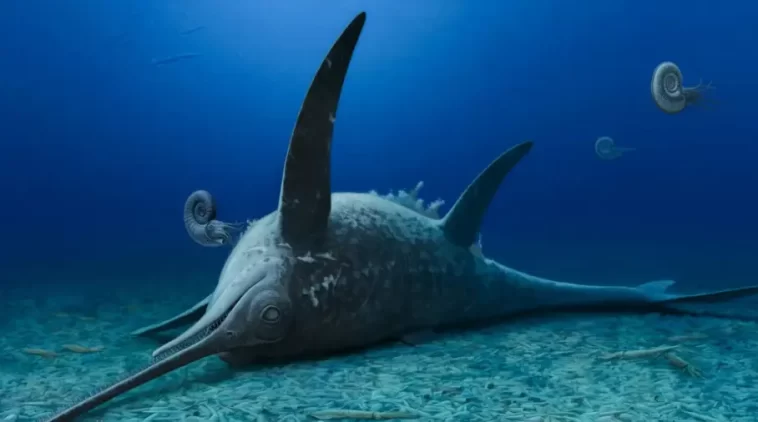
Sword Dragon ichthyosaur research is offering scientists a rare new perspective on life in Earth’s oceans nearly 190 million years ago. A remarkably preserved marine reptile fossil uncovered along England’s southern coast is helping paleontologists better understand a critical evolutionary turning point—one that reshaped ocean ecosystems during the Early Jurassic period.
Nicknamed the “Sword Dragon of Dorset,” the fossil represents a previously unknown genus of ichthyosaur, an extinct group of dolphin-shaped marine reptiles that once ruled the seas. The discovery sheds light on a poorly understood moment in prehistoric history, when older ichthyosaur families vanished and new ones emerged.
A Fossil That Waited Two Decades to Tell Its Story
Although the fossil was first discovered in 2001, it took more than twenty years of careful study before scientists fully understood its importance. Found near the cliffs of Golden Cap on England’s famous Jurassic Coast, the specimen was collected by local fossil enthusiast Chris Moore and later examined by an international research team.
The fossil has now been formally named Xiphodracon goldencapensis, making it the first new genus of Early Jurassic ichthyosaur described in over a century. Measuring approximately three meters (around ten feet) in length, the animal lived during a time when Earth’s marine life was undergoing dramatic change.
According to researchers, the skeleton is among the most complete ichthyosaur fossils ever recovered from this specific time interval.
Why the Sword Dragon Ichthyosaur Is So Important
Ichthyosaurs are well known from both earlier and later periods of the Jurassic, with thousands of fossils discovered worldwide. However, specimens from the Pliensbachian age—roughly 193 to 184 million years ago—are extremely rare.
This gap has long frustrated scientists, as fossil records before and after this period show completely different ichthyosaur species, suggesting a major evolutionary turnover.
The Sword Dragon ichthyosaur helps bridge that gap.
Researchers believe this species represents a transitional form, closely related to later Jurassic ichthyosaurs while still retaining some older features. Its existence suggests that the shift between ichthyosaur families happened earlier than previously believed.
A Distinctive Skull and Sword-Like Snout
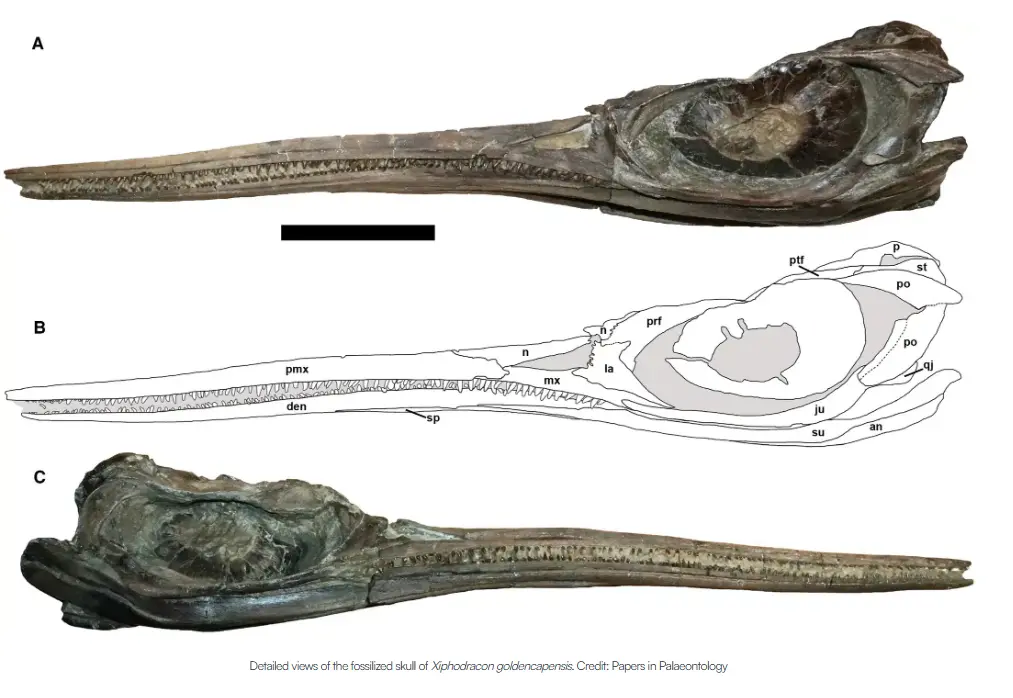
One of the most striking features of Xiphodracon goldencapensis is its skull. The fossil preserves:
- A massive eye socket, typical of deep-diving marine hunters
- An elongated, narrow snout resembling a blade or sword
- Sharp teeth adapted for catching fast-moving prey
This unusual skull shape inspired the creature’s name. “Xipho” comes from the Greek word for sword, while “dracon” refers to the long-standing nickname “sea dragons” used to describe ichthyosaurs.
Scientists believe the Sword Dragon likely fed on fish and squid, and there is even speculation that traces of its final meal may still be preserved within the fossilized remains.
Evidence of Injury, Disease, and Survival
Beyond its evolutionary significance, the skeleton also tells a more personal story—one of survival in a dangerous prehistoric ocean.
Detailed analysis revealed malformed limb bones and irregular teeth, suggesting the animal suffered from serious injury or disease while it was still alive. Even more striking, the skull appears to show bite marks consistent with an attack by a much larger predator, possibly another ichthyosaur.
Despite these injuries, the animal survived long enough for its bones to heal partially, offering rare insight into the physical challenges faced by marine reptiles during the Jurassic.
Such evidence helps scientists better understand not only how these animals evolved, but also how they lived, fought, and endured in ancient ecosystems.
The Jurassic Coast’s Ongoing Legacy
England’s Jurassic Coast is one of the world’s most important fossil sites, recognized for its nearly continuous geological record spanning 185 million years. Since the early 19th century, the region has played a central role in the development of paleontology.
The coastline famously yielded groundbreaking discoveries by Mary Anning, whose finds helped shape early scientific understanding of prehistoric life.
The Sword Dragon ichthyosaur continues this legacy, proving that even in well-studied locations, major discoveries still await.
Solving an Evolutionary Mystery
The findings were published in the peer-reviewed journal Papers in Palaeontology, where researchers explained how the new fossil helps clarify the timing of a major faunal shift among ichthyosaurs.
Before this discovery, scientists could see that ichthyosaur species before and after the Pliensbachian period were completely different—but they lacked fossils from the transition itself.
The Sword Dragon changes that.
By comparing its anatomy to both older and younger species, researchers now have a clearer timeline for when this evolutionary turnover occurred, even if the exact cause—such as climate change, ocean chemistry, or competition—remains unknown.
A Rare Addition to a Major Museum Collection
Following its scientific description, the fossil has been added to the collection of the Royal Ontario Museum, where it is expected to go on public display.
This will allow visitors to see firsthand a creature that not only swam in Jurassic seas but also helped scientists rewrite part of prehistoric history.
Museum officials say the specimen will play a key role in future research, education, and public engagement with Earth’s deep past.
What the Sword Dragon Ichthyosaur Teaches Us
The discovery of Xiphodracon goldencapensis highlights several important lessons:
- Major evolutionary events can remain hidden for millions of years due to gaps in the fossil record
- Even long-known fossil sites can still produce groundbreaking finds
- Individual fossils can reshape scientific timelines, not just add new species
Most importantly, the Sword Dragon ichthyosaur reminds us that prehistoric life was dynamic, fragile, and constantly changing—much like life on Earth today.
As researchers continue to study this extraordinary skeleton, it may yet reveal even more secrets about the ancient oceans it once ruled.
