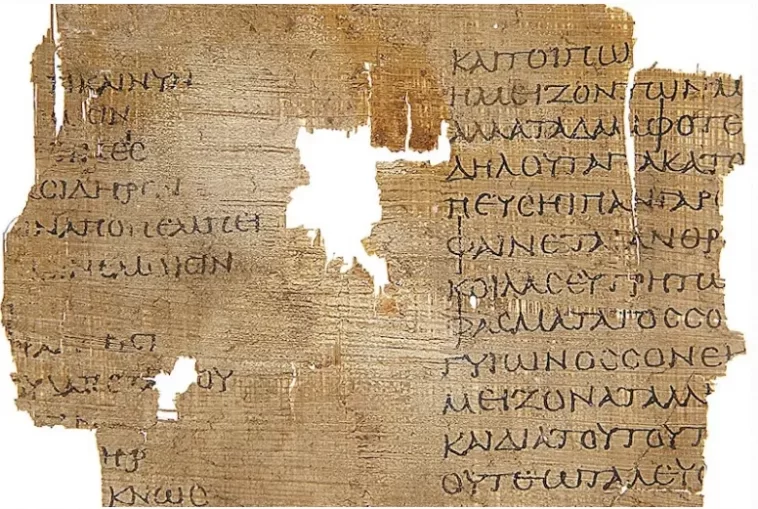
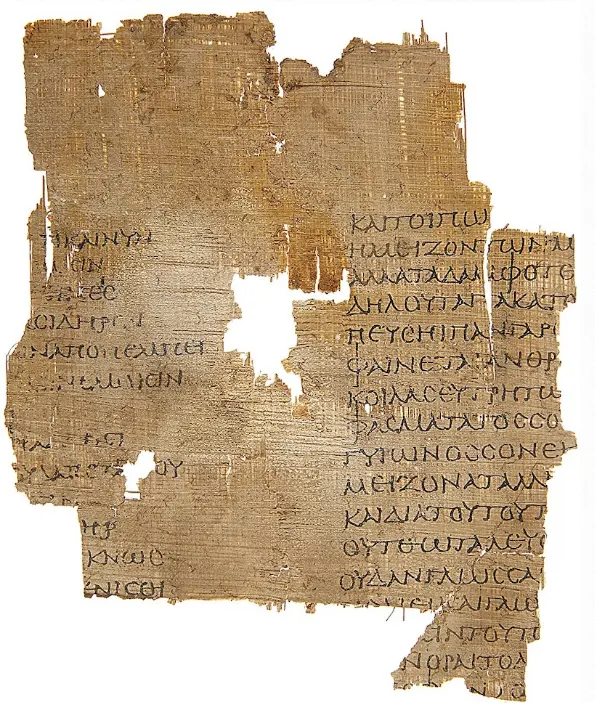
Empedocles papyrus discovery has brought to light a remarkable set of ancient texts that shed new light on early Greek philosophy. A 2,000-year-old papyrus fragment found in Cairo has revealed 30 previously unknown lines attributed to the pre-Socratic philosopher Empedocles, offering scholars a rare direct glimpse into his original work.
A Rare Archaeological Breakthrough
The discovery comes from archives of a French archaeological institute in Cairo, where researchers identified the fragment as part of Empedocles’ lost poetic work known as Physica. Until now, most knowledge about Empedocles came indirectly through quotations and references preserved by later philosophers such as Plato, Aristotle, and Plutarch.
This newly studied papyrus provides something far more valuable: direct access to the philosopher’s own words. Scholars emphasize that this is the only known surviving manuscript linked to this particular work, while additional fragments connected to the same text are preserved in other European collections.
Why This Discovery Matters
The significance of this find lies in its authenticity and rarity. Ancient philosophical texts often survive only in fragments, and in many cases, they are reconstructed through secondary sources. The Empedocles papyrus discovery changes that dynamic by offering original content that was not filtered through later interpretations.
Researchers can now compare these newly uncovered lines with known references and gain a clearer understanding of how Empedocles expressed his ideas in their original form. This allows historians to reassess earlier assumptions about his philosophy and its influence on later thinkers.
Insights into Early Scientific Thought
The recovered text touches on themes related to particle theory and sensory perception, particularly vision. These ideas suggest that Empedocles had developed concepts that would later influence scientific thinking in ancient Greece.
Interestingly, the analysis of the fragment revealed connections to several later philosophers and writers. Similar ideas appear in works by Plutarch, Plato, and Theophrastus, indicating that Empedocles’ thinking may have had a broader and more direct influence than previously believed.
In addition, traces of his ideas can also be found in the works of Roman poet Lucretius and Greek playwright Aristophanes, showing that his philosophical concepts extended beyond purely academic circles and into literature and culture.
Re-evaluating Empedocles’ Role in Philosophy
Empedocles is often recognized as one of the early thinkers who contributed to the development of natural philosophy. The newly discovered text strengthens the argument that he may have been a precursor to atomist philosophers such as Democritus.
The fragment suggests that Empedocles explored the nature of matter and perception in ways that align with early atomic theory. This positions him as an important transitional figure between mythological explanations of the world and more systematic scientific approaches.
A Window Into Lost Knowledge
Scholars compare the importance of this discovery to finding a partial original manuscript of a major literary figure whose work had been known only through summaries and quotations. Even a small fragment can significantly alter our understanding of historical ideas when it comes directly from the source.
The papyrus discovery represents not only a textual recovery but also a broader cultural and intellectual revival. It highlights how much of ancient knowledge remains hidden and how each new finding can reshape historical narratives.
The Ongoing Search for Ancient Texts
Papyrus research has long been a field dedicated to uncovering lost works of antiquity. Since the 19th century, researchers have been examining fragments preserved in various collections around the world. This discovery is part of that continuing effort to reconstruct the intellectual heritage of ancient civilizations.
Much like Renaissance scholars who searched European libraries for forgotten manuscripts, modern papyrologists continue to piece together scattered remnants of ancient literature. Each fragment adds another layer of understanding to the history of philosophy and science.
A New Perspective on Ancient Philosophy
The Empedocles papyrus discovery is being described by researchers as part of what could be considered a “second Renaissance” in the study of ancient texts. With each new fragment, scholars gain fresh opportunities to reinterpret philosophical traditions and better understand the evolution of ideas.
This particular find not only enriches knowledge about Empedocles himself but also helps place his work within the broader context of Greek intellectual history. It offers a clearer picture of how early philosophers influenced one another and how their ideas were transmitted across generations.
Conclusion
The discovery of previously unknown lines from Empedocles marks an important milestone in the study of ancient philosophy. By providing direct access to original material, the papyrus allows researchers to move beyond secondary interpretations and engage with the philosopher’s ideas in their most authentic form.
As further analysis continues, this fragment may reveal even more connections and insights into early scientific and philosophical thought. For now, it stands as a powerful reminder of how ancient texts, even in fragmentary form, continue to shape our understanding of the past.
