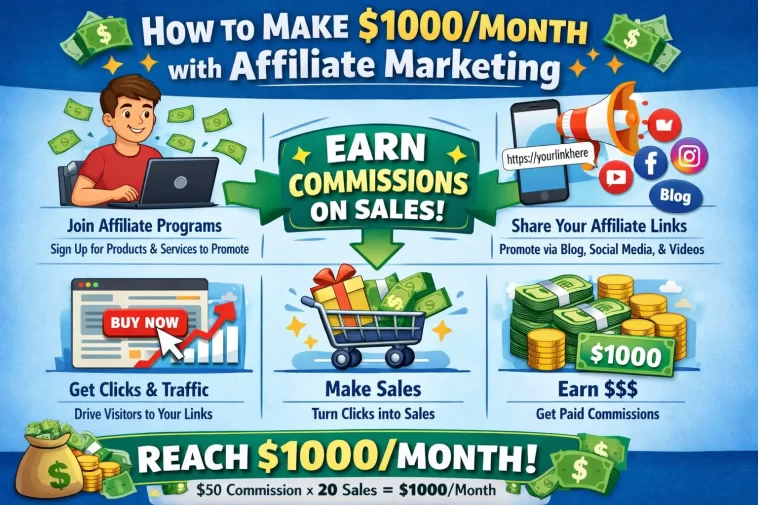
Making $1000 a month with affiliate marketing is not a fantasy. Thousands of people hit that number every month — some from a single website, others from a YouTube channel or email list.
How to make $1000/month with affiliate marketing comes down to three things: picking the right products, building an audience that trusts you, and creating content that actually converts. This guide walks you through exactly how to do it, step by step.
Is $1000/Month with Affiliate Marketing Realistic?
Yes — and it’s one of the more achievable income goals for beginners. You don’t need a massive audience. You don’t need to go viral. You just need the right niche, the right offers, and consistent effort over several months.
To put it in perspective:
- If you promote a product that pays a $50 commission, you need 20 sales per month
- If your commission is $100, you only need 10 sales
- If you’re in a high-ticket niche, even 3–5 sales can hit $1000
The math is very doable. The challenge is building the traffic and trust to make those sales happen regularly.
Step 1: Choose a Profitable Niche
Your niche determines everything — the products you promote, the audience you attract, and how much you can earn per sale.
The best affiliate niches share a few traits:
- People in the niche spend money regularly
- There are quality products to promote with decent commissions
- You can create consistent content around the topic
- There’s search volume but not impossible competition
Some of the strongest niches for affiliate marketing right now include:
- Personal finance (credit cards, budgeting tools, investing apps)
- Health and fitness (supplements, workout programs, gear)
- Software and SaaS (recurring commissions, high intent buyers)
- Home improvement (tools, smart home devices, services)
- Online education (courses, certifications, learning platforms)
Pick something you can write about for years, not just a few months.
Step 2: Find the Right Affiliate Programs
Not all affiliate programs are created equal. You want programs that offer fair commissions, reliable payouts, and products people actually want to buy.
Where to Find Affiliate Programs
- Amazon Associates — low commissions (1–5%) but massive product selection and high conversion rates
- ShareASale — hundreds of merchants across every niche
- CJ Affiliate — larger brands and higher-ticket offers
- Impact — popular with software and SaaS companies
- Direct programs — many companies run their own affiliate programs; search “[product name] affiliate program”
What to Look For in a Program
- Commission rate of at least 20–30% for digital products
- Cookie duration of 30 days or more
- Reliable payment schedule
- Good conversion rate (ask or check reviews from other affiliates)
- Products with strong reviews and reputation
For SaaS and software products, recurring commissions are a game-changer. If a customer keeps paying monthly, you keep earning monthly.
Step 3: Build a Platform
You need somewhere to send people. The three most common platforms for affiliate marketing are:
A Blog or Website
A blog is still one of the best long-term assets for affiliate marketing. It compounds over time — articles you write today can rank on Google and earn commissions for years.
You don’t need a fancy setup. A simple WordPress site with a clean theme is enough to start.
YouTube Channel
Video content is extremely powerful for product reviews and tutorials. People who watch a 10-minute review before buying are much more likely to click your affiliate link than someone who skimmed a short article.
YouTube also drives traffic for free, and videos can rank in Google search results too.
Email List
An email list is the most valuable asset you can build as an affiliate marketer. Your subscribers have already said they trust you enough to give you their email address. That makes them far more likely to buy on your recommendation.
Even a small, engaged list of 1,000–2,000 subscribers can generate $1000/month consistently.
Step 4: Create Content That Converts
Content is the engine of affiliate marketing. But not just any content — you need content that matches what your audience is searching for and guides them toward a buying decision.
The Best Types of Affiliate Content
Product reviews — In-depth, honest reviews of individual products. These convert extremely well because readers are already in research mode.
Comparison posts — “Tool A vs Tool B” content works great because it captures people who are almost ready to buy but haven’t decided yet.
Best-of lists — “Best project management tools for freelancers” or “Top 5 VPNs in 2026.” These rank well and let you include multiple affiliate links naturally.
How-to tutorials — Teaching someone how to do something while recommending the right tools to do it. Very natural and non-pushy.
Resource pages — A curated list of everything you use and recommend. These can become passive earners once you have traffic.
Writing Tips for Higher Conversions
- Be honest — including negatives builds trust
- Use your own experience when possible
- Add clear calls to action near your links
- Include comparison tables for product roundups
- Place affiliate links near the top and bottom of long posts
Step 5: Drive Targeted Traffic
Great content means nothing without traffic. Here are the main ways to build it:
SEO (Search Engine Optimization)
This is the most sustainable traffic source. Target keywords with buying intent — terms like “best,” “review,” “vs,” and “top” signal that someone is close to making a purchase.
Focus on:
- Long-tail keywords with lower competition
- Consistent publishing schedule (aim for 2–4 posts per week early on)
- Building backlinks through guest posts or digital PR
- On-page optimization using a tool like Rank Math
Pinterest works especially well for niches like home decor, food, fashion, finance, and personal development. It drives traffic fast compared to Google SEO and can send thousands of visitors to a new site within weeks.
YouTube SEO
As mentioned earlier, YouTube is a powerful channel for affiliate marketing. Optimize your video titles, descriptions, and tags for search terms your audience uses.
Social Media
Use Instagram, TikTok, or Twitter/X to build an audience and funnel them to your main platform. Don’t try to do everything — pick one social channel and do it well.
Step 6: Track What’s Working
Once you have content and traffic, you need to know what’s actually generating commissions.
Use these tools:
- Google Analytics — track traffic sources, bounce rate, and top-performing pages
- Affiliate dashboard — most programs show clicks, conversions, and earnings
- Heatmaps (like Hotjar) — see where visitors are clicking on your pages
- Link cloaking tool (like Pretty Links) — clean up your affiliate URLs and track clicks
When you find a post or product that’s converting well, double down. Write more content around that topic. Add internal links pointing to it. Update it regularly to keep it ranking.
Realistic Timeline to $1000/Month
Here’s what a typical journey looks like for a blogger using SEO:
| Month | Milestone |
|---|---|
| 1–2 | Set up site, publish 10–15 posts, join programs |
| 3–4 | Traffic starts growing, first few commissions |
| 5–6 | 50+ articles, consistent traffic, $200–$400/month |
| 7–9 | Authority builds, $500–$800/month |
| 10–12 | $1000+/month becomes consistent |
This timeline can be shorter if you already have an audience, or longer if you publish less frequently. The key is not giving up during the early months when results are slow.
Common Mistakes to Avoid
A lot of people try affiliate marketing and quit before seeing results. Here are the mistakes that slow people down the most:
- Promoting too many products at once — Focus on a few high-quality offers and promote them well
- Ignoring SEO — Without search traffic, you’re always dependent on paid ads or social algorithms
- Not disclosing affiliate links — It’s legally required in most countries and actually builds trust with readers
- Choosing products by commission alone — If the product is bad, your audience will lose trust in you
- Giving up too early — Most affiliate sites take 6–9 months before gaining real momentum
FAQ
How long does it take to make $1000/month with affiliate marketing? For most beginners starting a blog from scratch, it takes 6–12 months of consistent work. Those with existing audiences or who use paid traffic can reach this milestone faster.
Do I need a website to do affiliate marketing? No. You can do affiliate marketing through YouTube, social media, email newsletters, or even podcasts. However, a website gives you the most control and long-term stability.
Which affiliate program pays the most? High-ticket programs in finance, software, and insurance tend to pay the most per sale. Some SaaS affiliate programs pay recurring commissions of 20–40% every month.
Can I do affiliate marketing without showing my face? Absolutely. Many successful affiliate marketers run anonymous blogs or YouTube channels with voiceover videos. You don’t need to be personally visible to build trust.
How much traffic do I need to make $1000/month? It depends on your niche and commission rates. In a high-CPC niche with good products, 5,000–10,000 monthly visitors is often enough. In lower-paying niches, you may need 30,000–50,000.
Is affiliate marketing still worth starting in 2026? Yes. Affiliate marketing continues to grow as more commerce moves online. The competition is higher than it was in 2015, but so are the available tools, programs, and platforms to help you succeed.
Final Thoughts
Reaching $1000/month with affiliate marketing is absolutely within reach for anyone willing to put in consistent work. You don’t need to be an expert on day one — you just need to pick a niche, start creating content, and keep going when results are slow.
Focus on helping your audience make good decisions. When people trust your recommendations, the commissions take care of themselves.
Start today, stay consistent, and $1000/month is just the beginning.
