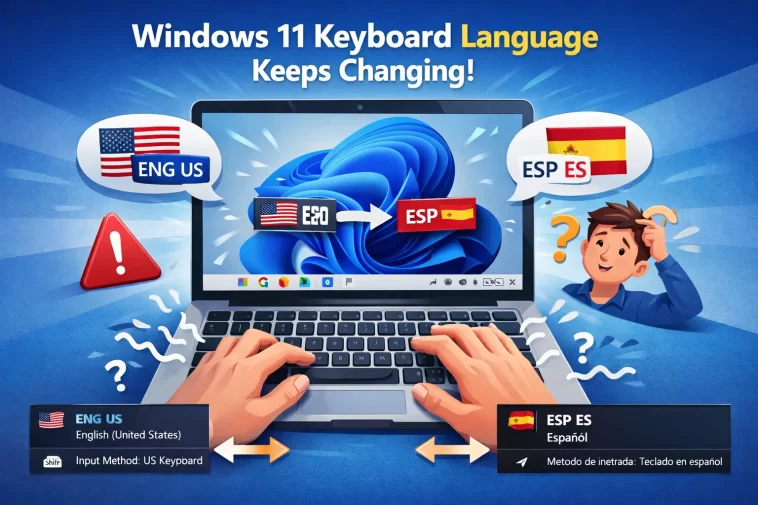
You’re typing along and suddenly your keyboard switches to a different language on its own. Letters come out wrong, punctuation lands in the wrong place, and you have to stop everything to switch it back. Then it happens again five minutes later.
If your Windows 11 keyboard language keeps changing, you’re not alone. This is one of the most complained-about issues in Windows 11, and it has several possible causes. The good news is that it’s fixable — and this guide covers every solution, from the quickest one-minute fix to the deeper settings that stop it from coming back.
Why Does the Keyboard Language Keep Changing in Windows 11?
Before jumping into fixes, it helps to understand why this happens. There are a few common culprits:
- Accidental hotkey press — Windows has a built-in shortcut to switch input languages. Many people trigger it without realizing it.
- Multiple keyboard layouts installed — If you have more than one language or layout added, Windows can switch between them automatically in some situations.
- App-specific language settings — Some apps remember their own input language and switch to it when you click inside them.
- Windows syncing language settings — If you’re signed in with a Microsoft account, Windows can sync language preferences across devices and override your local settings.
- A Windows Update — Some updates reset or shuffle language preferences.
Identifying which one is causing your problem makes it much easier to fix.
Fix 1: Disable the Keyboard Layout Switching Hotkey
This is the most common cause. Windows 11 has a default shortcut — either Left Alt + Shift or Windows key + Spacebar — that switches between installed input languages. It’s very easy to press accidentally, especially during fast typing.
How to Turn It Off
- Open Settings → Time & Language → Language & Region
- Scroll down and click Keyboard
- Click Input language hot keys
- In the window that opens, select Between input languages
- Click Change Key Sequence
- Set both options to Not Assigned
- Click OK and Apply
After this, pressing Left Alt + Shift or other combinations will no longer trigger a language switch. This single fix resolves the problem for a large number of users.
Fix 2: Remove Extra Keyboard Layouts
If you have multiple keyboard layouts installed for the same language, or have languages added that you don’t use, Windows may cycle through them unexpectedly.
How to Remove Unused Keyboards
- Go to Settings → Time & Language → Language & Region
- Click the three dots next to your primary language
- Select Language options
- Under Keyboards, look at what’s listed
- If there are layouts you don’t use, click the three dots next to each one and select Remove
Keep only the keyboard layout you actually use. For most people, that’s just one.
Also Remove Unused Languages
While you’re there, go back to the Language & Region page and check your Preferred languages list. If there are languages listed that you don’t need, remove them:
- Click the three dots next to the unwanted language
- Select Remove
Fewer installed languages means fewer chances for Windows to switch between them.
Fix 3: Set a Default Input Method and Lock It
Windows 11 lets you set a specific input method as the default, which helps prevent random switching.
- Go to Settings → Time & Language → Language & Region
- Scroll to the bottom and look for Keyboard or click through to keyboard settings
- Click Advanced keyboard settings
- Under Override for default input method, select your preferred keyboard layout from the dropdown
- Also check the option “Use the desktop language bar when it’s available” — this gives you more direct control
This tells Windows to always default back to your chosen layout rather than remembering the last used language per app.
Fix 4: Turn Off Per-App Language Settings
Windows 11 introduced a feature that lets each app remember its own input language. This means when you switch to a different app, the language can change automatically to whatever that app last used.
Many users don’t realize this feature exists — and it causes a lot of confusion.
How to Disable It
- Go to Settings → Time & Language → Language & Region
- Click Advanced keyboard settings
- Look for the option “Let me use a different input method for each app window”
- Make sure this option is unchecked (disabled)
When this is turned off, Windows uses the same input language across all apps consistently.
Fix 5: Stop Microsoft Account from Syncing Language Settings
If you’re signed in with a Microsoft account and use Windows on multiple devices, your language settings might be getting synced and overwritten from another device.
How to Turn Off Language Sync
- Go to Settings → Accounts → Windows Backup
- Look for Remember my preferences
- Expand it and find the option related to language preferences or other Windows settings
- Toggle it off, or uncheck language-related sync options
This stops other devices from pushing their language settings onto your current PC.
Fix 6: Check and Fix the Default Language in Control Panel
Some deeper language settings are still controlled through the old Control Panel rather than the new Settings app. If the newer Settings changes aren’t sticking, this is worth checking.
- Press Windows + R, type
controland press Enter - Go to Clock and Region → Region
- Click the Administrative tab
- Click Copy settings
- Make sure your current language is shown correctly
- Check both boxes at the bottom:
- Welcome screen and system accounts
- New user accounts
- Click OK
This applies your language preference to the system level, not just your user account. It can fix situations where the language resets after restarting or when the lock screen appears.
Fix 7: Edit the Registry to Prevent Language Switching (Advanced)
If none of the above fixes work, you can disable language switching at the registry level. This is a more permanent solution but requires a little care.
Before editing the registry, create a backup:
- Press Windows + R, type
regedit, press Enter - Click File → Export and save a backup somewhere safe
Registry Fix
- Open Registry Editor (regedit)
- Navigate to:
HKEY_CURRENT_USER\Keyboard Layout\Toggle- You’ll see values like Language Hotkey, Layout Hotkey, and Hotkey
- Double-click each one and set the value to 3 (which means “disabled”)
- Close Registry Editor and restart your PC
Setting these values to 3 disables the toggle hotkeys at the system level, which is more reliable than the Settings UI in some cases.
Fix 8: Run Windows Update and Check for Driver Updates
Some language-switching bugs have been caused by specific Windows 11 builds and later fixed in updates. If you’ve been delaying updates, it’s worth installing them.
- Go to Settings → Windows Update
- Click Check for updates
- Install any available updates and restart
Also check for keyboard driver updates:
- Right-click the Start button → Device Manager
- Expand Keyboards
- Right-click your keyboard device → Update driver
- Select Search automatically for drivers
Fix 9: Create a New User Account
In some cases, the language settings for a specific user profile become corrupted. Creating a new account and migrating to it can permanently solve the problem.
- Go to Settings → Accounts → Other users
- Click Add account
- Set it up as a local account if you don’t want Microsoft account sync
- Log into the new account and configure language settings fresh
- Test whether the switching issue persists
If the new account works correctly, the problem was tied to your old profile rather than Windows itself.
Quick Summary: Which Fix to Try First
If you’re not sure where to start, follow this order:
- Disable the hotkey (Fix 1) — solves it for most people
- Remove extra layouts (Fix 2) — quick and easy, often overlooked
- Disable per-app language switching (Fix 4) — very commonly the hidden cause
- Turn off Microsoft account sync (Fix 5) — important if you use multiple devices
- Control Panel language settings (Fix 6) — for issues that survive restarts
- Registry edit (Fix 7) — if everything else fails
FAQ
Why does my keyboard language keep switching to a different language in Windows 11? The most common reason is an accidental hotkey press — Left Alt + Shift switches input language by default in Windows 11. Multiple installed keyboards and the per-app language feature are also frequent causes.
How do I stop Windows 11 from automatically changing my keyboard layout? Go to Settings → Time & Language → Language & Region → Keyboard → Input language hot keys. Set the switching shortcut to “Not Assigned.” Also disable the “Let me use a different input method for each app window” option.
Why does my keyboard language reset after every restart? This usually means your language settings aren’t applied at the system level. Open Control Panel → Region → Administrative tab → Copy settings, and apply your preferences to the welcome screen and new user accounts.
Does Windows 11 sync language settings across devices? Yes, if you’re signed in with a Microsoft account. Go to Settings → Accounts → Windows Backup and disable language preference syncing to stop this.
Can a Windows Update change my keyboard language settings? Yes, some updates have been known to reset language preferences. After any major update, it’s worth checking your language settings and re-applying them if needed.
How do I permanently set one keyboard language in Windows 11? Remove all extra keyboard layouts, disable the switching hotkey, turn off per-app language settings, and apply your preference through the Control Panel Administrative settings. Together these steps lock in your preferred language reliably.
