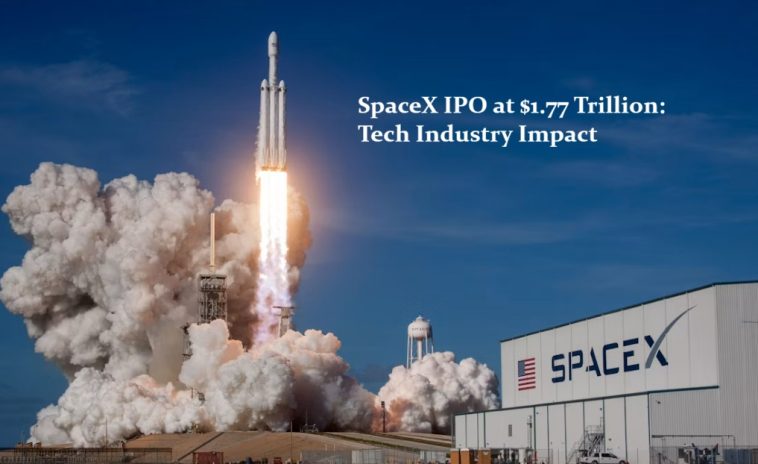
I remember sitting in front of my monitor, watching a live stream of the early Falcon 1 launch attempts, wondering if a private company could ever truly compete with government aerospace giants. Fast forward to today, and that same company has completely shattered Wall Street records with an initial public offering that felt unimaginable back then. The historic SpaceX IPO at $1.77 Trillion has officially arrived, rewriting the playbook for tech valuations, capital raises, and global market dynamics.
When the offering priced at $135 per share to raise a record-breaking $75 billion, the entire financial and technological landscape shifted on its axis. Witnessing this massive transition from a private entity into a public mega-cap made me realize we are entering a brand new era of innovation. The scale of this debut does not just impact aerospace; it sets off a massive ripple effect across the entire tech ecosystem.
If you are trying to understand how this monumental valuation affects the broader technology industry, you need to look beyond the rockets. The capital flowing into this listing will fundamentally reshape artificial intelligence, cloud infrastructure, global connectivity, and deep-tech venture funding. Let us break down exactly what this means for the tech sector and how you can navigate the shifts ahead.
1. Establishing a New Valuation Benchmark for Deep Tech
When SpaceX priced its offering to hit a $1.77 trillion valuation, it forced a massive re-evaluation of how the market values “deep tech” companies. For years, software-as-a-service (SaaS) and digital platforms commanded the highest revenue multiples because they lacked heavy physical infrastructure.
Now, Wall Street is proving it will pay an absolute premium for massive, capital-intensive hardware moats if they are paired with scaling digital networks.
Shifting the Multiples for Hardware
Historically, traditional aerospace and hardware manufacturing companies traded at modest valuation multiples relative to their sales.
SpaceX entered the public market trading at roughly 94 times its 2025 revenue of $18.7 billion. While the company posted a net loss of $4.9 billion for 2025, public investors looked right past the short-term bottom line to focus on the long-term infrastructure dominance.
If you are building or investing in hardware-centric tech sectors, this public appetite is incredibly encouraging. It signals that long-term, capital-heavy infrastructure projects can achieve software-like premiums if they display structural monopolies.
Paving the Way for Trillion-Dollar Tech Debuts
This massive valuation acts as a critical proof of concept for other late-stage technology giants waiting in the wings. The successful absorption of a $75 billion capital raise injects incredible confidence into a public market that had grown highly cautious about speculative tech.
The warm reception clears a path for other highly anticipated tech listings slated for later this year. Companies pioneering foundational AI architectures, robotics, and advanced logistics are watching this debut closely to time their own public market entries.
2. Accelerating the Confluence of AI and Space Infrastructure
To understand the true core of this valuation, you have to look at how the company integrated its satellite network with artificial intelligence. A massive portion of the $1.77 trillion valuation relies on a thesis that the next major frontier for AI compute will not be built entirely on Earth.
+------------------------------------+
|  Terrestrial Data Center Limits    |
|  - Extreme Power Grid Strain       |
|  - High Cooling Infrastructure Costs|
|  - Regional Regulatory Hurdles     |
+-----------------+------------------+
                  |
                  v  [Solution]
+------------------------------------+
|     Orbital AI Compute Clusters    |
|  - Solar-Powered Satellites        |
|  - Passive Deep-Space Cooling      |
|  - Borderless Data Processing      |
+------------------------------------+
The Concept of Orbital Data Centers
Building massive AI data centers on land is running into a severe bottleneck: energy availability. Terrestrial power grids are struggling to keep up with the electricity demands of cutting-edge AI training and inference models.
By leveraging its upgraded satellite constellations, the company plans to build massive, solar-powered orbital data centers. If you process data directly in orbit, you bypass the energy constraints of regional power grids entirely.
Furthermore, the natural environment of space provides passive cooling advantages that drastically reduce the operational overhead seen in terrestrial server farms.
Financial Implications for the AI Market
Lead underwriters are already projecting that this convergence could trigger a massive surge in orbital AI revenue over the next decade. If you look at the underlying financial models, analysts predict that space-based AI computing could capture a significant slice of the global enterprise cloud market.
This model changes the definition of a satellite network from a simple internet service provider into a global, decentralized cloud computing platform running specialized AI hardware.
3. Rewriting the Rules of Global Connectivity and Edge Computing
The expansion of space-based broadband alters how global tech firms deploy edge computing architecture. With millions of active subscribers spread across more than 160 countries, the Starlink constellation is no longer just a rural internet alternative.
True Direct-to-Cell Broadband
The recent integration of expanded spectrum licenses allows the constellation to transition from basic emergency messaging to full direct-to-cell broadband on unmodified smartphones. If you are an app developer or enterprise software architect, this eliminates traditional dead zones completely.
- Universal Access: Software services can now target billions of users in completely remote regions without relying on local telecom towers.
- Continuous Synchronization: IoT devices, autonomous vehicles, and remote industrial sensors can maintain persistent, high-bandwidth cloud connections anywhere on Earth.
- Reduced Dependency on Local Telecoms: Global tech platforms can deliver services directly via satellite, shifting power away from regional cellular monopolies.
Redefining the Edge Computing Layer
If you operate cloud networks, the edge of your network is no longer a localized CDN server in a metropolitan data center. The edge is now moving directly into orbit.
Processing data closer to where it is collected—whether from maritime shipping lanes, commercial aviation, or remote agricultural sensors—drastically cuts down latency. It creates an infrastructure layer where data is captured, analyzed via orbital AI, and beamed back to the user in fractions of a second.
4. Disrupting Tech Capital Allocations and Index Fund Dynamics
The sheer size of this public debut forces an automatic restructuring of how institutional capital moves through the tech industry. It directly alters passive investment vehicles and changes the risk tolerance of venture capital firms.
| Metric | Detail | Impact on Tech Sector |
| IPO Offering Price | $135 per share | Establishes the premium entry point for deep-tech public assets. |
| Total Capital Raised | $75 Billion | Draws massive institutional liquidity into aerospace and infrastructure. |
| Retail Allocation | 20% to 25% | Empowers individual investors, creating a highly liquid retail base. |
| Fast-Entry Window | 15 Trading Days | Forces rapid capital reallocation from standard index-tracking funds. |
The Impact of Index Fast-Tracking
Because Nasdaq implemented specialized “fast-track” rules for this listing, the company is eligible to enter the Nasdaq-100 index after just 15 days of trading. If you hold shares in popular index-tracking funds like the Invesco QQQ Trust, your portfolio will automatically adjust to buy a piece of this space giant.
To make room for a company debuting at $1.77 trillion, passive index funds must rebalance by selling off fractional percentages of existing tech holdings. This mechanical reallocation shifts billions of dollars away from traditional enterprise software and social media stocks into the aerospace and deep-tech sector.
Re-Calibrating Late-Stage Venture Capital
For years, late-stage venture capital firms struggled to find viable exit paths for massive, deep-tech startups. The public markets frequently demanded immediate profitability, forcing capital into safer, short-term software plays.
This record-breaking public debut proves that public markets are hungry to fund long-term tech roadmaps, even those carrying billions in upfront research and development costs. You can expect private venture capital to pivot heavily toward ambitious engineering projects, knowing that a massive public exit is achievable.
5. How You Can Adapt to the Transformed Tech Landscape
If you want to position your business or career to ride this massive wave of infrastructure development, you cannot afford to treat this as just an aerospace news story. You must actively look for the structural integration points it creates.
Step 1: Audit Your Architecture for Global Satellite Fallbacks
Do not let your enterprise platforms depend entirely on localized terrestrial infrastructure. You should start designing applications to leverage direct-to-cell capabilities and ubiquitous satellite coverage.
- Review your application’s offline data sync models and replace them with low-bandwidth, direct-to-satellite protocols.
- Ensure your connected devices can seamlessly switch between traditional cellular networks and orbital broadband without service interruption.
- Optimize your mobile assets to handle data processing tasks that leverage high-altitude or orbital edge connections.
Step 2: Prepare for the Transition to Orbital Cloud Services
As orbital data centers come online, the cost structures and capabilities of cloud computing will undergo a radical shift. You need to keep an eye on how your cloud providers integrate space-based compute units into their stacks.
- Begin evaluating which workloads—such as massive geospatial analysis, climate modeling, or global financial modeling—are best suited for orbital compute clusters.
- Factor space-based data processing regulations into your compliance and data sovereignty strategies, as international borders blur when data is stored in orbit.
- Keep track of early developer access programs for orbital API endpoints to ensure your engineering team builds familiarity with space-based infrastructure early.
Step 3: Align Your Investment and Development Priorities with Deep Tech
The massive flow of capital into public markets means that traditional tech niches will face fiercer competition for investor dollars. You must align your technical skills or business models with areas that command these massive infrastructure premiums.
- Shift focus away from repetitive consumer software clones and dedicate resources to solving complex, physical-world engineering problems.
- Build expertise in specialized fields like computer vision for satellite telemetry, autonomous robotics coordination, and high-frequency orbital communications.
- Focus your development pipelines on creating software tools that optimize or secure the massive supply chains required by aerospace and advanced hardware industries.
Final Thoughts on a Historic Milestone
The SpaceX IPO at $1.77 Trillion marks a clear dividing line in the history of the technology sector. It completely destroys the notion that private capital cannot fund world-changing infrastructure, and it proves that public markets have an immense appetite for long-term, visionary engineering.
By merging global launch monopolies, massive satellite internet operations, and cutting-edge orbital AI compute projects, a whole new model for tech dominance has been built. If you are an engineer, entrepreneur, or investor, the rules of the game have evolved. The infrastructure is moving to the stars, and the best time to start adapting your strategy to this new reality is right now.
Frequently Asked Questions
Why did SpaceX choose to IPO at a $1.77 trillion valuation despite running a net loss?
The $1.77 trillion valuation reflects the company’s near-monopoly on commercial space launches and the rapid growth of its Starlink network. Public investors are paying a premium for its massive physical infrastructure moat, its direct-to-cell capabilities, and its long-term plans to deploy high-margin orbital AI data centers. Wall Street is prioritizing long-term market dominance and revenue growth over short-term profitability metrics.
How does the fast-track inclusion into the Nasdaq-100 affect other technology stocks?
Because the company is being fast-tracked into major indices like the Nasdaq-100 within 15 trading days, passive index funds are legally required to purchase billions of dollars of its stock. To fund these massive purchases, these index-tracking funds must sell off fractional portions of their existing holdings. This mechanical rebalancing temporarily drains liquidity from traditional software and internet stocks to accommodate the new mega-cap arrival.
What are orbital data centers, and how do they benefit the artificial intelligence industry?
Orbital data centers are satellite clusters equipped with advanced AI hardware that process data directly in space. They solve the terrestrial power grid crisis by sourcing energy directly from massive solar arrays in orbit. Additionally, the cold vacuum of space provides free, natural cooling for intense computing operations, drastically reducing the environmental and financial overhead associated with traditional, land-based data centers.
Will the SpaceX IPO change how venture capital funds early-stage tech startups?
Yes, this successful debut will likely cause late-stage venture capital to pivot back toward deep tech, robotics, and complex hardware engineering. For years, VCs favored low-overhead software applications because they offered faster exit strategies. This record-breaking IPO proves that public markets are willing to handsomely reward capital-intensive, multi-year infrastructure plays, which opens up massive exit opportunities for ambitious deep-tech founders.
