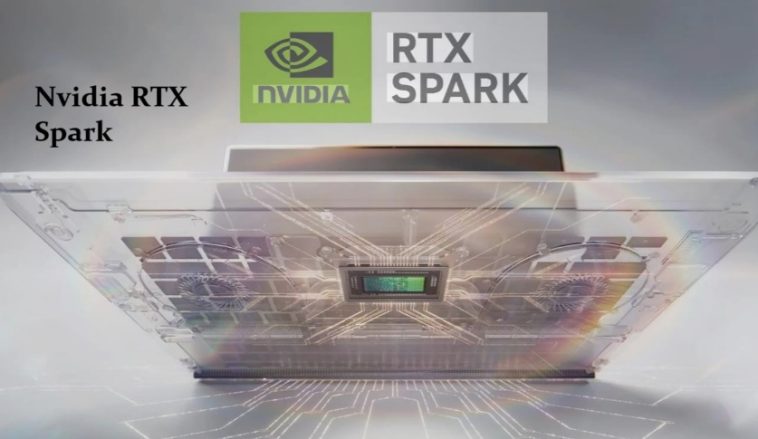
Nvidia RTX Spark is the most talked-about chip announcement of 2026 — and for good reason. Unveiled at Computex 2026 by CEO Jensen Huang, it’s Nvidia’s boldest move yet into the laptop processor market, bringing the same AI muscle that powers data centers into the thinnest Windows laptops ever made.
If you’ve been watching Apple dominate the premium laptop space with its M-series chips, Nvidia just showed up to that fight with serious hardware.
What Exactly Is the Nvidia RTX Spark?
The RTX Spark is a superchip — a single package combining a powerful ARM-based CPU and a next-generation Blackwell RTX GPU, connected by Nvidia’s own high-speed interconnect. Nvidia describes it as bringing together 30 years of company innovation into one chip designed for Windows PCs.
Think of it as Nvidia’s answer to Apple Silicon. Apple fused its CPU, GPU, and Neural Engine into one chip years ago and completely transformed the Mac lineup. Now Nvidia is doing something similar for Windows, and Microsoft is fully on board.
The RTX Spark chip is built on the same Grace Blackwell architecture that powers Nvidia’s DGX Spark — the portable AI supercomputer released earlier in 2025. The difference is that the RTX Spark is tuned for slim laptops and compact desktop PCs running Windows.
Key Specs: What’s Inside RTX Spark?
Here’s what the RTX Spark superchip brings to the table:
- CPU: 20-core ARM-based Nvidia Grace processor, co-designed with MediaTek using Arm Cortex-X925 cores, boosting up to 5.2 GHz
- GPU: Nvidia Blackwell RTX GPU with 6,144 CUDA cores, fifth-generation Tensor Cores with FP4 precision
- AI Performance: Up to 1 petaflop of AI compute
- Memory: Up to 128GB of unified LPDDR5X memory shared between CPU and GPU
- Memory Bandwidth: Up to 300 GB/s
- Interconnect: Nvidia NVLink-C2C chip-to-chip interconnect delivering 600 GB/s bidirectional bandwidth between CPU and GPU
- NPU: Dedicated Neural Processing Unit included
- Platform: Windows on ARM, in full partnership with Microsoft
The 1 petaflop of AI compute means the chip can theoretically run AI models with up to 120 billion parameters entirely on-device — without sending anything to the cloud. For developers and AI researchers, that’s a significant milestone for a laptop chip.
Why Does It Matter? The “Superchip” Concept Explained
For most of the PC industry’s history, CPUs and GPUs were separate chips from different companies. Intel or AMD made the processor; Nvidia or AMD made the graphics card. They communicated over a relatively slow connection.
Apple changed the game in 2020 by putting everything on one piece of silicon — the CPU, GPU, memory, and AI accelerator all sharing the same pool of unified memory with extremely high bandwidth between them. The result was a dramatic leap in performance-per-watt that left the Windows PC world scrambling.
Nvidia’s RTX Spark takes the same fundamental approach. By fusing its Grace CPU and Blackwell GPU through the NVLink-C2C interconnect, it achieves 600 GB/s of bidirectional bandwidth between the two. That’s roughly double the interconnect speed of Apple’s M4 Max UltraFusion architecture.
The GPU can directly access CPU data without copying it across a slow bus, slashing the latency and bottlenecks that hurt performance in traditional laptop designs. For AI workloads especially, this kind of unified memory architecture makes a massive difference.
RTX Spark vs Apple M-Series: How Do They Compare?
This is the comparison everyone is making — and it’s genuinely complicated.
Where RTX Spark Has an Edge
The RTX Spark’s GPU is where it clearly shines. With 6,144 CUDA cores and the full Blackwell architecture, it brings capabilities that Apple’s integrated GPU simply cannot match:
- Gaming: DLSS, ray tracing, G-SYNC, and Reflex are all fully supported on RTX Spark. Apple Silicon still struggles with game availability due to its separate ecosystem. Gamers will prefer the RTX Spark.
- AI Development: CUDA is the standard software platform for AI research and model training. It runs natively on RTX Spark, which is a significant advantage for developers working with PyTorch, TensorFlow, and similar tools.
- Creative Workflows: Early benchmarks from Computex suggest double-digit performance gains in creative apps like Adobe Photoshop and Premiere compared to previous Windows laptops. Nvidia worked closely with Adobe to optimize performance on the platform.
- Unified Memory Capacity: With up to 128GB of unified memory, RTX Spark can handle enormous models and workloads that would otherwise require cloud resources.
Where Apple Still Leads
It’s not all one-sided. Some analysts and independent testers have noted that on single-threaded CPU performance, the RTX Spark’s Grace CPU is currently competitive with Apple’s M3-era chips — meaning Apple has already moved ahead with M4 and M5, which shipped since then. One analysis placed the RTX Spark roughly 22% behind the base M4 in single-thread performance.
Apple also has advantages in:
- Software optimization: macOS and Apple’s entire toolchain is deeply integrated with its silicon, producing exceptional efficiency.
- Supply chain: Apple locks in memory pricing years in advance. RTX Spark OEMs are exposed to market memory pricing fluctuations, which affects final laptop costs.
- Process node: Apple’s M5 chips are built on TSMC’s advanced process, and M6 is expected to debut on TSMC’s newest N2 node — which could widen the gap if the RTX Spark doesn’t keep pace on future generations.
The honest takeaway is that RTX Spark is a stronger AI and GPU-focused machine, while Apple Silicon leads in CPU efficiency and software integration. Neither chip is universally better — it comes down to your workflow.
Which Laptops Will Use RTX Spark?
Nvidia announced a wide ecosystem of OEM partners at Computex 2026. Laptops and desktops using RTX Spark are coming from:
- Microsoft — Surface Laptop Ultra (15-inch, mini-LED PixelSense Ultra display, 2,000 nits peak brightness) and the Surface RTX Spark Dev Box
- Asus — ProArt P16 and P14, creator-focused laptops with OLED displays
- Dell — XPS 16 Creator Edition with a tandem OLED screen
- Lenovo — Announced RTX Spark models (details to follow)
- HP — Announced RTX Spark models
- MSI — Announced RTX Spark models
- Acer and Gigabyte — Expected to follow after the initial wave
In total, Nvidia says approximately 30 laptops and more than 10 desktop PCs will be built around the RTX Spark platform. That’s a proper product ecosystem, not a one-off experiment.
Desktop RTX Spark systems are targeted for Q3 2026, with laptops arriving in fall 2026.
What Will RTX Spark Laptops Cost?
Pricing hasn’t been officially confirmed, but reports from Morgan Stanley and industry sources suggest:
- Entry-level RTX Spark (N1 chip) laptops: Starting around $1,799
- High-end RTX Spark (N1x chip) laptops: Starting around $2,899
- Microsoft Surface Laptop Ultra: Estimated between $3,000 and $7,000 depending on configuration
That puts these machines squarely in MacBook Pro territory — the 16-inch MacBook Pro M5 Max currently starts at $3,499. Both Microsoft and Nvidia have said final pricing will be announced closer to the fall launch, partly because global memory prices are still fluctuating.
The AI Angle: Agentic Computing
Nvidia and Microsoft are framing RTX Spark not just as a faster laptop chip, but as the foundation for a new kind of computing they’re calling “agentic AI.”
The idea is that instead of you clicking through menus and typing commands, AI agents running locally on your device will do the heavy lifting. You give a goal; the agent plans, executes, evaluates, and refines — using local AI models rather than always calling out to the cloud.
The RTX Spark is designed specifically to run these kinds of agents efficiently and securely. Microsoft is building new security primitives into Windows to support this, and Nvidia’s OpenShell platform provides the infrastructure for local agents to work without sending sensitive data to external servers.
Whether “agentic computing” becomes the next major shift in how people use PCs or remains mostly a marketing concept is still an open question. But the hardware capability Nvidia is providing is real — running 120-billion-parameter models on a laptop is not nothing.
RTX Spark Roadmap: This Is Just the Beginning
One of the most reassuring things Nvidia announced at Computex was a multi-generational roadmap for the RTX Spark platform. The Grace Blackwell chip is the first generation. Future generations include chips based on the Rubin architecture (with LPDDR6 memory) and then Rosa Feynman beyond that.
This matters because OEM partners — Dell, Asus, HP, Lenovo — need to know that investing in this platform will pay off over time. A one-time chip release isn’t worth building an entire product lineup around. By publicly committing to multiple future generations at Computex, Nvidia is signaling that RTX Spark is a long-term platform, not a curiosity.
Should You Wait for an RTX Spark Laptop?
That depends on what you need.
RTX Spark is probably right for you if:
- You do AI development or run large local AI models
- Gaming on your laptop matters to you
- You use CUDA-based tools and workflows
- You work in creative apps like video editing, 3D rendering, or AI image generation
- You want a high-end Windows laptop that doesn’t compromise on GPU power
You might prefer Apple Silicon if:
- You’re deep in the Apple ecosystem (iPhone, iPad, iCloud)
- Single-threaded CPU performance is your priority
- Software compatibility and optimization matter more than raw GPU specs
- You prefer macOS for your workflows
For most Windows users, RTX Spark represents a genuine leap forward — especially over Intel and AMD-based competition. The question is whether the fall 2026 pricing will be reasonable enough for consumers to choose it over a MacBook Pro.
FAQ: Nvidia RTX Spark
What is the Nvidia RTX Spark?
The RTX Spark is Nvidia’s first integrated superchip for Windows laptops and compact desktops. It combines an ARM-based Grace CPU and a Blackwell RTX GPU in a single package, connected by the NVLink-C2C interconnect, with up to 128GB of unified memory.
When will RTX Spark laptops be available?
RTX Spark laptops are scheduled to arrive in fall 2026. Desktop versions are targeting Q3 2026. Google Pixel devices tend to get updates first while other manufacturers follow their own timelines.
Is RTX Spark better than Apple’s M-series chips?
It depends on the task. RTX Spark has a clear advantage in GPU performance, gaming, and CUDA-based AI workloads. Apple Silicon leads in CPU single-thread performance and software optimization. Neither is universally better.
Can RTX Spark run AI models locally?
Yes. RTX Spark delivers up to 1 petaflop of AI compute and supports up to 128GB of unified memory, enabling it to run AI models with up to 120 billion parameters entirely on-device without cloud connectivity.
What laptops will have Nvidia RTX Spark?
Confirmed brands include Microsoft (Surface Laptop Ultra), Asus, Dell, HP, Lenovo, MSI, with Acer and Gigabyte to follow. About 30 laptop models and over 10 desktop PCs are expected to feature RTX Spark.
How much will RTX Spark laptops cost?
Pricing is not yet official. Estimates suggest entry-level models starting around $1,799, with premium configurations starting around $2,899. The Microsoft Surface Laptop Ultra is estimated at $3,000 to $7,000.
Does RTX Spark support gaming?
Yes — RTX Spark supports DLSS, ray tracing, G-SYNC, and Nvidia Reflex. It’s designed to run the latest games on slim Windows laptops, which gives it a significant edge over Apple Silicon in the gaming department.
Is RTX Spark the same chip as the DGX Spark?
They share the same Grace Blackwell architecture. The RTX Spark is the consumer/Windows version designed for laptops and compact desktops, while the DGX Spark was a standalone AI workstation released earlier. The RTX Spark is tuned specifically for Windows on ARM.
Final Thoughts
The Nvidia RTX Spark is a genuinely significant moment for Windows PCs. After years of watching Apple Silicon set the standard for what an integrated chip could do, Nvidia has arrived with its own answer — and it’s compelling on the right workloads.
It won’t replace Apple Silicon for everyone. But for developers, gamers, and creators who need the Windows ecosystem with serious GPU and AI performance, RTX Spark may be exactly what they’ve been waiting for.
Fall 2026 is going to be an interesting time to buy a laptop.
