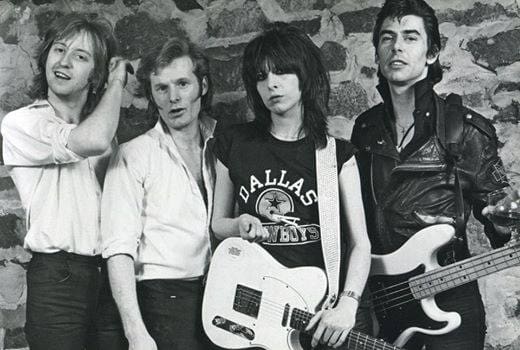
NOVEMBER 4, 1956 – Born on this day in Hereford, Herefordshire, England: Musician/songwriter JAMES HONEYMAN-SCOTT (d. June 16, 1982)
Honeyman-Scott, along with Pretenders bandmates Pete Farndon (bass guitar, vocals) and Martin Chambers (drums, vocals, percussion), came from Hereford, Herefordshire, England, UK. Prior to joining the Pretenders, Honeyman-Scott played in several bands, including a precursor to the Enid with Robert John Godfrey, the Hawks (Kelv Wilson, bass guitar & vocals; Dave Plowman, guitar; Stan Speak, drums), the Hot Band, and the Cheeks. Fellow members in The Cheeks included Chambers and ex-Mott the Hoople keyboardist Verden Allen, Kelv Wilson (bass guitar, vocals). When Honeyman-Scott joined the Pretenders, he was growing vegetables and selling guitars in a music store in Widemarsh Street, Hereford, called Buzz Music.
Honeyman-Scott acknowledged a number of influences on his guitar playing (Guitar Player, 1981). Early musical influences included Cream and the Allman Brothers Band. Later, he was influenced by the lead lines and finger vibrato used by Mick Ralphs of Mott the Hoople. Honeyman-Scott also credited Nick Lowe and Elvis Costello with their “big jangly” Rickenbacker-influenced guitar sound (Guitar Player, 1981). During his tenure with the Pretenders, Dave Edmunds and Billy Bremner from Rockpile were influential, as well as Nils Lofgren and Chris Spedding.
During the mid-1970s, Honeyman-Scott met future Pretenders bandmate Pete Farndon while the bassist was playing with Cold River Lady in Hereford (Melody Maker, 1979). In 1978, Farndon recruited Honeyman-Scott for a series of Pretenders rehearsals and recording sessions, and he officially joined the group that summer (New Musical Express, 1980). Chrissie Hynde recalled, “As soon as I heard Jimmy Scott, I knew I was getting close. Jimmy and I turned out to have a genuine musical affinity” (Rhino Entertainment Company, 2006).
Honeyman-Scott’s role in shaping the Pretenders’ sound primarily involved adding melodic lead lines to existing songs to help tie them together (Guitar Player, 1981). He recalled in the early days, “We did lots of rehearsing – seven days a week, all hours of the day and night. At first a lot of the licks were very heavy – like ‘Up the Neck’ started off as a reggae song. I said, ‘Let’s speed it up,’ and put in that little guitar run. The melodic parts of the numbers really all started coming together by me putting in these little runs and licks. And then Chrissie started to like pop music, and that’s why she started writing things like ‘Kid'” (Guitar Player, 1981).

His style evolved during his tenure with the group: “When I joined the Pretenders I could use a lot more melodic stuff, so my style changed quite a bit. Dave Edmunds and Nick Lowe had a lot to do with it…. They always seem to have nice little guitar songs that you can sing along to, and that’s what I started trying to do” (Guitar Player, 1981). Honeyman-Scott’s playing relied on power chords, arpeggiated or percussive rhythms, “dive bombs” live, and short hooks rather than long solos. Although he preferred short fixed patterns, he did admit he was “a lot more wild” playing live (Guitar Player, 1981).
Hynde and Honeyman-Scott have both acknowledged the influence their contrasting styles had on each other (Guitar Player, 1981; Uncut, 1999). According to Honeyman-Scott, Hynde had a unique style he adjusted to in several ways: “She does quite a bit of rhythm guitar, and I don’t know anybody who plays like her. It’s real distinct, and I can’t count her beat half the time. Instead, I just put a little guitar line over it, like the lick in ‘Tattooed Love Boys'” (Guitar Player, 1981). He joked about his other strategy: “I’ve never told them I can’t work out their time at all! They are used to me coming in a bar too late; they think that’s the way I play. But it’s because I’ve missed where she comes in! I just bluff it and hope for the best.” (Guitar Player, 1981).
Hynde later summarised his influence on her playing by saying that Honeyman-Scott was her “musical right-hand” and that “he really was the Pretenders sound. I don’t sound like that. When I met him, I was this not-very melodic punky angry guitar player and singer and Jimmy was the melodic one. He brought out all the melody in me” (Uncut, 1999, p. 62). Chambers later said, “Despite everything the original band accomplished in only two albums, Jimmy and Chrissie were just starting to figure out what they were capable of as a creative team” (Rhino Entertainment Company, 2006).
In May and June 1982, Honeyman-Scott was first in Los Angeles and then in Austin, Texas, for a short visit with his wife Peggy Sue Fender (an actress/model based in Austin, Texas) whom he had married in April 1981. His wife was staying with local guitarist Mark Younger Smith at this time (FamousInterview.com). While in Austin, he became involved in his first co-production effort for an album by Stephen Doster that was never released (Austin Chronicle, 1997). He also discussed plans with Jol Dantzig for doing a side project called “The Boss Weird” that was to include possibly Elliot Easton as well (Dantzig Design Group, 2006).

During the sessions with Stephen Doster in Austin, Honeyman-Scott was called back to London for a band meeting on June 14th with Chrissie Hynde and Martin Chambers that resulted in the dismissal of Pete Farndon from the Pretenders, due to Farndon’s increasing substance dependence. Two days after the dismissal of Pete Farndon, Honeyman-Scott was found dead in a girlfriend’s apartment of heart failure caused by cocaine intolerance (Washington, D.C. City Paper, 1984; Uncut, 1999). He was 25 years old. James Honeyman-Scott is buried in the churchyard at St. Peters Church, Lyde, Herefordshire.
Although Honeyman-Scott died young, he influenced other well-known guitarists such as Johnny Marr, who noted that “most of all, the jingle-jangle came from James Honeyman-Scott of the Pretenders. He was the last important influence on my playing before I went out on my own. The first time I played ‘Kid’ with the Pretenders, I couldn’t believe it. I’ve used that solo to warm up with every day for years” In addition, Scott is also credited with discovering the Violent Femmes, who opened for Pretenders at the Oriental Theatre in Milwaukee, Wisconsin, while the band was on tour (IO Productions, Inc., undated).
Another legacy was the effect Honeyman-Scott’s death had on the Pretenders’ subsequent direction and longevity. Hynde later said, “One of the things that kept the band alive, ironically, was the death of Jimmy Scott. I felt I couldn’t let the music die when he did. We’d worked too hard to get it where it was…. I had to finish what we’d started” (Rhino Entertainment Company, 2006). At the group meeting on June 14, 1982, Honeyman-Scott suggested bringing Robbie McIntosh into the group in some capacity. After Honeyman-Scott’s death, McIntosh became the group’s lead guitarist for several years.
Credits:
Mike Pemberton
SOURCES
http://www.allmusic.com/…/james-honeyman-scott-mn…/biography
http://www.allmusic.com/a…/pretenders-mn0000492331/biography
http://www.pretendersarchives.com/articles/ArtGP4-81.html
http://www.mtv.com/artists/the-pretenders/biography/
http://www.pretendersarchives.com/BandHistory.html
https://rockhall.com/inductees/the-pretenders/timeline/
http://www.furious.com/perfect/jameshoneymanscott.html
http://jasobrecht.com/james-honeyman-scott-the-pretenders-…/
http://www.soundonsound.com/…/se…/articles/classictracks.htm
http://www.songfacts.com/detail.php?id=1262
http://en.wikipedia.org/wiki/James_Honeyman-Scott
http://en.wikipedia.org/wiki/The_Pretenders
https://www.facebook.com/pretenders
https://www.facebook.com/JamesHoneymanScott
