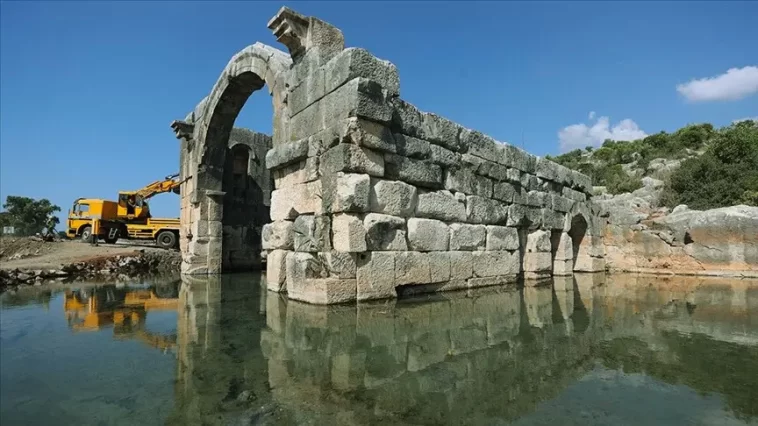
Antalya, Turkey – Deep within the historic landscapes of Demre, a unique piece of Roman heritage is preparing to return to life. Archaeologists have revealed that the 1,850-year-old nymphaion (a monumental fountain built over a sacred spring) in the ancient city of Myra will soon be restored to its original function, offering healing waters to visitors once more.
The site, located between Myra and its ancient harbor Andriake, was long buried beneath layers of soil and hidden beneath an abandoned industrial zone. Following the removal of modern structures, excavations have accelerated, uncovering a remarkable water complex unlike any other from the Roman period.
A Healing Sanctuary from the Roman Empire
Built during the 2nd century AD, under the flourishing reign of Emperor Hadrian, the nymphaion is more than just an architectural wonder. Unlike typical Roman fountains, this structure was deliberately constructed over a medicinal spring rich in magnesium, iron, sulfur, and phosphorus—minerals long believed to have therapeutic properties.
Surrounding the fountain are remnants of aqueducts, baths, and cisterns, suggesting that this was once a grand “healing water complex” where ancient inhabitants sought both spiritual and physical restoration. Locals in Demre still refer to the spring as “Burguç”, and for centuries it has been associated with wellness rituals.
Monumental Roman Architecture
Professor Nevzat Çevik, head of the Myra excavations, describes the structure as “a monumental piece of Roman engineering, carved partly into the bedrock and partly constructed with precision-cut stone blocks.” The building contains multiple entrances and interconnected chambers, designed for both utility and ceremonial use.
“What makes this site extraordinary,” Prof. Çevik explains, “is that it was not merely a decorative fountain. It was purposefully built to harness the healing properties of mineral water. In that sense, it stands apart from other Roman nymphaea.”
The construction includes a hybrid technique, merging natural rock formations with stone masonry, and appears to have functioned until the 7th century AD, when natural silting, similar to the fate of Andriake Harbor, rendered it unusable.
Future Plans: An Archaeopark with Healing Waters
The restoration project is part of Turkey’s “Heritage for the Future” initiative led by the Ministry of Culture and Tourism. By late 2026, the fountain will not only be preserved but also reactivated as part of a planned archaeopark.
Visitors will be able to swim among the ruins in mineral-rich water, experiencing a rare combination of archaeology and wellness tourism. “To imagine tourists once again bathing in these same healing waters after nearly two millennia is truly inspiring,” Çevik remarks.
The project has faced technical challenges, including constant groundwater inflows that refill the excavation overnight. Workers have relied on pumps to manage water levels, carefully uncovering the structure by hand. Yet despite the difficulties, the team remains determined to complete the project on schedule.

Reviving an Ancient Tradition
When complete, the Myra nymphaion will join other iconic Roman healing sites, such as the baths of Bath in England and Aquae Sulis, as one of the few surviving examples where visitors can actively engage with ancient wellness practices.
For Antalya and Turkey’s tourism sector, this restoration promises to be a major attraction, blending history, archaeology, and health tourism. As Demre welcomes thousands of international visitors each year for its Lycian heritage, the return of the healing waters may redefine the region’s cultural landscape.
By 2026, after 1,850 years of silence, the healing fountain of Myra will once again flow—bringing both history and health back to life.
