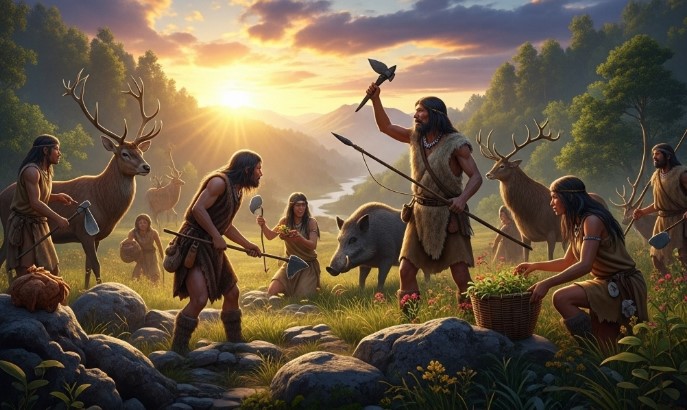
Hunter-gatherer societies represent the earliest and longest-lasting form of human social organization, dominating human existence for millions of years before the advent of agriculture. Studying both archaeological evidence and contemporary hunter-gatherer groups offers valuable insights into their way of life.
Here are some key facts about hunter-gatherer life:
1. Subsistence and Diet:
- Diverse Food Sources: Hunter-gatherers obtained food by hunting wild animals, fishing, and foraging for wild plants, including fruits, nuts, roots, and seeds. Their diet was highly varied and adapted to their local environment.
- Not Just Meat: While hunting was important, gathering often provided the majority of calories. In many societies, women’s gathering activities were crucial for sustenance.
- Seasonal Movement: They followed seasonal availability of resources, moving their camps to coincide with animal migrations and plant growth cycles.
- High Fiber and Nutrients: Their diets were naturally high in fiber, vitamins, and minerals, often exceeding modern dietary recommendations for these nutrients.
- Minimal Processing: Food was consumed raw or minimally processed, leading to a different nutrient profile than modern diets.
2. Social Structure and Organization:
- Small, Nomadic Groups: Hunter-gatherers typically lived in small, kin-based groups, often consisting of 20-50 individuals. This size facilitated mobility and efficient resource acquisition.
- Egalitarianism: Most hunter-gatherer societies were highly egalitarian, with a lack of formal hierarchies. Leadership was often informal and based on skill, knowledge, or ability to resolve conflicts.
- Resource Sharing: Food and other resources were commonly shared among the group, acting as a crucial social safety net and promoting cooperation. Generosity was highly valued.
- Flexible Kinship: While kinship was central, groups often exhibited flexibility in their residential patterns, with individuals moving between camps, sometimes resulting in a surprising number of non-kin within a band.
- Gender Roles: While there was often a division of labor (men typically hunted, women gathered), both sexes contributed significantly to food acquisition, leading to relatively equal social standing.
3. Daily Life and Work:
- More Leisure Time than Expected: Contrary to popular belief, anthropological research suggests that many hunter-gatherer groups spent relatively little time on “work” (food acquisition), often as little as 15-20 hours per week. Much of their time was dedicated to activities modern societies might consider leisure, such as hiking, fishing, and socializing.
- Adaptation and Skill: They possessed intricate knowledge of their environment, including animal behavior, plant cycles, and weather patterns. This expertise allowed them to efficiently utilize available resources.
- Portable Shelters: Due to their nomadic lifestyle, they typically constructed temporary shelters or utilized natural rock formations like caves.
4. Technology and Innovation:
- Stone Tools: Early hunter-gatherers developed and refined a wide array of stone tools for cutting, scraping, hunting, and processing food and hides. This included early Oldowan tools, more sophisticated Acheulean handaxes, and later, specialized blades.
- Beyond Stone: They also utilized tools made from wood, bone, and antler, and innovated with items like bows and arrows, fishhooks, harpoons, nets, and baskets.
- Control of Fire: The controlled use of fire was a significant innovation, providing warmth, light, protection from predators, and enabling the cooking of food, which expanded their dietary options.
5. Spiritual Beliefs and Culture:
- Deep Connection to Nature: Their lives were intimately connected to the natural world, influencing their spiritual beliefs and practices.
- Animism and Totemism: Many hunter-gatherer societies held animistic beliefs, where spirits inhabited natural objects, and practiced totemism, revering certain animals as clan symbols.
- Ritual and Symbolism: Their spiritual beliefs were often expressed through rituals, symbolism, and art forms such as petroglyphs, pictographs, and body art. Shamans often played important roles as healers and spiritual guides.
- Storytelling and Oral Tradition: Communal time around the hearth likely fostered storytelling and the transmission of knowledge and culture through oral tradition.
6. Environmental Impact:
- Sustainable Practices: Hunter-gatherers generally maintained a sustainable relationship with their environment. They often practiced conservation methods, such as seasonal restrictions on hunting and rotating harvesting areas, due to a direct understanding of resource limits.
- Mobility as Conservation: Their nomadic lifestyle itself was a form of resource management, allowing ecosystems to recover and regenerate.
Hunter-gatherer life, while challenging, was characterized by adaptability, deep ecological knowledge, and highly cooperative social structures, offering valuable lessons for understanding human history and our relationship with the environment.
