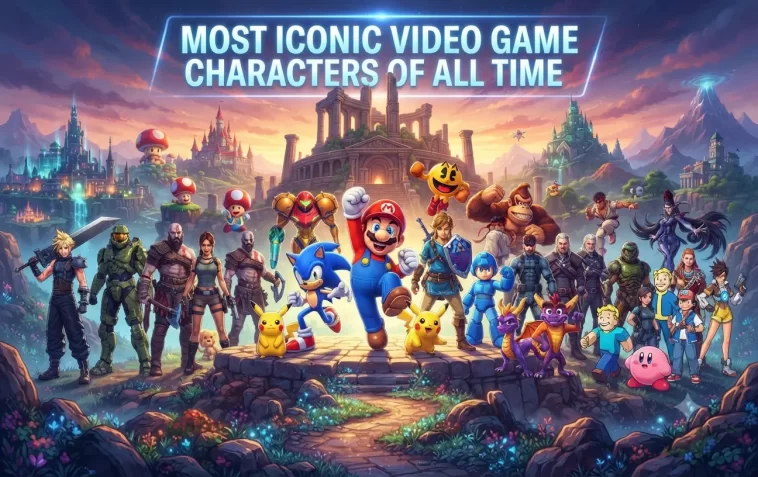
Iconic video game characters are the reason so many of us fell in love with gaming in the first place. I still remember the exact moment I first jumped as Mario over a Goomba, and decades later I can still hum the sound effect from memory. Some characters just stay with you.
This list is not only about sales numbers or how many games a character has appeared in, although that matters. It is about cultural weight, recognizability, and the kind of lasting impression that turns a video game protagonist into a genuine pop culture icon. I pulled from decades of gaming history, crossed genres and consoles, and put together 50 names that most gamers will instantly recognize, even people who barely play games at all.
What Actually Makes a Character Iconic
Not every popular character earns lasting icon status. You will notice a few things that separate the truly unforgettable ones from the merely memorable.
- Instant visual recognition. You should be able to identify the character from a silhouette alone.
- Cultural crossover. The best examples show up in movies, merchandise, memes, and everyday conversation, far beyond their original game.
- Longevity. Characters who remain relevant across decades, not just a single hit game, tend to earn a permanent spot in gaming history.
- A defining trait or catchphrase. Whether it is a signature move, a voice line, or a design choice, something about them sticks in your memory instantly.
- Influence on the industry. Many of these characters did not just star in great games, they helped shape entire genres.
The Nintendo Icons
No conversation about gaming icons can skip Nintendo. The company has produced more instantly recognizable characters than perhaps any other studio in history.
Mario
Mario is very often named the single most recognized video game character in the world, and it is not close. Since his debut in the early 1980s, he has starred in platformers, racing games, sports titles, and even feature films, becoming a face that reaches far beyond the gaming audience.
Link
Despite Zelda being the title character of his own franchise, Link is usually more recognized than the princess he sets out to save. His appearances in beloved entries like Ocarina of Time and Breath of the Wild, along with his role in the Super Smash Bros. series, have cemented him as a defining fantasy hero of gaming.
Donkey Kong
One of the very first video game villains turned hero, Donkey Kong began as an arcade antagonist before becoming the star of his own acclaimed platforming series, growing into a distinct and beloved character in his own right.
Kirby
A small pink ball with an enormous personality, Kirby has floated his way into the hearts of players through his simple design and surprisingly wide range of abilities absorbed from enemies.
Samus Aran
As one of gaming’s earliest and most influential female protagonists, Samus helped define an entire genre of exploration-based games and remains a landmark character in gaming history.
Legendary Sega and Arcade Characters
Sega built its own identity around a blue hedgehog, but the arcade era produced plenty of icons that still resonate decades later.
Sonic the Hedgehog
Sonic’s speed and attitude made him an instant rival to Mario in the early 1990s. His name recognition has grown so large that people often need context just to know whether someone is talking about the character or the fast food chain that shares his name.
Pac-Man
Debuting in Japanese arcades in 1980, Pac-Man’s simple yellow design became one of the most recognizable shapes in entertainment history. His four ghost enemies, Blinky, Pinky, Inky, and Clyde, are just as memorable as the hero himself.
Action, Adventure, and Stealth Icons
Some of gaming’s most enduring characters come from action and adventure titles where personality and presentation matter just as much as gameplay.
Lara Croft
Lara Croft became so culturally significant that a search for her name often returns results treating her as a movie character rather than a video game one. Her adventurous spirit helped define an entire genre of action-adventure gaming.
Solid Snake
Introduced in 1987’s original Metal Gear, Solid Snake became the face of stealth gaming. His appearances across more than ten games in the Metal Gear franchise, along with crossovers into other major titles, have kept him relevant for decades.
Master Chief
Full name Master Chief Petty Officer John-117, this Halo hero is a genetically enhanced supersoldier who became the reason many players bought an Xbox in the first place, launching one of gaming’s most important shooter franchises.
Crash Bandicoot
This genetically altered marsupial debuted in 1996 and quickly became a mascot for an entire console generation, going on to appear in more than twenty games throughout his career.
Leon S. Kennedy
A defining face of survival horror, Leon’s appearances across the Resident Evil series have made him one of the most recognizable characters in the genre’s long history.
RPG and Fantasy Legends
Role-playing games have given us some of the deepest and most beloved characters in the medium, often thanks to strong storytelling and years of fan attachment.
Cloud Strife
Since debuting as the protagonist of 1997’s Final Fantasy VII, Cloud has made more than thirty appearances across games and other media, remaining one of the most requested characters whenever a new crossover title is announced.
Steve
The default player character from 2011’s Minecraft, the best-selling video game of all time, Steve has become instantly recognizable through his simple blocky design, appearing in spinoff titles well beyond the original game.
Geralt of Rivia
The gruff monster hunter from The Witcher series became a global phenomenon, helped along by strong writing and a hit television adaptation that introduced him to audiences who had never picked up a controller.
Commander Shepard
Both the male and female versions of Shepard from Mass Effect became icons of player choice and customization, proving that a fully voiced, player-shaped protagonist could still carry genuine star power.
Fighting Game and Villain Icons
Great heroes need great rivals, and fighting games in particular have produced some of gaming’s most enduring personalities on both sides of the fight.
Chun-Li
As the first playable female character in the Street Fighter franchise, Chun-Li helped pave the way for stronger female representation in fighting games while becoming one of the most recognizable characters in the genre.
Pikachu
The only Pokémon widely considered iconic enough to stand alongside gaming’s biggest names, Pikachu has appeared in over a hundred properties across film, television, comics, and merchandise since his debut.
Bowser
Mario’s longtime rival is instantly recognizable by his spiked shell and fiery personality, remaining one of gaming’s most enduring and lovable villains after decades of kidnapping the same princess.
The Full List of 50 Most Iconic Video Game Characters
- Mario – Super Mario franchise
- Link – The Legend of Zelda
- Sonic the Hedgehog – Sonic franchise
- Pikachu – Pokémon
- Lara Croft – Tomb Raider
- Solid Snake – Metal Gear
- Master Chief – Halo
- Kratos – God of War
- Cloud Strife – Final Fantasy VII
- Crash Bandicoot – Crash Bandicoot franchise
- Donkey Kong – Donkey Kong franchise
- Kirby – Kirby franchise
- Samus Aran – Metroid
- Pac-Man – Pac-Man
- Steve – Minecraft
- Geralt of Rivia – The Witcher
- Commander Shepard – Mass Effect
- Chun-Li – Street Fighter
- Bowser – Super Mario franchise
- Leon S. Kennedy – Resident Evil
- Ryu – Street Fighter
- Scorpion – Mortal Kombat
- Sub-Zero – Mortal Kombat
- Gordon Freeman – Half-Life
- Nathan Drake – Uncharted
- Ellie – The Last of Us
- Joel – The Last of Us
- Aloy – Horizon Zero Dawn
- Arthur Morgan – Red Dead Redemption 2
- Geralt’s Companion Yennefer – The Witcher
- Zelda – The Legend of Zelda
- Peach – Super Mario franchise
- Yoshi – Super Mario franchise
- Luigi – Super Mario franchise
- Ganondorf – The Legend of Zelda
- Sephiroth – Final Fantasy VII
- Deckard Cain – Diablo
- Duke Nukem – Duke Nukem
- Spyro the Dragon – Spyro franchise
- Banjo and Kazooie – Banjo-Kazooie
- Agent 47 – Hitman
- Big Boss – Metal Gear
- Vault Boy – Fallout
- Doomguy – Doom
- Alucard – Castlevania
- Cortana – Halo
- Sora – Kingdom Hearts
- Son Goku – Dragon Ball video games
- Chell – Portal
- GLaDOS – Portal
How to Spot the Next Iconic Character
If you enjoy following the industry, it helps to know what signals a rising character might have real staying power.
You should look for characters who:
- Get a strong visual redesign across sequels rather than staying frozen or forgettable.
- Show up in crossover titles like fighting games or all-star collections early in their life.
- Generate merchandise demand beyond simple promotional items.
- Anchor a franchise rather than appearing in a single standalone title.
- Develop a defining trait, whether that is a voice, a weapon, or a personality quirk fans can quote.
FAQ
1. Who is considered the most iconic video game character of all time? Mario is very commonly named the most iconic video game character in the world, thanks to his instantly recognizable design and decades of continuous presence across generations of gaming.
2. What makes a video game character truly iconic? Iconic status usually comes from a combination of visual recognizability, cultural crossover into film and merchandise, and long-term relevance across multiple games rather than a single release.
3. Are villains ever considered as iconic as heroes? Yes, characters like Bowser, Ganondorf, and Sephiroth are considered just as iconic as the heroes they oppose, often because a great villain makes a hero’s story more memorable.
4. Why are so many iconic characters from Nintendo games? Nintendo has consistently created characters with simple, distinctive designs and kept them relevant across decades of sequels and spinoffs, which has helped many of them become permanent cultural fixtures.
5. Do newer characters ever reach the same iconic status as older ones? It happens, but it takes time. Characters like Aloy and Arthur Morgan have built strong followings quickly, though it usually takes years of consistent presence to reach the same recognition as characters like Mario or Sonic.
6. Can a character be iconic without appearing in multiple games? It is rare but possible. A few single-game characters achieve iconic status through cultural impact alone, though most of the names on lists like this one built their reputation across an entire franchise.
7. How much does voice acting affect a character’s iconic status? Voice acting can matter a great deal, especially for characters known for catchphrases or strong personality. Distinctive voice work has helped characters become instantly recognizable even outside of gameplay footage.
8. Do mascots count as iconic video game characters? Yes, mascot characters like Sonic, Pac-Man, and Crash Bandicoot are among the most iconic in gaming history, since many of them were created specifically to represent an entire console or studio identity.
Editor’s Opinion
Making this list was actualy really hard becouse everyone has thier own favorite and its impossible to please everybody lol. For me personaly Mario will always be number one, i grew up with him and so did basicaly everyone i know. But i gotta say seeing characters like Aloy and Arthur Morgan climbing up so fast is pretty cool too, shows the industry keeps making new legends. Some people will probably be mad i didnt put thier favorite higher up the list, and thats fine, thats what makes these lists fun to argue about honestly.
