10 best AI transcription tools changed how I work every single day. Last year, I found myself spending nearly two hours after every meeting just typing out notes and sorting quotes from recorded interviews.
My hands were constantly sore, and I was spending way too much energy focusing on capturing every word instead of listening. I knew there had to be a better way to handle speech-to-text without losing accuracy.
I decided to test dozens of speech-to-text platforms to see which ones could actually handle accents, background noise, and technical language. The difference it made in my daily routine was immediate and massive.
Why Modern AI Transcription Matters Today
Manual speech conversion is no longer necessary for busy professionals, creators, and teams. Old recognition software used to require precise speaking styles and constant manual corrections.
Modern artificial intelligence models analyze natural speech patterns, filter out background noise, and recognize different speakers automatically. They turn raw audio files into structured, readable documents in just a few seconds.
Using smart speech technology reduces your daily administrative burden significantly. Instead of sitting down to type out interviews or call recordings line by line, you can generate complete drafts instantly.
Beyond converting words into text, these platforms capture actionable value from conversations. They highlight key decision points, generate summary bullet points, and translate transcripts into dozens of languages automatically.
What to Look for in Speech Recognition Platforms
Finding the right conversion tool depends on how you capture audio and what you intend to do with the text. Before picking a tool, consider these critical elements:
- Punctuation and Formatting Accuracy: The tool should handle capitalization, punctuation, and paragraph breaks without requiring manual edits.
- Speaker Diarization: Look for software that correctly separates who said what during multi-person calls or panel discussions.
- Custom Vocabulary Support: You need the ability to add industry jargon, brand names, and technical terms to prevent common spelling errors.
- Export Options: Make sure the platform lets you export files as Word documents, plain text, or subtitle formats like SRT and VTT.
- Security and Privacy: Ensure the platform protects your personal records and does not use private client calls to train public models.
Breakdown of the Top Speech-to-Text Solutions
Here is an in-depth breakdown of the leading speech recognition tools available today. Each platform targets specific needs, from real-time meeting bots to video subtitle editing.
1. Otter.ai: Ideal for Live Meeting Notes and Team Summaries
Otter.ai is one of the most widely used platforms for live video meetings. It connects directly with standard calendar systems to join scheduled calls on Zoom, Google Meet, and Microsoft Teams automatically.
During a call, the software records the audio, tags different speakers, and displays a running transcript in real time. Attendees can highlight important sentences, drop inline comments, or assign action items directly inside the transcript.
Once the meeting finishes, it generates an automated summary with key takeaways and action points sent straight to your inbox. It eliminates the need to assign a dedicated note-taker during team catchups.
Highlights
- Automated Meeting Bot: Joins video calls automatically and captures audio without manual input.
- Real-time Collaboration: Allows call participants to highlight and comment on live text.
- Action Item Extraction: Automatically identifies and lists assigned tasks from discussions.
2. Descript: Ideal for Text-Based Media and Podcast Editing
Descript approaches audio and video editing in a completely unique way. Instead of working on a traditional timeline, it turns your media file into a text document that you edit like a standard Word file.
When you delete a word or sentence from the generated transcript, the app automatically trims that exact moment from the underlying audio or video track. This makes podcast and video editing remarkably fast.
It also includes built-in tools to detect and remove filler words like “um” and “uh” with a single click. You can refine your media quality and generate polished transcripts in one unified workspace.
Highlights
- Text-Based Cutting: Edit audio and video clips simply by deleting words from the script.
- Filler Word Removal: Strips out hesitations and repetitive phrases automatically.
- Studio Sound Enhancement: Enhances voice clarity and cancels room noise with one click.
3. Sonix: Ideal for Multilingual File Conversion and Speed
Sonix is built for speed, high precision, and broad language support. It processes pre-recorded audio and video files quickly through a clean, web-based editor.
The online editor aligns transcript text directly with the underlying audio player. Clicking on any word jumps the recording directly to that exact second, making verification and minor adjustments effortless.
It also supports automated translation into over fifty languages. You can convert your initial transcript into multiple localized languages in minutes, which is helpful for international teams.
Highlights
- In-Browser Audio Alignment: Syncs transcript text directly with original audio playback.
- Multi-Language Support: Translates transcripts across dozens of global languages fast.
- Custom Dictionary: Allows users to input technical terms for higher accuracy.
4. Notta: Ideal for Cross-Device Recording and Dictation
Notta offers a flexible experience across mobile devices, desktop screens, and web browser extensions. It is designed for professionals who need to convert voice notes on the move.
You can record live interviews using your smartphone, capture web browser audio, or upload pre-recorded audio files. The platform syncs data instantly across all your connected devices.
It also features built-in translation and summary templates that organize long recordings into clean executive recaps. It serves as a handy tool for journalists, field researchers, and mobile workers.
Highlights
- Cross-Device Sync: Seamlessly access recordings on web, desktop, and mobile apps.
- Live Web Capture: Records and converts browser-based audio via a simple extension.
- Summary Templates: Converts lengthy transcripts into clean, actionable notes.
5. Rev: Ideal for Legal Precision and Hybrid Verification
Rev stands out by offering both fast artificial intelligence transcriptions and professional human-verified review services on the exact same platform.
If you need a quick draft of a internal call, the automated engine processes your file in seconds. When you need certified accuracy for legal matters or official media publishing, you can request a human editor to review the transcript.
This flexible approach ensures you only pay for high-level human review when accuracy is essential. Its automated system remains fast, affordable, and dependable for everyday needs.
Highlights
- Dual Service Options: Choose between fast automated conversion or human-verified editing.
- High Accuracy Guarantee: Human orders offer up to 99% guaranteed accuracy.
- Custom Glossaries: Accepts custom term lists to improve automated recognition.
6. Fireflies.ai: Ideal for Sales Intelligence and CRM Automation
Fireflies.ai is built specifically to turn voice conversations into structured business data. It focuses on sales, recruitment, and customer management workflows.
The tool records and converts sales calls automatically while tracking conversation metrics like speaker talk-time ratios, positive or negative sentiment, and main topic discussions.
It connects directly with major CRM platforms like Salesforce, HubSpot, and Slack to log call notes without manual effort. This keeps your records up to date automatically after every client conversation.
Highlights
- CRM Integration: Sends notes, summaries, and transcripts straight to sales platforms.
- Conversation Analytics: Tracks speaker talk times and sentiment during client calls.
- Smart Search Filters: Filters recordings by pricing, competitors, or specific key terms.
7. Happy Scribe: Ideal for Video Subtitles and Localization
Happy Scribe is tailored for media teams, educators, and content creators who need clean subtitle files alongside standard text transcripts.
It supports over 120 languages and accents, making it a versatile option for global projects. The built-in subtitle editor allows you to adjust timing, line breaks, and screen positions easily.
You can export your completed projects in specialized caption formats like SRT or VTT, or burn subtitles directly onto video files. It streamlines video accessibility and localization tasks significantly.
Highlights
- Subtitles and Captions: Generates, edits, and exports standard video caption files easily.
- Broad Language Range: Handles over 120 global languages and regional dialects.
- Interactive Video Editor: Allows fine-tuning of subtitle timings alongside video playback.
8. Trint: Ideal for Newsrooms and Media Production
Trint was created by journalists specifically to speed up editorial and storytelling workflows. It turns raw audio and video into searchable text built for rapid publishing.
Its shared workspace lets multiple writers highlight quotes, drop notes, and pull excerpts directly into story drafts in real time. This helps newsrooms publish breaking stories under tight deadlines.
It also supports live stream recording and instant captioning, making it an effective choice for broadcast teams, event organizers, and media publications.
Highlights
- Real-time Team Workspace: Enables team members to collaborate on transcripts together.
- Live Stream Conversion: Converts broadcast feeds into live text as events happen.
- Editorial Tools: Allows easy quote-highlighting and story drafting within the app.
9. TurboScribe: Ideal for Long Audio Files and Bulk Processing
TurboScribe focuses on handling large files, long recordings, and bulk uploads without complex usage caps or restrictive minute limits.
Powered by advanced speech engines, it processes multi-hour lectures, focus groups, or podcasts efficiently. It supports dozens of languages and deals well with low-quality audio or ambient noise.
Its straightforward design makes it simple to drop multiple files into the system and download completed transcripts in your preferred file format without unnecessary hassle.
Highlights
- Bulk Upload Capacity: Processes several long files at once without performance drops.
- Handles Noisy Audio: Delivers reliable results even on low-quality background recordings.
- Simple Flat Pricing: Offers unlimited transcription options for heavy users.
10. AssemblyAI: Ideal for Developers and Custom Applications
AssemblyAI is an API built specifically for developers who want to integrate speech-to-text features into their own software platforms.
Beyond raw word conversion, its API provides advanced audio features like sensitive data scrubbing, content moderation, sentiment tracking, and automatic topic detection.
Software teams can build custom voice tools, internal meeting software, or customer service platforms backed by powerful speech recognition models without building models from scratch.
Highlights
- Developer API: Connects speech recognition features directly into custom apps.
- Data Scrubbing: Automatically redacts sensitive personal information for privacy compliance.
- Advanced Audio Insights: Detects sentiment, topics, and safety issues in speech.
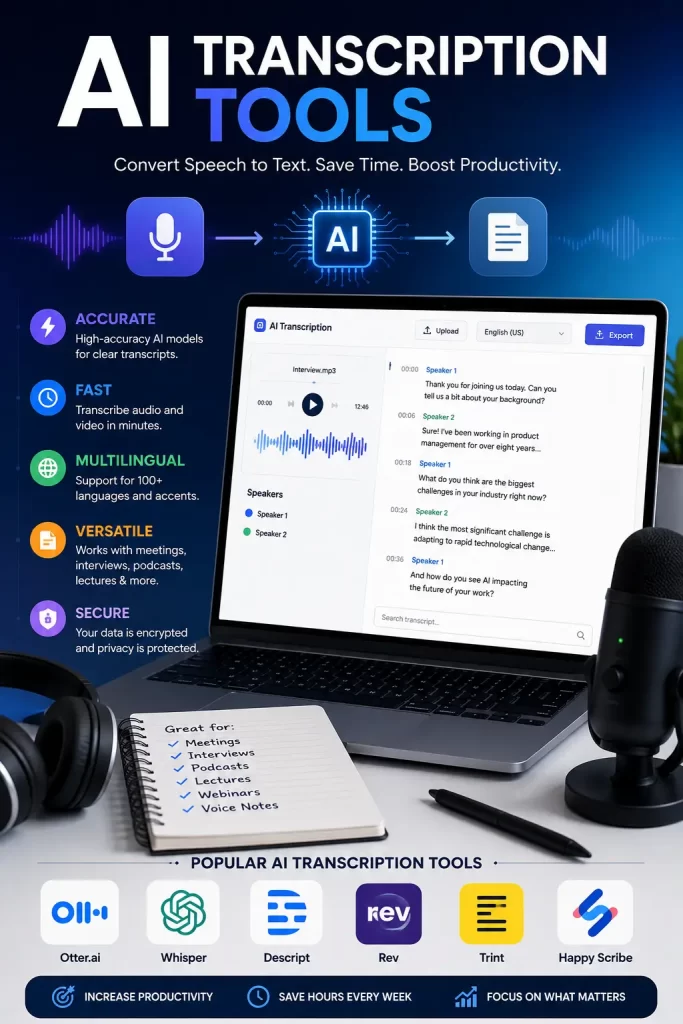
Comparison Table: Finding Your Match
Use this quick comparison table to match your specific needs with the right solution:
| Tool Name | Best Primary Purpose | Standout Feature | Best Suited For |
| Otter.ai | Live Video Meetings | Automatic call bots & team action items | Corporate teams & consultants |
| Descript | Audio & Video Editing | Edit media files by deleting text in script | Podcasters & video creators |
| Sonix | Multilingual File Conversion | Interactive editor synced with audio | Researchers & media producers |
| Notta | Mobile Dictation | Cross-device sync & browser recording | Field reporters & mobile staff |
| Rev | Legal & High Accuracy | Choice between AI and human verification | Legal teams & court reporters |
| Fireflies.ai | Sales Calls & CRMs | Tracks buyer sentiment & updates CRMs | Sales teams & account managers |
| Happy Scribe | Video Captions & Subtitles | Custom subtitle timing & SRT exports | Media producers & educators |
| Trint | Journalism & Newsrooms | Real-time live stream transcription | News outlets & broadcast teams |
| TurboScribe | Long Files & Bulk Uploads | High-volume file processing with no limits | Students & archivists |
| AssemblyAI | App Integration | API with custom data redaction & analysis | Developers & software teams |
How You Can Set Up an Automated Transcription Workflow
To get the most out of your speech recognition tools, you must set up your daily routine properly. Follow these clear steps to achieve accurate results every time:
Step 1: Improve Your Input Audio Quality
Garbage audio leads to poor transcripts. Always use an external microphone instead of your laptop’s built-in microphone when recording meetings or interviews.
Position the microphone close to the speaker and choose a quiet room with minimal echo. Clear audio input immediately improves accuracy rates and saves you from fixing errors later.
Step 2: Build a Custom Terminology List
Before uploading audio or running live meeting bots, open your software settings and enter custom vocabulary. Add proper nouns, company names, product acronyms, and technical jargon.
Teaching the system your specific terms prevents recurring spelling errors and ensures your drafts are clean and ready to share immediately.
Step 3: Use Auto-Summaries for Quick Skimming
Do not read through hour-long transcripts word for word if you only need key outcomes. Use the platform’s automatic summary feature to get an overview of key points first.
Use search tools to locate specific keywords or quotes. This approach lets you grab what you need in seconds without reading through full pages of raw conversation.
Step 4: Export and Archive Files Systematically
Establish a clean filing system for your completed text files. Export transcripts immediately into shared folders, project boards, or internal documentation channels.
Assign consistent file names that include the date, project name, and primary speaker. This keeps your voice records searchable for future reference.
Frequently Asked Questions (FAQ)
What are the 10 best AI transcription tools in 2026?
The top ten tools include Otter.ai, Descript, Sonix, Notta, Rev, Fireflies.ai, Happy Scribe, Trint, TurboScribe, and AssemblyAI. Each platform focuses on distinct needs such as live meetings, video editing, or API integration.
How accurate are speech recognition tools with accents?
Modern speech platforms handle regional accents, varied speaking speeds, and non-native speakers well. However, using a clear microphone and minimizing background noise remains essential for high accuracy.
Can these tools distinguish between different speakers?
Yes, most modern software includes speaker diarization features. They identify different voices during a recording and tag them with distinct speaker labels automatically.
Is my audio data safe when using online transcription software?
Reputable platforms use strong data encryption and strict privacy policies. Always check that your provider guarantees your private meeting records will not be used to train public language models.
Do I need special hardware to run transcription software?
No special hardware is required. Most platforms run directly inside standard web browsers, mobile apps, or cloud integrations, requiring only a stable internet connection and a working microphone.
Conclusion
Managing voice records no longer requires tedious manual typing or hours of tedious work. By choosing one of the 10 best AI transcription tools, you can convert hours of spoken conversations into clear, actionable text in just a few clicks.
Whether you need Otter.ai for live team meetings, Descript for fast media editing, or TurboScribe for long audio files, taking advantage of modern speech tools will save you valuable time every day. Pick the platform that fits your workflow and simplify your note-taking routine today.
Editor’s Opinion
i have tested so many of these speech tools recently and they really save me a lot of time. before using them, i had to type all my notes manually and my wrists were always hurting after long meetings. now i just let the software do the heavy work and i only fix small mistakes. sometimes it misspells hard names, but it is still so much faster than doing it yourself. if you spend a lot of time typing notes, you should try one of these tools right now. it makes your daily work so much easier and lets you focus on real tasks.
