Best AI tools for e-commerce store owners completely changed how I run my online business. A couple of years ago, I was spending over four hours every day writing product descriptions, manually editing product photos, and handling repetitive customer support messages.
I was constantly exhausted, and my store growth hit a plateau because I was bogged down by routine tasks. I realized I could not scale my business alone without working twenty hours a day.
I decided to test and integrate modern artificial intelligence tools into my daily e-commerce workflow. The transformation was almost immediate and saved my sanity.
By automating product creation, image background removal, and customer inquiries, I cut my daily operational workload by more than half while boosting my sales conversion rate. If you are struggling to manage your online store efficiently, this guide will walk you through the top solutions to automate your store today.
Why E-commerce Store Owners Need AI in 2026
Running an online store manually is no longer a sustainable business strategy. Modern shoppers expect instant customer support replies, personalized product recommendations, and high-quality visual content.
Artificial intelligence allows small store owners to compete directly with massive retail brands without hiring a huge team. It handles repetitive administrative tasks in the background while you focus on brand strategy and inventory.
Adopting automated store workflows reduces human error significantly. Instead of manually updating inventory tags or writing hundreds of unique SEO descriptions from scratch, software engines generate optimized assets in seconds.
Beyond saving time, smart platforms directly boost store revenue. They analyze customer browsing habits to present targeted upselling offers, reducing abandoned carts and increasing average order value.
What to Look for in E-commerce Automation Software
Choosing the right platform depends on your store size, product niche, and specific operational bottlenecks. Before investing in a new software subscription, evaluate these essential factors:
- E-commerce Platform Integration: Ensure the software connects natively with platforms like Shopify, WooCommerce, BigCommerce, or Wix.
- Product Catalog Syncing: Look for tools that can read your product inventory directly to generate accurate descriptions and automated tags.
- Ease of Use: You want intuitive dashboards that do not require complex coding skills or advanced technical knowledge to operate.
- Personalization Capabilities: Choose software that tailors product recommendations and marketing messages based on real-time customer behavior.
- Data Security and Privacy: Verify that the vendor complies with global data protection standards like GDPR to keep customer data safe.
Best AI Tools for E-commerce Store Owners in 2026
Here is a breakdown of the leading platforms helping online sellers streamline operations, create high-converting visual assets, and increase sales.
1. Octane AI: Ideal for Personalized Product Quizzes and Zero-Party Data
Octane AI helps online store owners capture customer preferences through interactive shop quizzes. It acts as a digital salesperson that guides visitors to the exact product they need.
The app uses smart logic to ask shoppers about their personal needs, skin types, or style preferences. It then recommends a personalized product bundle tailored specifically to their answers.
This interactive process increases conversion rates significantly while gathering valuable customer data. You can then use this data to send hyper-targeted follow-up email campaigns.
Highlights
- Interactive Buyer Quizzes: Guides store visitors to the right products based on custom preference questions.
- Higher Conversion Rates: Increases sales by providing personalized product bundle recommendations.
- Zero-Party Data Collection: Gathers specific customer preference data to improve email marketing segmentation.
2. Photoroom: Ideal for Studio-Quality Product Photography
Product photography used to require expensive studio rentals, professional lighting setups, and tedious manual photo editing. Photoroom replaces that entire production pipeline with instant mobile image generation.
You simply snap a picture of your physical item using your phone, and the software automatically removes the background with pinpoint accuracy. You can then place your product into realistic background scenes using simple text prompts.
It allows you to batch-edit hundreds of product images at once, ensuring consistent lighting and shadow effects across your entire catalog. This gives your storefront a clean, professional aesthetic.
Highlights
- Instant Background Removal: Erases messy backgrounds from product photos in a single tap.
- AI Scene Generation: Places products into realistic studio or lifestyle environments using text prompts.
- Batch Editing Mode: Edits and formats full product catalog photos simultaneously.
3. Gorgias AI: Ideal for Automated Customer Service and Order Tracking
Customer service can quickly overwhelm an e-commerce owner, especially during sales surges or holiday seasons. Gorgias AI integrates directly with your store database to handle common support tickets automatically.
It reads incoming customer messages across email, live chat, and social channels, recognizing common questions about order status, return policies, or shipping updates. It then drafts and sends accurate responses instantly.
For complex issues, it summarizes the conversation history and passes the ticket to a human support agent. This drastically cuts ticket resolution times while keeping customer satisfaction scores high.
Highlights
- Automated Order Tracking: Answers routine “where is my order” questions instantly without human intervention.
- Multi-Channel Support: Unifies messages from email, live chat, Instagram, and Facebook into one inbox.
- Smart Intent Detection: Categorizes incoming tickets by urgency and topic for faster resolution.
4. Copy.ai: Ideal for High-Converting Product Descriptions and Ad Copy
Writing hundreds of unique product descriptions for an expanding catalog is time-consuming and tedious. Copy.ai simplifies this process by generating persuasive, SEO-friendly marketing copy in seconds.
You enter basic product specifications, target audience details, and your preferred brand voice. The software generates multiple variations of product titles, bullet points, meta tags, and social media ad text.
It helps maintain a consistent tone across your entire website while ensuring your pages are optimized for search engines. This speeds up new product launches significantly.
Highlights
- Bulk Description Generator: Creates unique product copy for large catalogs fast.
- Brand Voice Customization: Learns and matches your brand’s specific tone and messaging style.
- Multi-Format Output: Generates product page text, email subject lines, and social ad copy.
5. Klarna KXM (formerly Searchspring): Ideal for Smart Site Search and Merchandising
When customers visit an e-commerce store, the search bar is often their primary navigation tool. Searchspring provides intelligent site search, visual merchandising, and personalized product recommendations.
The software understands customer search intent, handling misspellings, synonyms, and long-tail queries effortlessly. It ensures relevant items always appear at the top of search results pages.
Store owners can also set automated visual merchandising rules to promote high-margin items, clear out end-of-season inventory, or hide out-of-stock products automatically.
Highlights
- Intent-Based Search: Delivers accurate search results even when shoppers make typos or use vague terms.
- Visual Merchandising Rules: Allows drag-and-drop arrangement of product grids on category pages.
- Automated Recommendations: Displays cross-sell and up-sell product recommendations across the buyer journey.
6. Klaviyo AI: Ideal for Predictive Email and SMS Marketing
Klaviyo is a premier email and SMS marketing platform designed specifically for online retail businesses. Its artificial intelligence features help store owners predict customer behavior and automate lifecycle messaging.
The platform analyzes purchase history to predict when a customer is likely to make their next purchase or churn. It then automatically sends targeted email offers at the exact moment maximum impact is likely.
It also features automated subject line generators, smart send-time optimization, and predictive customer lifetime value calculations. This keeps your audience engaged without manual newsletter scheduling.
Highlights
- Predictive Analytics: Forecasts next-purchase dates, churn risk, and customer lifetime value.
- Smart Send-Time Optimization: Delivers marketing messages when individual subscribers are most active.
- Automated Subject Line Testing: Generates and tests high-performing email subject lines automatically.
7. Triple Whale: Ideal for Multi-Channel Ad Tracking and Attribution
Tracking return on ad spend across Facebook, Google, TikTok, and Pinterest has become extremely difficult due to modern browser privacy updates. Triple Whale solves this problem by offering clear cross-channel ad attribution.
Its central dashboard tracks every step of the customer journey, showing you exactly which ad creative or campaign drove a specific sale. It eliminates guesswork when allocating your marketing budget.
The platform also includes an integrated assistant called Willy, which answers natural language questions about your store metrics, net profit, returning customer rates, and inventory health in real time.
Highlights
- First-Party Ad Attribution: Tracks real ad performance accurately across multiple marketing channels.
- Unified Financial Dashboard: Consolidates ad spend, shipping costs, and product margins to calculate real net profit.
- Willy AI Assistant: Answers plain-English questions about your store’s daily performance metrics.
8. Pebblely: Ideal for E-commerce Graphic Design and Ad Creatives
Pebblely is an image generator designed specifically to turn basic product photos into eye-catching promotional banners and social media ads.
You upload a clean picture of your item, and Pebblely generates mood boards, holiday themes, and outdoor settings around the product. It maintains realistic lighting, proportions, and reflections automatically.
This tool allows you to create fresh ad creatives for Instagram, Pinterest, and email newsletters in minutes without needing a dedicated graphic designer.
Highlights
- Instant Ad Backgrounds: Surrounds product photos with custom-designed marketing backgrounds.
- Seasonal Theme Creation: Generates holiday, summer, or minimalist theme settings with one click.
- High-Resolution Assets: Exports print-ready and web-ready image files suitable for major ad networks.
9. Syte: Ideal for Visual Search and Discovery
Syte brings visual search technology to fashion, home decor, and lifestyle e-commerce stores. It allows shoppers to upload an image of an outfit or room setup to find similar items in your inventory.
Instead of typing text descriptions into a search box, customers can simply click on an image they like to view matching products instantly. This creates an intuitive, Pinterest-style shopping experience on your store.
It also automatically tags your product catalog with detailed visual attributes like pattern, neckline, or color shade, saving your team from manual tagging tasks.
Highlights
- Visual Search Camera: Lets shoppers upload images to find matching or similar items in your shop.
- Automated Deep Tagging: Scans product images to generate detailed color, style, and attribute tags.
- In-Context Discovery: Displays shoppable tags directly on lifestyle photos across your site.
10. Descript: Ideal for Product Demo Videos and Social Reels
Video content drives the highest engagement on modern e-commerce channels like TikTok and Instagram Reels. Descript helps store owners turn raw product video footage into polished promotional content fast.
You upload your product review or unboxing footage, and Descript transcribes the speech into text. You can then edit your video clip simply by deleting words from the script text.
It generates animated captions automatically, removes background noise, and strips out awkward pauses. It makes producing short-form video ads simple and accessible for non-technical store managers.
Highlights
- Text-Based Video Editing: Cut and arrange video footage by editing the text transcript.
- Automated Caption Generator: Adds stylish, animated text captions for silent social media viewing.
- Studio Audio Enhancement: Cleans up background noise to produce crisp voiceovers for product videos.
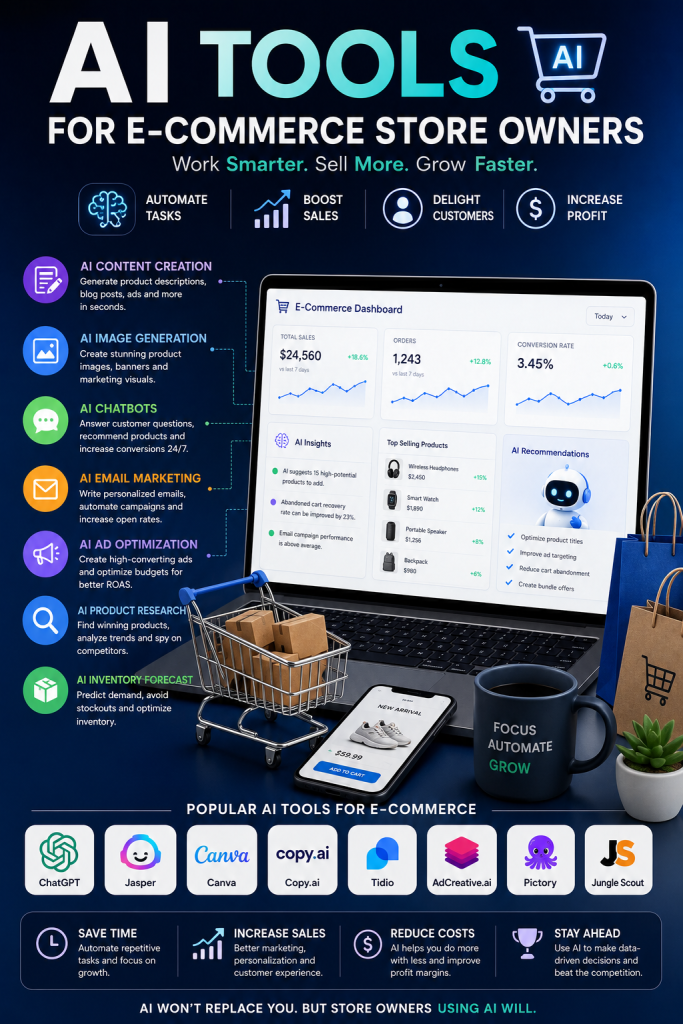
Comparison Table: Finding Your Match
Use this comparison table to identify which automation tool solves your store’s immediate operational challenges:
| Tool Name | Primary Purpose | Standout Feature | Best Suited For |
| Octane AI | Buyer Quizzes & Personalization | Interactive product recommendation quizzes | DTC brands & specialized stores |
| Photoroom | Product Photography | Instant background removal & studio scenes | Independent sellers & catalog managers |
| Gorgias AI | Automated Customer Service | Auto-replies to order tracking inquiries | High-volume stores with heavy ticket loads |
| Copy.ai | Product Descriptions | Bulk SEO description & ad text generation | Stores expanding large product catalogs |
| Searchspring | Site Search & Merchandising | Intent-based search & visual grid editor | Brands with broad product selections |
| Klaviyo AI | Predictive Email & SMS | Forecasts churn risk & next-purchase timing | Retention marketers & email teams |
| Triple Whale | Ad Attribution & Analytics | Accurate cross-channel ad tracking & net profit | Paid media buyers & store founders |
| Pebblely | Social Ad Graphics | Generates lifestyle backgrounds for products | Social media managers & ad creators |
| Syte | Visual Search & Auto-Tagging | Search-by-image camera tool for shoppers | Fashion, furniture, & lifestyle stores |
| Descript | Product Video Editing | Edits video reels through text transcripts | Content creators & video ad marketers |
How You Can Integrate AI Tools into Your E-commerce Workflow
To achieve genuine growth, you must implement software step-by-step rather than trying to automate everything overnight. Follow these practical steps to build an efficient automated store:
Step 1: Identify Your Biggest Daily Operational Bottleneck
Take a look at your daily schedule and pinpoint the single task that consumes most of your working time. Is it answering repetitive customer emails, editing photos, or writing descriptions?
Focus on automating that specific bottleneck first. Solving your biggest time-drain immediately gives you back the mental bandwidth needed to tackle other areas of your business.
Step 2: Connect Tools to Your Central Store Platform
Install selected applications directly through your platform app store (such as the Shopify App Store or WooCommerce Plugin Directory). Grant necessary permissions for product catalog and order syncing.
Ensure data flows smoothly between your inventory database and your new software. This prevents stock discrepancies or inaccurate order tracking responses.
Step 3: Establish Guidelines and Review Outputs Regularly
Never leave automation completely unsupervised when launching a new tool. Set up brand voice guidelines, review generated description drafts, and inspect customer service auto-responses.
Spend time refining your prompts and settings during the first few weeks. Training the software on your specific products ensures its output remains accurate and aligned with your brand voice.
Step 4: Monitor Conversion Rates and Key Store Metrics
Track store metrics closely after integrating new solutions. Monitor your conversion rates, average order value, customer ticket resolution times, and return on ad spend.
Use these insights to double down on tools that deliver a clear financial return, and tweak or remove software that does not add measurable value to your business.
Frequently Asked Questions (FAQ)
What are the best AI tools for e-commerce store owners in 2026?
Top solutions include Octane AI for product quizzes, Photoroom for product photography, Gorgias AI for customer support, Copy.ai for copywriting, Klaviyo AI for email marketing, and Triple Whale for ad analytics.
Will using AI generated product descriptions harm my store’s SEO?
No, provided the descriptions are high quality, unique, and helpful to human readers. Ensure you edit generated descriptions to include accurate product details and relevant keywords before publishing.
Are automated customer service tools safe to use on small stores?
Yes, platforms like Gorgias AI are built specifically for retail security. They handle routine questions like order tracking safely while routing complex customer issues directly to human support staff.
Do I need coding skills to use these store tools?
No, the vast majority of modern e-commerce automation platforms are built for non-technical users. They feature simple drag-and-drop interfaces and one-click integrations with major store builders.
How much do e-commerce automation tools cost?
Pricing varies widely based on store volume and feature tiers. Many tools offer free plans or trial periods, while paid subscriptions typically range from fifteen dollars to several hundred dollars monthly for advanced enterprise features.
Conclusion
Running a successful online store in 2026 does not require working endless hours or managing every single task manually. By adopting the best AI tools for e-commerce store owners, you can transform a chaotic workload into a streamlined, automated business engine.
Whether you start with Photoroom for clean photo editing, Copy.ai for fast descriptions, or Gorgias AI for customer support, taking action today will give you a competitive edge. Pick the platform that addresses your biggest headache and start scaling your online shop efficiently.
Editor’s Opinion
i have been running my online shop for years now and using these automated tools really saved my business. before setting them up, i was spending all night answering support chats and editing photo backgrounds manually. now i just let the software handle the daily boring stuff while i focus on getting new products. sure, sometimes the description generator makes a weird word choice, but it is so easy to fix. if you run an online shop and feel overwhelmed, you should try at least one of these platforms. it makes your store run smooth and gives you your free time back.
