
“RollerCoaster Tycoon” is a series of video games that simulate amusement park management. The first game, released in 1999, was developed by Scottish programmer Chris Sawyer and published by Hasbro Interactive.
The game puts players in charge of managing amusement parks, which include various rides and attractions, such as roller coasters, ferris wheels, and food stands. The players’ objective is to successfully manage these parks to meet certain goals, which can range from attracting a certain number of guests to achieving a certain park rating or earning a certain income.
RollerCoaster Tycoon Facts
- “RollerCoaster Tycoon” was developed by Chris Sawyer, a Scottish game developer, who spent two years working on the project almost single-handedly.
- The game was programmed primarily in assembly language, a low-level programming language, which is an unusual choice for game development, especially in the late 1990s. This contributed to the game’s efficient performance even on lower-end systems.
- It was initially released for Microsoft Windows in 1999, and later for Xbox.
- The game introduced a unique feature that allowed players to build and customize their own roller coasters, which could then be evaluated and ridden by park guests.
- “RollerCoaster Tycoon” has two expansion packs: “Added Attractions” (released in the US as “Corkscrew Follies”) in 1999, and “Loopy Landscapes” in 2000.
- The game was a commercial success, with over 4 million copies sold worldwide by 2002.
- The game was based on the concept of micromanagement, requiring players to oversee every aspect of park operation, including staff hiring and training, ride construction and maintenance, and pricing strategy.
- “RollerCoaster Tycoon” includes scenarios based on real-world amusement parks. Some of these include Blackpool Pleasure Beach and Alton Towers in the UK.
- While the game primarily focused on roller coasters, it also included various other attractions such as Ferris wheels, go-karts, and even water rides.
- Players could also manipulate the landscape of their park, sculpting land, adding or removing water, and planting trees and other decorations.
- One popular feature of the game was the ability to “crash” roller coasters, leading to some dark humor as guests could be injured or even “die” in the game, which could in turn affect the park’s popularity and ratings.
- The game included a financial system, with players needing to take out loans for large projects and manage their parks within their budget to be successful.
- The graphics of the game, although fairly simple by today’s standards, were impressive at the time and allowed for a wide range of customization.
- “RollerCoaster Tycoon” is considered one of the best simulation games of all time, and its success helped spawn a new genre of games, the “tycoon” genre.
- The game was followed by several sequels, including “RollerCoaster Tycoon 2” and “RollerCoaster Tycoon 3”, as well as a number of spin-offs for various platforms. The franchise continues to be popular more than two decades after the release of the original game.
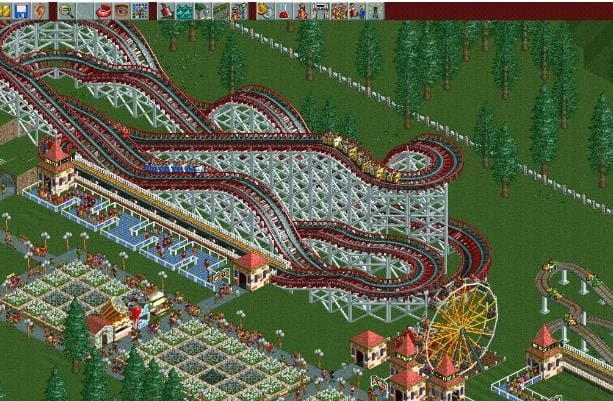
RollerCoaster Tycoon Gameplay
- Understand the basics of supply and demand: If your park is packed and your ride queues are full, it’s likely you can increase the admission price of those popular rides. Conversely, if a ride isn’t getting much traffic, you might need to lower its price or advertise it.
- Keep an eye on your guests’ thoughts: The thoughts of your guests are an invaluable resource. They can tell you if your park entry fee is too high, if your park is dirty, if they can’t find the exit, or if they’re hungry or thirsty, among other things. Use this feedback to constantly tweak and improve your park.
- Manage your staff effectively: Hire enough staff to keep your park clean and your rides functional, but don’t overstaff and waste money. It’s often a good idea to set patrol areas for your handymen to ensure all areas are covered without any overlap.
- Design efficient paths: Make sure there are plenty of paths leading to popular attractions and that guests can easily find their way around without getting lost. Dead-end paths can often lead to lost and unhappy guests.
- Test your rides: Before opening a new ride, especially roller coasters, make sure to test them first to ensure they’re safe and enjoyable.
- Start with gentle rides and build up: At the start of the game, don’t just rush into building the biggest and most exciting rides. Start with smaller, gentler rides and gradually build up to bigger ones as your park grows and becomes more popular.
- Advertise: Use the advertising campaigns to attract more guests to your park or specific rides.
- Stay on top of your finances: Keep an eye on your park’s income and expenditure, and make sure you’re turning a profit. Take out loans only if necessary, and try to pay them back as soon as possible.
- Have a good mix of rides: To attract as many guests as possible, try to have a good mix of thrill rides, gentle rides, and roller coasters. Different guests have different preferences, so a good variety can help maximize your park’s appeal.
- Use scenery and landscaping: Scenery and landscaping can make rides more exciting and improve the overall attractiveness of your park. But remember, don’t overspend on scenery if your budget is tight.
RollerCoaster Tycoon game control keys
- Arrow keys: These keys move the view around the park. You can also click and drag with the mouse to achieve the same effect.
- Shift: Holding this while placing a ride or attraction can raise or lower it.
- + and – keys: These keys can zoom in and out of the game view.
- Enter: Rotates the view 90 degrees.
- F1-F4: These keys correspond to the speed of the game. F1 sets the game to pause, F2 is the slowest speed, F3 is normal speed, and F4 is the fastest speed.
- Page Up and Page Down: These keys can raise or lower the land when using the landscaping tool.
