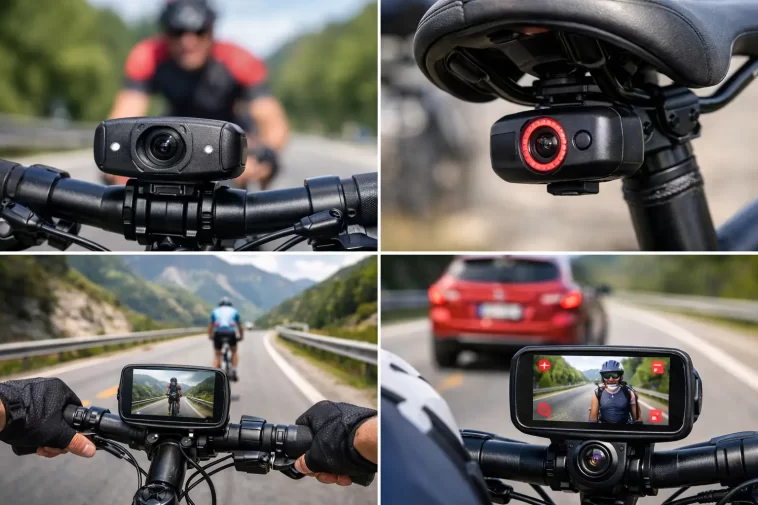
Best bike cameras in 2026 do two things well: they capture your rides in vivid detail, and they protect you when things go wrong on the road.
Whether you’re a road cyclist wanting cinematic footage for YouTube, a commuter who needs dashcam-style incident recording, or a mountain biker chasing the perfect POV shot on a technical descent — there’s a camera built exactly for how you ride.
The tricky part is that “bike camera” means different things to different cyclists. An action camera mounted on your helmet isn’t the same as a dedicated front dashcam that runs for seven hours and automatically saves footage when a driver cuts you off. This guide covers both — and everything in between.
Here are the 10 best bike cameras available in 2026, chosen for real-world cycling performance, durability, stabilization, and honest value for money.
What Makes a Good Bike Camera?
Before the list, it’s worth being clear about what actually matters when a camera is strapped to a bike or helmet. Specs that look impressive in a product sheet often mean less in practice than these core requirements:
- Stabilization — Bikes vibrate, bounce, and hit potholes. A camera without effective stabilization produces unwatchable shaky footage. Look for EIS (electronic image stabilization), horizon lock, or built-in gimbal systems.
- Battery life — Most action cameras die in 60–90 minutes. For cyclists doing long rides, this is a dealbreaker. Specific cycling cameras like Cycliq models last 7+ hours.
- Waterproofing — Rain, spray, and mud are guaranteed on most rides. A minimum IPX5 rating (rain resistant) is essential; IPX8 (fully submersible) is better.
- Mounting system — Handlebar mounts, helmet mounts, and seat rail mounts serve different purposes. Check what’s included and how secure the attachment is on rough terrain.
- Field of view — A wider lens (150°+) captures more of your surroundings and is more useful for incident recording. A narrower lens gives cleaner, less distorted footage for cinematic use.
- Low-light performance — Early morning commutes and evening rides require a camera that doesn’t turn to noise in low light.
- Loop recording — Essential for dashcam-style safety use. Old footage is automatically overwritten when the card is full, but incident footage is locked and preserved.
1. GoPro HERO 13 Black — Best Overall Bike Camera
Price: $329
The GoPro HERO 13 Black is still the benchmark in 2026 for most cyclists. It shoots 5.3K at 60fps, runs HyperSmooth 6.0 stabilization (the most effective EIS system available in an action camera), and is waterproof to 33 feet without any additional housing. The new modular HB lens system adds options that previous GoPros never had — including an anamorphic lens for widescreen cinematic footage and a macro lens for close-up detail shots.
For cycling specifically, HyperSmooth 6.0 is the headline feature. It handles road vibration, cobblestones, and rough gravel trails with impressive smoothness. The AutoBoost mode dynamically adjusts stabilization intensity, so you’re never over-cropping for unnecessary stability on smooth roads.
The HERO 13 also introduces a slightly larger 1,900mAh battery, good for up to 90 minutes of 4K/30fps recording — an improvement over earlier models. The 8:7 aspect ratio sensor means you can crop to any format (landscape, portrait, square) without losing quality, which is ideal for creators who publish across YouTube, TikTok, and Instagram simultaneously.
Best for: Road cyclists, mountain bikers, and content creators who want the best all-around action camera.
Pros:
- HyperSmooth 6.0 — best stabilization in the category
- 5.3K/60fps, 4K/120fps slow motion
- Waterproof to 33ft, no housing needed
- Modular HB lens system for creative flexibility
- Massive accessory ecosystem
Cons:
- No front-facing selfie screen (GoPro Max Lens Mod 2.0 helps but costs extra)
- Battery life of ~90 min is limiting on longer rides
- No charging while recording
2. Insta360 Ace Pro 2 — Best for Helmet Mounting & Low Light
Price: ~$429–$509
The Insta360 Ace Pro 2 is widely regarded as the best helmet camera for cyclists in 2026, particularly for mountain bikers and those who ride in variable or low-light conditions. Its Leica-branded SUMMARIT lens and dual AI chip produce 8K video at 30fps and some of the cleanest low-light footage available in an action camera at this price.
The 2.5-inch flip screen is a standout feature for solo creators — you can check your framing without removing the camera from your helmet. Subject tracking is AI-powered and works well for following-shot scenarios. The 3-hour battery life is respectable, and the camera’s body is built to handle the knocks and scrapes that come with aggressive riding.
For trail and mountain bike riders who push into forested, shaded terrain — where most action cameras struggle with grain and loss of detail — the Ace Pro 2’s low-light performance is genuinely class-leading.
Best for: Mountain bikers, trail riders, helmet-mounted POV footage, low-light conditions.
Pros:
- 8K video with Leica SUMMARIT optics
- Best-in-class low-light performance
- 2.5-inch flip screen for easy framing
- AI subject tracking for dynamic shots
- 3-hour battery life
Cons:
- Larger and heavier than ultra-compact options
- More expensive than standard action cameras
- 8K recording requires fast, high-capacity memory cards
3. DJI Osmo Nano — Best Compact Wearable Bike Camera
Price: ~$239–$329
The DJI Osmo Nano launched in late 2025 and immediately stood out as one of the most innovative bike camera designs available. It features a modular, magnetic design where the camera module detaches from its battery/screen unit — the camera alone weighs just 52g, making it one of the lightest usable action cameras available.
The 1/1.3-inch CMOS sensor delivers 4K/60fps video with 10-bit color and D-Log M support for professional color grading. The camera can be worn around your neck on a magnetic lanyard, clipped to a helmet, attached magnetically to your jersey, or mounted to your bike’s handlebars — the versatility is remarkable.
Battery life from the camera alone is about 90 minutes, but docked to the Vision Dock accessory unit that extends to 200 minutes — more than enough for most cycling sessions. It’s waterproof up to 10 meters (camera only), which covers anything short of full submersion during rain or stream crossings.
Note: Like the DJI Osmo Pocket 4, the Osmo Nano has limited official availability in the US due to DJI’s FCC situation. UK and international buyers have no such restriction.
Best for: Commuters, casual cyclists, and content creators who want a minimal, wearable camera that mounts anywhere.
Pros:
- Ultra-light at 52g (camera module only)
- 4K/60fps, 10-bit, D-Log M for color grading
- Innovative magnetic mounting — attach anywhere
- 200 minutes with Vision Dock attached
- Waterproof to 10m
Cons:
- Limited US availability through official channels
- Smaller 1/1.3″ sensor vs. dedicated action cameras
- No built-in screen on the camera module itself
4. Insta360 X5 — Best 360° Bike Camera
Price: $559
The Insta360 X5 is the most versatile bike camera available if you shoot 360° content — and if you don’t yet, it might change your mind about whether you should.
The X5 captures 8K 360° video, which means you film every direction simultaneously. After the ride, you reframe your shots in the app — choosing what direction to look, zooming in, or creating dynamic camera movements that would require a drone or camera car to achieve conventionally. The third-person bike mount, which positions the camera on a pole behind and above the front wheel, produces footage that looks like it came from a professional cycling documentary.
AI-powered features auto-select highlights, track subjects, and simplify the post-production workflow considerably. The X5 is waterproof to 33 feet and performs well in low light for a 360° camera — a category where competitors often struggle.
If you ride solo and want footage that makes your channel look professional without bringing a second camera operator, the X5’s “reframe in post” approach solves a real problem.
Best for: Content creators, solo cyclists who want dynamic angles, YouTubers who want cinematic cycling footage.
Pros:
- 8K 360° video — reframe any angle in post
- Third-person bike mount creates cinematic drone-like shots
- AI highlight detection and subject tracking
- Waterproof to 33ft
- Strong low-light performance for 360° category
Cons:
- Requires more post-production time than standard cameras
- Stitching artifacts can appear in tight mounting situations
- More expensive than most action cameras
5. Cycliq Fly12 Sport — Best Front Safety Camera for Road Cyclists
Price: ~$249–$299
The Cycliq Fly12 Sport is a different kind of bike camera entirely. It’s not primarily designed to create cinematic content — it’s a dedicated cycling dashcam that combines a front-facing camera with a 400-lumen front light. Think of it as the cycling equivalent of a car’s dashcam.
It records continuously in a loop, automatically overwriting old footage but locking and preserving any footage triggered by an incident (a sudden hard braking event, a crash, or a sharp impact). This makes it invaluable for road cyclists who deal with close passes, dangerous driving, and near-misses — common experiences that many cyclists wish they’d had on camera afterward.
The QHD camera records at 2560×1440p/30fps with 6-axis stabilization, captures license plates clearly, and features a new OLED display screen. The seven-hour battery life means it runs for your entire ride — something no GoPro or Insta360 can claim. The Strava data overlay feature lets you embed speed, route, and heart rate data directly into the footage.
Best for: Road cyclists, commuters, and touring riders who want dashcam-style safety recording.
Pros:
- 7-hour battery — outlasts any ride
- Smart incident detection locks and saves crucial footage
- Combines camera + 400-lumen front light in one unit
- Strava data overlay on footage
- Loop recording, always-on protection
Cons:
- Lower resolution than dedicated action cameras
- No slow-motion capability
- Less useful for content creation than safety recording
6. Cycliq Fly6 Pro — Best Rear Safety Camera
Price: ~$199–$249
If the Fly12 Sport is the front dashcam, the Cycliq Fly6 Pro is its rear equivalent. It mounts to your seatpost, points backward, and records continuously — capturing every vehicle that comes up behind you.
The Fly6 Pro records in 4K UHD (3840×2160/30fps) with 6-axis stabilization and features a dual LED rear light at 100 lumens. Like the Fly12 Sport, it runs seven hours on a single charge, uses loop recording, and automatically locks footage when an incident is detected. IP67 waterproofing means it handles full rain and mud without any issues.
The combination of the Fly12 Sport (front) and Fly6 Pro (rear) gives road cyclists complete coverage — the same logic that makes dual dashcams standard in cars. Cycliq even sells both as a bundle for those who want full-circle protection.
Best for: Road cyclists and commuters who want rear incident coverage and safety documentation.
Pros:
- 4K rear recording with 6-axis stabilization
- 7-hour battery, always-on loop recording
- Incident protection mode locks footage automatically
- IP67 waterproofing — fully weatherproof
- Integrated 100-lumen rear safety light
Cons:
- Primarily a safety camera, not a content creation tool
- Less creative flexibility than action cameras
- Resolution, while 4K, is lower bitrate than action camera 4K
7. DJI Osmo Action 6 — Best Budget Action Camera for Cyclists
Price: ~$199–$249
The DJI Osmo Action 6 is the most accessible action camera on this list that doesn’t compromise on the things cyclists actually care about. RockSteady 3.0 stabilization keeps footage smooth over rough surfaces, the front-facing color screen lets you check framing without removing the camera (something the GoPro HERO 13 Black lacks without an accessory), and the larger sensor delivers solid performance in low-light conditions.
Battery life is where the Osmo Action 6 genuinely surpasses the GoPro — up to 160 minutes of recording on a single charge, which means fewer mid-ride battery swaps. The magnetic quick-release mounting system makes it fast to attach and remove from your bike or helmet, and DJI’s cycling accessory kit adds handlebar and seat rail mounts for road-specific positioning.
For cyclists on a budget who don’t need 5K resolution or the most advanced stabilization available, the Action 6 punches well above its price.
Best for: Budget-conscious cyclists, casual riders, commuters wanting a reliable action camera without the GoPro price tag.
Pros:
- Front-facing color screen for easy self-monitoring
- Up to 160-minute battery life — significantly longer than GoPro
- RockSteady 3.0 effective on rough terrain
- Magnetic quick-release mounting
- More affordable than competitors
Cons:
- Lower maximum resolution than GoPro HERO 13 Black
- Smaller accessory ecosystem
- Not officially available in US through DJI channels
8. Insta360 GO 3S — Best Ultra-Compact Bike Camera
Price: ~$349–$399
The Insta360 GO 3S is the smallest serious bike camera available. At just 39g, the camera module is barely larger than your thumb — yet it shoots 4K/30fps video with effective image stabilization and a wide field of view.
The two-part modular system works well for cycling: the tiny camera module can be mounted almost anywhere (on a helmet, jersey, seatpost, or handlebars), while the larger Action Pod acts as a controller and extended battery when needed. The pod’s flip screen lets you preview footage and adjust settings between segments of your ride.
For cyclists who want multiple camera angles without the weight and bulk of full-size action cameras — a helmet cam and a handlebar cam simultaneously, for example — the GO 3S’s minimal footprint makes it uniquely practical. Pairing two of them for multi-angle coverage is cheaper and lighter than equivalent setups with larger cameras.
The main limitation is battery life: the camera alone runs for about 38 minutes, extended to 140 minutes with the Action Pod. For shorter rides or commutes, this is fine. For long rides, you’ll need to bring the pod.
Best for: Cyclists who want the smallest possible camera, multi-angle setups, and minimal weight on helmet or body.
Pros:
- 39g camera module — barely noticeable on a helmet
- 4K/30fps video, effective stabilization
- Mount almost anywhere due to tiny size
- Magnetic mounting system
- Good for multi-angle creative setups
Cons:
- Only 38 minutes battery in camera-only mode (140 with Action Pod)
- 4K limited to 30fps (no 60fps)
- 64GB or 128GB internal storage, no memory card
9. GoPro MAX 2 — Best 360° Alternative
Price: ~$399–$449
The GoPro MAX 2 is GoPro’s answer to the Insta360 X5 in the 360° camera category, and it holds up well. For cyclists already invested in the GoPro ecosystem — with existing mounts, accessories, and the GoPro subscription — it’s a natural extension that adds 360° shooting capability without switching to a new brand.
The MAX 2 shoots in full 360° and also functions as a conventional HERO-style action camera using the front or rear lens independently. The MAXSMOOTH stabilization performs excellently when mounted on a bike — the footage holds up smoothly even on rough terrain or during fast descents. The camera is waterproof to 16 feet without housing.
One cycling-specific advantage is the GoPro mount ecosystem compatibility. Virtually every cycling mount, chest harness, and helmet clip that works with HERO cameras also works with the MAX 2, which simplifies things considerably.
Best for: GoPro ecosystem users, cyclists who want 360° coverage with familiar mounting and app experience.
Pros:
- 360° shooting plus conventional single-lens modes
- MAXSMOOTH stabilization for bump-free footage
- Full GoPro ecosystem compatibility
- Waterproof to 16ft without a case
- Versatile shooting modes for creative content
Cons:
- Lower resolution than Insta360 X5 in 360° mode
- More expensive than the GoPro HERO 13 Black
- Bulkier than single-lens action cameras
10. Garmin Varia RCT715 — Best All-in-One Cycling Safety Camera
Price: ~$299–$349
The Garmin Varia RCT715 takes a completely different approach to the bike camera category. Rather than prioritizing video quality for content creation, it’s built around safety and ride intelligence — integrating a rear-facing radar system with a dash-camera and a 65-lumen rear light in a single unit.
The radar component detects vehicles approaching from behind up to 140 meters away, alerting you via your Garmin bike computer or Apple Watch before the vehicle is visible in your mirrors. The 1440p camera captures the rear view continuously, automatically saving footage when an incident is detected. For road cyclists and commuters who prioritize safety awareness over video quality, this combination is genuinely unique — no other camera on this list tells you a car is approaching before you can see or hear it.
The footage quality is good rather than exceptional (1440p rather than 4K), but the primary value here is integration with Garmin’s cycling ecosystem and the radar intelligence that adds real-time awareness to your ride.
Best for: Road cyclists who use Garmin computers, safety-focused commuters, cyclists who ride in high-traffic environments.
Pros:
- Rear radar detects vehicles up to 140m away
- Automatically saves footage on incident detection
- Integrates with Garmin Edge computers and Apple Watch
- Combines radar, camera, and rear light in one unit
- Weatherproof for all-weather use
Cons:
- 1440p is lower resolution than dedicated action cameras
- Only a rear camera — no front coverage without a separate unit
- Full value requires Garmin cycling computer for radar alerts
- More expensive than standalone action cameras
Full Comparison Table
| Camera | Price | Resolution | Battery | Best Use | Waterproof |
|---|---|---|---|---|---|
| GoPro HERO 13 Black | $329 | 5.3K/60fps | ~90 min | Content + action | 33ft |
| Insta360 Ace Pro 2 | ~$429 | 8K/30fps | ~180 min | Helmet, low light | 33ft |
| DJI Osmo Nano | ~$270 | 4K/60fps | 200 min (w/ dock) | Wearable, compact | 33ft |
| Insta360 X5 | $559 | 8K 360° | ~135 min | 360° creative | 33ft |
| Cycliq Fly12 Sport | ~$269 | QHD/30fps | 7 hours | Front dashcam | Yes |
| Cycliq Fly6 Pro | ~$229 | 4K/30fps | 7 hours | Rear dashcam | IP67 |
| DJI Osmo Action 6 | ~$229 | 4K/60fps | ~160 min | Budget action | 33ft |
| Insta360 GO 3S | ~$379 | 4K/30fps | 140 min (w/ pod) | Ultra-compact | 33ft |
| GoPro MAX 2 | ~$429 | 5.7K 360° | ~90 min | 360° + GoPro eco | 16ft |
| Garmin Varia RCT715 | ~$329 | 1440p | ~10 hours | Radar + rear cam | Yes |
How to Choose the Right Bike Camera
For road cyclists and commuters who ride in traffic → Cycliq Fly12 Sport (front) + Fly6 Pro (rear) gives you dashcam-style protection with 7-hour battery. Add a Garmin Varia RCT715 if you want radar alerts as well.
For mountain bikers and trail riders → Insta360 Ace Pro 2 on the helmet for the best low-light performance on shaded trails. GoPro HERO 13 Black is a great alternative if you’re already in that ecosystem.
For cyclists who create YouTube content → GoPro HERO 13 Black for handlebar or helmet footage, Insta360 X5 for cinematic 360° shots that make your channel look professional.
For commuters and casual cyclists on a budget → DJI Osmo Action 6 at ~$229 gives you reliable 4K action camera performance with a front-facing screen at a price that doesn’t sting.
For cyclists who want the lightest possible setup → Insta360 GO 3S at 39g is genuinely unnoticeable on a helmet or jersey, with 4K quality in a package smaller than your thumb.
For Garmin ecosystem users → Garmin Varia RCT715 integrates seamlessly with your Edge computer for radar + camera + light in one unit.
FAQ: Best Bike Cameras 2026
Q: What is the best bike camera overall in 2026?
The GoPro HERO 13 Black is the best all-around choice for most cyclists. It offers the most effective stabilization (HyperSmooth 6.0), the widest accessory ecosystem, and waterproofing without a housing. For safety-focused road cyclists, the Cycliq Fly12 Sport is the better choice due to its 7-hour battery and dashcam functionality.
Q: Do I need a 360° bike camera?
Not unless you want the creative flexibility to reframe footage after the ride. 360° cameras like the Insta360 X5 produce footage that looks cinematic and unique — particularly with the third-person bike mount — but they require more post-production time. For safety recording or straightforward POV footage, a standard action camera is simpler and often better.
Q: How long should a bike camera battery last?
Most action cameras last 60–90 minutes, which is fine for short commutes and mountain bike sessions. For long road rides or touring, you’ll need a dedicated cycling camera like the Cycliq Fly12 Sport (7 hours) or should plan on carrying spare batteries. The DJI Osmo Action 6 (up to 160 minutes) is a good middle ground.
Q: What is the best camera for recording cycling evidence and insurance?
The Cycliq Fly12 Sport (front) and Cycliq Fly6 Pro (rear) are purpose-built for exactly this. They run continuously on a loop, automatically save footage when a crash or incident is detected, and record high enough quality to capture license plates. The Garmin Varia RCT715 adds radar detection for cars approaching from behind.
Q: Where should I mount a bike camera?
The most common positions are: handlebars (for a road-level forward view), helmet (for a POV perspective that moves with your head), chest (for a stable frontal view), and seatpost (for rear coverage). Many serious cyclists run two cameras — a front-facing handlebar or helmet mount and a rear-facing seatpost camera for full coverage.
Q: Is GoPro still the best action camera for cycling in 2026?
GoPro HERO 13 Black is still the best traditional action camera for cycling, with the most effective stabilization and the largest mounting ecosystem. However, the Insta360 Ace Pro 2 beats it in low-light performance, and DJI cameras like the Osmo Action 6 beat it on battery life. The right choice depends on your priorities.
Q: What frame rate do I need for cycling footage?
For standard footage, 4K/30fps is sufficient and gives you large file sizes without excessive storage use. For smooth slow-motion playback, look for 4K/60fps or higher. The GoPro HERO 13 Black offers 4K at 120fps for detailed slow motion — useful for analyzing technique or capturing dramatic crash footage.
Final Thoughts
The best bike cameras in 2026 fall into two clear categories: content cameras and safety cameras. The best choice for you depends on which one matters more.
If you create cycling content for YouTube, TikTok, or social media, the GoPro HERO 13 Black remains the benchmark. The Insta360 X5 adds creative angles that feel genuinely cinematic. The Insta360 Ace Pro 2 is the best option if your rides regularly take you into shaded or low-light terrain.
If your priority is on-road safety and incident evidence, the Cycliq ecosystem (Fly12 Sport + Fly6 Pro) is the most purpose-built solution available. Add the Garmin Varia RCT715 if radar detection is important to you.
Most cyclists end up with something from both categories eventually. A small action camera for capturing the ride, and a dedicated front or rear safety camera running in the background, just in case.
All prices are approximate and based on information available as of June 2026. Prices may vary by retailer and region.
