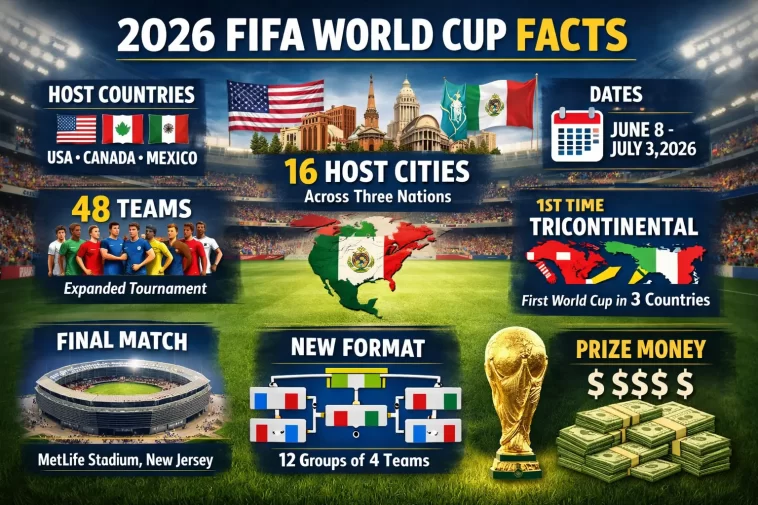
The 2026 FIFA World Cup is shaping up to be the biggest sporting event in human history. For the first time ever, three countries will co-host the tournament — the United States, Canada, and Mexico. With 48 teams, 104 matches, and stadiums packed across two continents, there’s a lot to take in.
Whether you’re a die-hard football fan or just getting into it, these 100 facts will give you everything you need to know before the tournament kicks off.
General Overview
- The 2026 FIFA World Cup will be held across the United States, Canada, and Mexico — the first time three nations have co-hosted.
- It will be the first World Cup to feature 48 teams, up from the previous 32.
- A total of 104 matches will be played throughout the tournament.
- The expanded format means more matches than any previous World Cup in history.
- The tournament is scheduled to run from June 11 to July 19, 2026.
- This marks the first time the USA has hosted the World Cup since 1994.
- Mexico becomes the first country to host the World Cup three times (1970, 1986, 2026).
- Canada will be hosting the FIFA World Cup for the very first time.
- The official name of the tournament is FIFA World Cup 2026™.
- FIFA selected the three-nation host bid in June 2018, defeating Morocco’s rival bid.
Host Cities and Stadiums
- Sixteen cities across three countries will host matches.
- The United States will host 11 cities: New York/New Jersey, Los Angeles, Dallas, San Francisco Bay Area, Miami, Atlanta, Seattle, Boston, Kansas City, Houston, and Philadelphia.
- Canada will host two cities: Toronto and Vancouver.
- Mexico will host three cities: Mexico City, Guadalajara, and Monterrey.
- MetLife Stadium in East Rutherford, New Jersey, will host the final.
- MetLife Stadium has a capacity of over 82,500 — making it one of the largest World Cup final venues ever.
- SoFi Stadium in Los Angeles will host the third-place match.
- Estadio Azteca in Mexico City will become the first stadium to host World Cup matches in three different tournaments (1970, 1986, 2026).
- AT&T Stadium in Arlington, Texas, is one of the largest indoor stadiums in the world and will host several matches.
- BC Place in Vancouver will be Canada’s main World Cup venue.
- BMO Field in Toronto, the home of Toronto FC, will also host matches.
- Estadio BBVA in Monterrey is considered one of the most modern stadiums in Latin America.
- Levi’s Stadium in Santa Clara, California, hosted the 2016 Copa América final — making it a familiar big-event venue.
- Gillette Stadium in Foxborough, Massachusetts (home of the New England Patriots) is one of the Boston-area venues.
- Hard Rock Stadium in Miami is another NFL stadium that will be converted for World Cup use.
The New 48-Team Format
- The 2026 World Cup is the first to use the new 48-team format officially approved by FIFA in 2017.
- Teams will be divided into 12 groups of four teams each.
- The top two teams from each group, plus the eight best third-place teams, will advance to the Round of 32.
- The Round of 32 is a new stage — something never seen in a World Cup before.
- From the Round of 32 onward, it becomes a straightforward knockout tournament.
- The expanded format gives more countries, especially smaller footballing nations, the chance to qualify.
- Africa’s allocation increases to 9 spots (from 5), giving African football a bigger stage.
- Asia gets 8.5 spots (up from 4.5), reflecting the continent’s growing football development.
- CONCACAF (North and Central America and Caribbean) gets 6 spots, up from 3.5.
- Europe retains the most spots with 16 teams.
- South America will have 6 spots.
- Oceania gets 1 guaranteed spot for the first time.
- The inter-confederation playoffs will determine the remaining spots.
- With 48 teams, it’s possible that some group stage matches will be played between nations that have never met competitively before.
- Critics of the new format argue that the extra round of 16 teams adds length without significantly improving quality. Supporters say the opposite.
History and Records
- Brazil holds the record for most World Cup titles with five (1958, 1962, 1970, 1994, 2002).
- Germany and Italy each have four World Cup titles.
- Argentina won the most recent World Cup, claiming their third title at Qatar 2022.
- The highest-scoring World Cup match remains France vs. Zaire in 1974 — France won 10–2 (though this is sometimes disputed in comparison to context).
- Just Fontaine (France) still holds the record for most goals in a single World Cup tournament — 13 goals in 1958.
- Miroslav Klose (Germany) holds the all-time World Cup scoring record with 16 goals.
- Cafu of Brazil is the only player to appear in three consecutive World Cup finals (1994, 1998, 2002).
- The 1950 World Cup final was actually a final group match, not a knockout game — Uruguay beat Brazil 2–1 in what became known as the “Maracanazo.”
- Only eight nations have ever won the World Cup: Brazil, Germany, Italy, Argentina, France, England, Uruguay, and Spain.
- The youngest World Cup goalscorer in history is Pelé, who scored at just 17 years old in 1958.
Qualification and Teams
- The qualification process for 2026 began in 2023 across all six FIFA confederations.
- Host nations USA, Canada, and Mexico automatically qualified for the tournament.
- For the first time, three automatic qualifiers are from the same confederation (CONCACAF).
- Several European giants like England, France, Germany, Spain, and Portugal are among the expected favorites.
- The 2026 World Cup could be the last for aging stars such as Lionel Messi and Cristiano Ronaldo, if they qualify and choose to participate.
- Lionel Messi won his first World Cup title at Qatar 2022 and could potentially defend it at 2026, aged 38.
- Japan, South Korea, and Australia continue to be Asia’s strongest footballing nations, with all three expected to qualify.
- African powerhouses Nigeria, Senegal, Morocco, and Cameroon are all strong contenders from the continent.
- Saudi Arabia’s stunning upset of Argentina at Qatar 2022 showed that any team can surprise on the World Cup stage.
- New Zealand, Solomon Islands, or Tahiti are the likely Oceania qualifiers — meaning potentially a historic debut for a Pacific nation in the main draw.
Fan and Cultural Facts
- The 2026 World Cup is expected to be the most-watched sporting event in history, with an estimated global TV audience exceeding five billion people.
- The United States is projected to see over 1.5 million international visitors during the tournament.
- The economic impact on the three host nations is estimated to be in the billions of dollars.
- Major fan zones are planned in all 16 host cities to handle the overflow of ticketed and un-ticketed fans.
- English, Spanish, and French are the three official FIFA languages for the event.
- The 2026 World Cup will cover more geographic distance between venues than any previous tournament, with matches spanning over 3,000 miles from Vancouver to Miami.
- Travel time between some venues — such as Vancouver and Miami — is over six hours by plane.
- This is expected to challenge teams in terms of travel fatigue and acclimatization.
- Fans traveling between venues may find themselves switching climates dramatically, from cooler Canadian cities to humid, tropical Miami.
- The local time zone difference between the easternmost and westernmost venues is three hours (Eastern vs. Pacific Time).
Technology and Innovation
- The 2026 World Cup will use the most advanced VAR (Video Assistant Referee) system yet deployed in a FIFA tournament.
- Semi-Automated Offside Technology (SAOT), first used at Qatar 2022, will continue to be a core part of officiating.
- AI-powered analytics are expected to play a bigger role than ever before — both for teams and for broadcasters.
- Broadcasters are exploring 8K live streaming for select matches, pushing the boundaries of sports media.
- FIFA is testing real-time in-stadium data overlays for fans, providing live stats and heatmaps on phone apps during matches.
- Wearable technology will be used by almost every national team for player monitoring and injury prevention.
- Goal-line technology has been standard since 2014 and will of course be in use again.
- Drone cameras are expected to offer new aerial broadcast angles inside some stadiums.
- The official match ball for 2026 has not yet been revealed (as of mid-2025), but Adidas will produce it — as they have for every World Cup since 1970.
- Smart ticketing systems using biometric data are being considered to reduce fraud and scalping.
Interesting and Surprising Facts
- The 2026 World Cup final at MetLife Stadium will be played on an artificial turf field — which has already drawn criticism from players and coaches.
- FIFA has been urged by players’ unions to ensure all final-stage venues use natural grass.
- The United States has never won a FIFA World Cup, despite being the host nation twice now.
- Canada’s men’s national team qualified for the 2022 World Cup for only the second time in their history — their first appearance since 1986.
- Mexico has reached the Round of 16 in every World Cup since 1994 — a run they’ll be hoping to finally break in 2026.
- The 2026 World Cup will feature the most matches played on home soil for a hosting confederation (CONCACAF) in history.
- The opening match of the tournament is scheduled for June 11, 2026, in Mexico City at Estadio Azteca.
- The Azteca opening match is a nod to the stadium’s iconic World Cup history.
- Some group stage matches in the USA will be played in NFL stadiums that seat over 70,000 fans — among the largest crowds ever for World Cup group matches.
- The prize money for the 2026 World Cup is expected to exceed $1 billion total — by far the highest in FIFA history.
Trivia Facts Worth Knowing
- The FIFA World Cup trophy weighs 6.175 kilograms and is made of 18-carat gold.
- The current trophy design has been in use since 1974.
- The original Jules Rimet Trophy was permanently awarded to Brazil in 1970 after their third title — but it was later stolen and never recovered.
- Uruguay were the first World Cup winners in 1930, hosting the inaugural tournament.
- The World Cup has been held every four years since 1930, with the exception of 1942 and 1946 due to World War II.
- Only one team — France in 2002 — has ever been eliminated in the group stage as defending champions.
- The fastest red card in World Cup history came after just 56 seconds — José Batista of Uruguay in 1986.
- Gordon Banks’ save from Pelé at the 1970 World Cup is widely considered the greatest save in football history.
- The 2026 World Cup will be the sixth held in the Americas (1930, 1950, 1962, 1970, 1986, 1994).
- No matter what happens on the pitch, the 2026 FIFA World Cup will go down in history as the largest, most ambitious, and most globally representative World Cup ever staged.
Frequently Asked Questions (FAQ)
Q: Where is the 2026 FIFA World Cup being held? A: The 2026 FIFA World Cup is co-hosted by three countries: the United States, Canada, and Mexico. Matches will be played across 16 cities in total.
Q: How many teams will play in the 2026 World Cup? A: For the first time, 48 teams will compete — up from the 32 teams that competed in previous tournaments.
Q: When does the 2026 FIFA World Cup start and end? A: The tournament runs from June 11 to July 19, 2026.
Q: Which stadium will host the 2026 World Cup final? A: The final will be held at MetLife Stadium in East Rutherford, New Jersey, with a capacity of over 82,500.
Q: How many matches will be played in total? A: A total of 104 matches will be played throughout the 2026 World Cup — more than any previous edition.
Q: Can Messi and Ronaldo play in the 2026 World Cup? A: Both players will be in their late 30s by 2026. Whether they participate depends on their fitness, form, and whether their countries qualify. Messi, as reigning World Cup champion, is expected to attempt to make the Argentina squad.
Q: What is new about the 2026 World Cup format? A: The biggest change is the expanded 48-team field and the new Round of 32 stage, which replaces the old Round of 16 as the first knockout round. Teams will now play in 12 groups of four rather than eight groups of four.
Q: Which countries have automatically qualified? A: The three host nations — USA, Canada, and Mexico — automatically qualified, as is standard FIFA practice.
Final Thoughts
The 2026 FIFA World Cup is more than just a football tournament. It’s a cultural moment, a historic milestone, and a celebration of the sport on the grandest possible scale. With 48 nations, 16 cities, and a brand-new format, this World Cup will be unlike anything the world has seen before.
Whether you’re planning to attend in person or watching from home, now you have 100 reasons to be excited.
