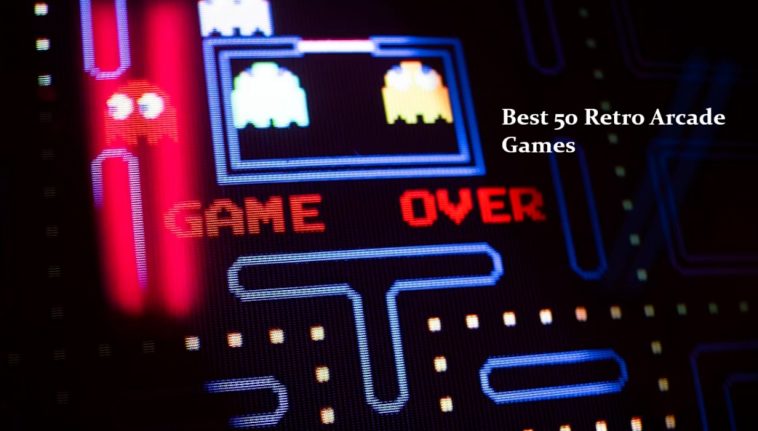
Retro arcade games didn’t just entertain a generation — they built the entire foundation of modern gaming as we know it today.
I remember the first time I walked into a proper arcade. I was maybe nine years old, and the sound hit me before anything else — a wall of electronic noise, beeps, explosions, synthesized music, and the rhythmic clatter of joysticks being yanked in every direction. Kids lined up three deep behind the best machines. A teenager with a crowd around him was doing something improbable in Street Fighter II, and I had no idea what a “Hadouken” was, but I wanted desperately to find out.
Those places were magic. And the games inside them changed everything.
The history of video games as we know it — the characters, the genres, the competitive culture, the billion-dollar industry — runs directly through the arcade. From the blinking pixels of Pong in 1972 to the cinematic chaos of Metal Slug in 1996, these 50 games didn’t just fill up quarters. They shaped history.
This is the list I wish someone had handed me back then.
A Brief History of Arcade Gaming
Before diving into the games themselves, it helps to understand the eras that produced them.
The Pre-Golden Age (1972–1977) gave us the first coin-operated video games. Pong launched Atari and proved that people would pay to play a video game. It was primitive, but it was proof of concept.
The Golden Age (1978–1983) is where everything exploded. Space Invaders caused a literal coin shortage in Japan. Pac-Man became a global cultural phenomenon. Arcades became social hubs generating over $8 billion annually by 1982 — more revenue than the music industry was making at the time.
The Silver Age (1984–1991) saw technological leaps — better graphics, deeper gameplay, laser disc technology, and the first beat-’em-ups and fighting games. Arcades adapted as home consoles grew.
The Fighting Game Era (1991–1997) was headlined by Street Fighter II and Mortal Kombat, which brought competitive gaming culture into mainstream consciousness and packed arcades like never before.
These 50 games represent the best, most influential, and most historically significant titles from all of these eras.
The Top 50 Retro Arcade Games That Shaped Gaming History
1. Pac-Man (1980) — Namco
Genre: Maze Chase | Developer: Namco
No game in history has had a bigger cultural footprint than Pac-Man. Designed by Toru Iwatani and released by Namco in 1980, it became a global sensation almost overnight — generating more than $14 billion in revenue by 2016 and spawning an animated TV series, merchandise, and one of gaming’s most recognizable characters.
What made it revolutionary was its appeal beyond the typical arcade demographic. Where most games targeted young men with shoot-’em-up mechanics, Pac-Man invited everyone in. The maze-chase format, the four ghost personalities (each with distinct AI behavior), and the satisfying loop of eating pellets and power-ups created something endlessly replayable.
Pac-Man and its cabinet joined Pong in the Smithsonian Institution’s permanent collection — one of only three games ever honored that way.
2. Space Invaders (1978) — Taito
Genre: Fixed Shooter | Developer: Taito
Space Invaders is where the Golden Age began. Designed by Tomohiro Nishikado and released by Taito in 1978, it was the first arcade game to feature the concept of a high score — a simple innovation that transformed gaming into a competitive activity.
Its popularity was staggering. The game caused a coin shortage in Japan when demand for 100-yen coins outpaced supply. It became the first video game to outsell the Atari 2600 console it was ported to, and it is widely credited with single-handedly establishing the arcade as a mainstream entertainment destination.
Every fixed shooter game that came after it — from Galaga to modern mobile titles — owes a direct debt to Space Invaders.
3. Donkey Kong (1981) — Nintendo
Genre: Platform | Developer: Nintendo
Donkey Kong didn’t just give us a great game. It gave us Mario — then called “Jumpman” — and in doing so, launched the most valuable video game franchise in history.
Designed by Shigeru Miyamoto, Donkey Kong was a technological breakthrough: the first arcade game with multiple stages featuring unique layouts, and the first to tell a genuine narrative through gameplay. You weren’t just shooting aliens or eating dots. You were rescuing someone you cared about from a giant ape, climbing ladders and dodging barrels on a construction site.
The game was also the subject of the famous documentary The King of Kong (2007), which brought the competitive arcade scene to mainstream audiences decades after the original release.
4. Street Fighter II (1991) — Capcom
Genre: Fighting | Developer: Capcom
Street Fighter II didn’t invent the fighting game genre, but it perfected it so completely that everything came after feels like a response to what Capcom built here. Released in 1991, it introduced a diverse global roster of fighters, each with unique special moves tied to specific joystick inputs — a system that created a skill ceiling so high that players are still competing at the highest levels today.
It became the defining arcade game of the early 1990s, reviving the arcade industry at a time when home consoles were threatening to eclipse it. The special move system — Ryu’s Hadouken, Guile’s Sonic Boom, Chun-Li’s Spinning Bird Kick — gave players something genuinely worth mastering.
The game’s competitive legacy is direct lineage to modern esports. Without Street Fighter II, there is no EVO Championship Series.
5. Galaga (1981) — Namco
Genre: Fixed Shooter | Developer: Namco
Galaga is what happened when a developer took Space Invaders and asked what would happen if the enemies fought back intelligently. Released in 1981 by Namco, it introduced enemy formations that could swoop down and attack your ship, and the famous “tractor beam” mechanic that could capture your fighter — and then be destroyed to release a dual-ship mode.
It remains one of the most-played arcade games of all time. The game’s cabinet could be found in virtually every arcade, diner, and pizza shop in America through the 1980s. Fans of a certain age still remember the trick of letting your ship get captured to double your firepower.
In a 2017 survey of Americans, Galaga ranked as one of the most recognized arcade games in history.
6. Asteroids (1979) — Atari
Genre: Multi-directional Shooter | Developer: Atari
Asteroids was a showcase of what vector graphics could do — crisp, geometric shapes in the place of pixel sprites, giving the game a clean, timeless visual style that still looks striking today. Players controlled a triangular spaceship in open space, rotating and thrusting to destroy asteroids and UFOs while managing inertia in a way no game had previously asked players to do.
It became Atari’s most successful arcade title and one of the bestselling games of the entire golden age. Its physics-based movement system influenced an enormous number of subsequent games and remains a benchmark for “feel” in spaceship games.
7. Ms. Pac-Man (1981) — Midway/Namco
Genre: Maze Chase | Developer: Midway (licensed by Namco)
Some sequels simply iterate. Ms. Pac-Man genuinely improved on its predecessor in almost every way. Released in 1981, it introduced four different mazes (compared to the original’s one), randomized ghost behavior that made previously memorizable patterns less useful, and bouncing fruit that moved around the screen rather than staying fixed.
The result was a game that arguably surpassed the original in pure gameplay quality. It was massively successful — and has the distinction of being widely regarded as the greatest arcade game sequel ever made. Ms. Pac-Man also brought gender representation into the conversation at a time when gaming was almost exclusively male-coded.
8. Mortal Kombat (1992) — Midway
Genre: Fighting | Developer: Midway
Mortal Kombat arrived in 1992 like a hand grenade thrown into the polished, cartoon-colored world of Street Fighter II. Its digitized photorealistic graphics, rivers of blood, and infamous “Fatality” finishing moves created a moral panic that reached the United States Congress — and directly led to the creation of the Entertainment Software Rating Board (ESRB), the rating system that governs video games to this day.
Beyond the controversy, Mortal Kombat was a genuinely excellent fighting game with iconic characters — Scorpion, Sub-Zero, Sonya Blade, Liu Kang — that became lasting cultural fixtures. Few games have had as wide-ranging an impact on regulation, culture, and franchise longevity simultaneously.
9. Defender (1981) — Williams Electronics
Genre: Horizontal Shooter | Developer: Williams Electronics
Defender was one of the most complex and demanding games of its era — and that was entirely intentional. Designed by Eugene Jarvis and released by Williams Electronics in 1981, it featured five buttons and a joystick, a horizontally scrolling playing field twice as wide as the screen, and the requirement to simultaneously shoot enemies and rescue falling humans from alien abductors.
It sold 60,000 cabinets and became one of the bestselling arcade games of all time despite (or because of) its brutal difficulty. The game proved that players would embrace complexity and challenge if the core mechanics were satisfying enough. Every side-scrolling shooter that followed owes a debt to Defender.
10. Centipede (1980) — Atari
Genre: Fixed Shooter | Developer: Atari
Centipede was different from its peers in one crucial way: it used a trackball for player movement rather than a joystick. This single hardware decision made it enormously accessible to a wider audience — particularly women and older players who found the precision of a trackball more intuitive than a joystick. Atari reported it was one of the first arcade games with a significant female player base.
The game itself was brilliantly designed — a centipede descends toward you through a field of mushrooms, and your job is to blast it apart while managing spiders, fleas, and scorpions. The interplay between the segmented enemy and the environment it navigates remains elegant decades later.
11. Donkey Kong Jr. (1982) — Nintendo
Genre: Platform | Developer: Nintendo
The sequel to Donkey Kong flipped the script entirely — now you played as the ape’s son trying to rescue his captured father from Mario (positioned here, unusually, as the villain). The role reversal was clever storytelling for 1982, and the gameplay introduced vine-climbing mechanics that added vertical complexity beyond the ladder-climbing of the original.
It further established Nintendo’s storytelling instincts and set the stage for the character work that would define the NES era.
12. Frogger (1981) — Konami
Genre: Action | Developer: Konami
Frogger’s genius lies in its simplicity. Guide a frog across a busy road and then across a river using moving logs and turtles, and get it safely to one of five lily pads. That’s it. And yet the tension, timing, and risk management required to do it well made it an immediate hit worldwide.
Released by Konami in 1981, Frogger became one of the most-ported games in history, appearing on virtually every home platform of the era. Its design template — navigating a dangerous environment in stages — influenced countless games across every genre.
13. Dig Dug (1982) — Namco
Genre: Action | Developer: Namco
Dig Dug was a creative marvel. Players could dig tunnels through the earth, pump enemies full of air until they exploded, or crush them with falling rocks. The dual strategy of direct attack and environmental manipulation gave it a depth that kept players coming back long after other games of the era had grown stale.
The game’s cheerful art style and satisfying audio — the pumping sound effect is one of the most recognizable in gaming history — made it instantly appealing. It was one of Namco’s biggest hits of the era.
14. Galaga (Galaxian) (1979) — Namco
Genre: Fixed Shooter | Developer: Namco
Galaxian was Namco’s direct response to Space Invaders, released just a year later in 1979. Where Space Invaders used monochromatic sprites on a dark background, Galaxian used full RGB color and introduced enemies that broke formation to dive-bomb the player — a seemingly simple change that dramatically increased the tension and excitement of the genre.
It was a commercial and critical success that directly paved the way for Galaga two years later, establishing Namco as one of the premier arcade developers of the golden age.
15. Tron (1982) — Midway
Genre: Multi-genre | Developer: Midway
Tron was one of the most sophisticated arcade games of 1982 — a four-in-one experience tied to the Disney film of the same name. Players rotated through light-cycle racing, grid bug shooting, I/O tower combat, and the MCP Cone battle in a package that demonstrated what movie-game tie-ins could be at their best.
The game was also one of the first major examples of a film and its companion game arriving simultaneously, establishing a template for licensed game development that would shape the industry for decades.
16. Joust (1982) — Williams Electronics
Genre: Action Platform | Developer: Williams Electronics
Joust is one of the most inventive game concepts of the entire golden age. Players rode flying ostriches (or storks) and competed to knock enemy knights off their mounts by hitting them from above. The flapping mechanic — hold the button to ascend, release to descend — gave the game a physical, rhythmic quality that made it immediately distinctive.
Its two-player simultaneous mode turned the experience into either cooperation or treachery depending on who you were playing with, and the competitive social dynamic it created was years ahead of its time.
17. Q*bert (1982) — Gottlieb
Genre: Action Puzzle | Developer: Gottlieb
Q*bert used isometric graphics — an unusual perspective for 1982 — to create a pyramid of cubes that the orange-nosed protagonist needed to hop across to change their color, while avoiding enemies from above and below. The game also featured voice synthesis, producing the famous “!@#$%” sound that became one of gaming’s earliest running jokes.
It was a visual and audio standout in any arcade lineup, and Q*bert himself became one of the recognizable mascot characters of the golden age — with a cameo in the 2015 film Pixels.
18. Missile Command (1980) — Atari
Genre: Fixed Shooter | Developer: Atari
Missile Command was designed with the Cold War explicitly in mind. Players defended six cities from incoming ballistic missiles by deploying three missile batteries — a scenario that the game’s creator, Dave Theurer, reportedly found so stressful to design that it gave him recurring nightmares.
The trackball control gave the game unusual precision, and the escalating pressure of multiple simultaneous missile streams created a sense of mounting dread that no game of its era matched. It’s one of the most psychologically loaded games ever made, and it remains a masterclass in difficulty scaling.
19. Robotron: 2084 (1982) — Williams Electronics
Genre: Multi-directional Shooter | Developer: Williams Electronics
Robotron: 2084 introduced the twin-stick shooter concept — one joystick for movement, one for shooting in any direction simultaneously — that remains foundational to games like Geometry Wars and Hades today. The screen was constantly filled with enemies, and the goal was to survive while rescuing the last human family alive.
The intensity was deliberate. Designer Eugene Jarvis (also responsible for Defender) pushed hardware to its absolute limit to generate as many simultaneous enemies as possible, creating a game that was genuinely overwhelming and demanded superhuman reflexes at high levels.
20. Dragon’s Lair (1983) — Cinematronics
Genre: Interactive Animation | Developer: Cinematronics / Don Bluth
Dragon’s Lair was unlike anything anyone had seen in 1983. Using LaserDisc technology, it played back full-motion animation by Don Bluth — the same animator behind The Secret of NIMH — and required players to input the correct direction or button at precisely the right moment to progress.
It was the first arcade game to feature full-motion video, and it charged 50 cents per play at a time when every other game cost 25. Players paid it gladly. Both Dragon’s Lair and Pac-Man are in the Smithsonian’s permanent collection — a distinction shared by only a handful of games in history.
21. Tempest (1980) — Atari
Genre: Tube Shooter | Developer: Atari
Tempest used vector graphics and a distinctive “tube” playing field — players moved around the rim of a three-dimensional geometric shape, shooting enemies crawling up from inside. The result was visually unlike anything else of the era and demanded a unique spatial awareness.
The cabinet’s spinner control gave it a tactile feel that joystick games couldn’t match, and the abstract art direction has aged beautifully. Tempest remains one of the most distinctive-looking games in arcade history.
22. Double Dragon (1987) — Technos Japan
Genre: Beat ’em Up | Developer: Technos Japan
Double Dragon essentially created the co-op beat-’em-up genre as a commercial mainstream phenomenon. Two players fought side-by-side through waves of street thugs to rescue a kidnapped girlfriend — a thin premise wrapped around some of the most satisfying brawling mechanics of the 1980s.
The ability to pick up and use enemies’ own weapons (chains, baseball bats, oil drums) and the cooperative tension of playing with a friend who might accidentally hit you created a social experience arcades had rarely delivered before. It established the template for every beat-’em-up that followed.
23. Teenage Mutant Ninja Turtles (1989) — Konami
Genre: Beat ’em Up | Developer: Konami
Konami’s four-player TMNT cabinet was a cultural phenomenon. Based on the massively popular animated series, it allowed four players simultaneously to choose their turtle and beat their way through Foot Clan soldiers to rescue April O’Neil. The massive cabinet with four sets of controls became a fixture of every mall arcade in America.
It proved that licensed games based on popular IP could be more than cash-grabs — with the right developer and the right design philosophy, they could be among the best games of their era.
24. Gauntlet (1985) — Atari
Genre: Dungeon Crawler | Developer: Atari
Gauntlet was a revelation in multiplayer design. Up to four players simultaneously chose a class — Warrior, Valkyrie, Elf, or Wizard — and fought through dungeon levels crawling with enemies, collecting treasure and food while their health constantly drained. The narrator’s booming “Warrior needs food badly!” became one of the most quoted phrases in arcade history.
It was also one of the first games to make health regeneration into a coin-sink mechanic, encouraging continued quarter insertion to survive. Its influence on dungeon-crawler RPG design — from Diablo to Baldur’s Gate — is direct and unmistakable.
25. Pole Position (1982) — Namco
Genre: Racing | Developer: Namco
Pole Position was the first racing game to use a behind-the-car perspective and a qualifying lap system before the main race — two conventions so standard in racing games today that it’s easy to forget they had to be invented. Released by Namco in 1982, it became one of the bestselling arcade games of that year.
The sensation of speed it created using sprite-scaling techniques (making road markings grow as they approached) influenced every racing game that came after it, from Out Run to Gran Turismo.
26. Out Run (1986) — Sega
Genre: Racing | Developer: Sega
Out Run was an experience as much as a game. Players drove a Ferrari Testarossa through branching routes across sun-drenched landscapes, choosing their own path at each fork and selecting from three iconic FM synthesizer soundtracks. The sit-down cabinet with force-feedback steering was an engineering achievement.
The game’s sense of style — Mediterranean colors, beautiful passenger, beach destinations — was aspirational in a way no game had attempted before. It wasn’t about winning. It was about the ride.
27. After Burner II (1987) — Sega
Genre: Rail Shooter | Developer: Sega
After Burner II placed you in the cockpit of an F-14 Tomcat engaging enemy aircraft in a spectacular, fast-moving dogfight. The cabinet was a sit-down cockpit that could pitch and roll with the action — one of the most ambitious arcade cabinet experiences ever built.
The game demonstrated Sega’s hardware dominance in the late 1980s and showed how physical cabinet design could become part of the gaming experience itself, a concept that influenced everything from racing simulators to VR experiences.
28. Contra (1987) — Konami
Genre: Run and Gun | Developer: Konami
Contra’s hard-driving action, tight controls, and punishing difficulty made it one of the most celebrated run-and-gun games in arcade history. Two players fought through jungles, bases, and alien lairs in a game that demanded both precision and aggression.
The spread gun power-up remains one of gaming’s most sought-after rewards, and the game’s co-op mode created some of the most memorable two-player moments of the late 1980s. Its influence on the run-and-gun genre remains enormous.
29. Ghosts ‘n Goblins (1985) — Capcom
Genre: Platform Action | Developer: Capcom
Ghosts ‘n Goblins became legendary for its cruelty. Players controlled Sir Arthur through a graveyard of undead horrors — and a single hit stripped him down to his underwear. Two hits and he was dead. Complete the game and discover you’ve only finished the first loop; do it again to see the true ending.
The game’s extraordinary difficulty became part of its identity and directly influenced the “brutally fair” design philosophy of games like Dark Souls decades later. Capcom’s willingness to punish the player completely and without apology was genuinely new.
30. Gradius (1985) — Konami
Genre: Horizontal Shooter | Developer: Konami
Gradius introduced the power-up selection system — a capsule bar that let players choose which upgrades to activate and in which order — giving a shoot-’em-up unusual strategic depth. The game’s flowing organic environments, iconic bosses, and relentless difficulty set a new standard for the genre.
It spawned one of the most beloved shooter franchises in gaming history and established Konami as a premier developer of arcade-quality action games.
31. Metal Slug (1996) — SNK/Nazca Corporation
Genre: Run and Gun | Developer: Nazca Corporation (SNK)
Metal Slug arrived in 1996 with hand-drawn 2D animation of a quality that had no business existing in an arcade cabinet. Every character, enemy, and explosion was painstakingly illustrated with a humor and artistry that made the game feel like a playable cartoon.
The run-and-gun mechanics were tight and satisfying, the level design was creative and varied, and the tone — a sort of manic, self-aware slapstick war movie — was completely its own. Metal Slug is frequently cited as one of the finest 2D games ever made, and its visual craftsmanship has never truly been surpassed in the genre.
32. Mortal Kombat II (1993) — Midway
Genre: Fighting | Developer: Midway
While the original Mortal Kombat created the controversy, Mortal Kombat II perfected the formula. Released in 1993, it introduced a larger and more memorable roster — Kitana, Jax, Mileena, Shang Tsung — expanded the move lists, deepened the combat system, and made the Fatalities even more spectacular.
It was a juggernaut in arcades, drawing massive crowds who wanted to witness (or perform) its signature finishing moves. The booming announcer and the satisfying impact sounds made it a sensory experience as much as a competitive one.
33. NBA Jam (1993) — Midway
Genre: Sports | Developer: Midway
NBA Jam took the stiff simulation of sports games and replaced it with joyful absurdity. Two-on-two basketball with no fouls, impossible dunks, a flaming ball when you were “on fire,” and real NBA players rendered in pixelated caricature — it was a game that trusted players to want entertainment over authenticity.
“He’s on fire!” and “Boomshakalaka!” became two of the most quoted phrases of 1990s gaming. NBA Jam proved that sports games didn’t have to simulate — they could exaggerate, and players would love them for it.
34. Tekken 3 (1997) — Namco
Genre: 3D Fighting | Developer: Namco
Tekken 3 brought 3D fighting to a level of fluidity and depth that felt genuinely new. Where earlier 3D fighters felt clunky or experimental, Tekken 3 delivered tight, responsive combat with a diverse roster and the introduction of sidestep mechanics that made full use of three-dimensional space.
It was the arcade game that convinced a generation of 2D fighting game purists that 3D could work — and the home PlayStation port became one of the bestselling games of the era.
35. Golden Axe (1989) — Sega
Genre: Beat ’em Up | Developer: Sega
Golden Axe applied the Double Dragon formula to a high fantasy setting with a brutally satisfying result. Three playable characters — a barbarian, a dwarf, and an amazon — fought through armies of skeleton warriors and ended each level by kicking small gnomes who carried magic potions.
The co-op mode was excellent, the magic system added tactical depth, and the ability to mount and ride enemy animals was a design innovation that delighted players. It remains one of Sega’s most beloved arcade titles.
36. Final Fight (1989) — Capcom
Genre: Beat ’em Up | Developer: Capcom
Final Fight set a new standard for the urban beat-’em-up. Three characters — including future Street Fighter protagonist Cody — fought through the grimy streets of Metro City in a game with larger sprites, more detailed environments, and crisper controls than anything in the genre had previously offered.
The game’s impact on Capcom’s own future was enormous: characters from Final Fight crossed over into the Street Fighter universe, cementing a shared world that fans still celebrate today.
37. R-Type (1987) — Irem
Genre: Horizontal Shooter | Developer: Irem
R-Type was the thinking person’s shooter. Where most shoot-’em-ups rewarded reflexes, R-Type demanded memorization, positioning, and a strategic approach to each encounter. The Force pod — an indestructible satellite that could be attached to the front or rear of your ship, or detached as a free-floating weapon — gave players unprecedented tactical flexibility.
Its boss designs were nightmarish and memorable, and the game’s dark, biomechanical aesthetic (clearly influenced by H.R. Giger) made it visually unlike anything else of the era.
38. Zaxxon (1982) — Sega
Genre: Isometric Shooter | Developer: Sega
Zaxxon was the first arcade game to use isometric perspective — an oblique 3D viewpoint that gave the game genuine visual depth while requiring players to judge altitude in three-dimensional space. Flying too low meant crashing into walls; flying too high meant vulnerability. The shadow beneath the ship became a crucial navigational tool.
It was a technical showcase and a design innovation that influenced isometric game design across every subsequent decade.
39. Spy Hunter (1983) — Midway
Genre: Action Racing | Developer: Midway
Spy Hunter cast players as a secret agent in a weaponized sports car — a concept so immediately appealing that the game became one of the most popular of 1983. Oil slicks, smoke screens, machine guns, and the ability to call in a weapons van for upgrades gave the game a cinematic energy that felt straight out of a James Bond film.
The theme music — a version of the Peter Gunn Theme by Henry Mancini — remains one of the most recognizable pieces of music in arcade history.
40. Bubble Bobble (1986) — Taito
Genre: Platform Action | Developer: Taito
Bubble Bobble is one of the most charming games ever made. Two small dinosaurs (Bub and Bob) moved through 100 single-screen levels, trapping enemies in bubbles and popping them to defeat them. The co-op mode was exceptional — certain level bonuses could only be unlocked with two players, encouraging genuine cooperation.
Its earworm theme music is notorious for lodging permanently in the brain after a single listen, and the game’s warm visual style and deep secret mechanics made it a classic for entirely different reasons than most of its contemporaries.
41. Paperboy (1984) — Atari
Genre: Action | Developer: Atari
Paperboy is one of those rare games where the concept sounds mundane and the execution is inspired. Players rode a bicycle along a suburban street, delivering newspapers to subscribers, breaking the windows of non-subscribers, and dodging an increasingly absurd obstacle course of hazards: dogs, remote-controlled cars, tornadoes, and the Grim Reaper.
The handlebar controls were genuinely novel, and the game’s dark comedy — the same kid who just destroyed a neighbor’s lawn ornament also has to navigate a death course — made it unlike anything else.
42. Track & Field (1983) — Konami
Genre: Sports | Developer: Konami
Track & Field invented something that has never gone away: the button-mashing mini-game. Players furiously alternated button presses to build speed for sprint events, timed their jumps for long jumps and hurdles, and executed precise inputs for javelin and hammer throws.
It was simple, physically demanding, and enormously fun with multiple players competing simultaneously. It also destroyed countless arcade buttons — and the fingers of the players hammering them.
43. Rampage (1986) — Midway
Genre: Action | Developer: Midway
Rampage gave players exactly what they secretly wanted: the ability to be a giant monster and knock down buildings. Three players chose from a gorilla, a lizard, or a wolf, then systematically demolished city blocks while eating soldiers and avoiding the military.
The cooperative destruction mechanic — and the delightful absurdity of three friends simultaneously demolishing Chicago — made it a social event. It remains one of the most straightforwardly fun concepts in arcade history.
44. Punch-Out!! (1984) — Nintendo
Genre: Boxing | Developer: Nintendo
Punch-Out!! was a masterclass in character-based game design. Each opponent — Glass Joe, King Hippo, Super Macho Man — had a distinctive pattern and weakness that players needed to identify and exploit. The game wasn’t about reflexes as much as observation and pattern recognition.
The wireframe protagonist (designed to be transparent so players could see their opponent) was an elegant design solution to a visual problem. Nintendo’s combination of humor, fairness, and escalating difficulty made Punch-Out!! one of the most beloved games in their catalogue.
45. Battlezone (1980) — Atari
Genre: First-Person Shooter | Developer: Atari
Battlezone is the great-grandfather of every first-person shooter ever made. Using vector graphics to create a three-dimensional tank battlefield, it placed players inside the action in a way no game had previously achieved. The cabinet included a periscope-style viewer to heighten the immersion.
The game was so convincing as a military simulation that the US Army reportedly approached Atari to create a version for training purposes — an early and fascinating instance of the military-gaming crossover that persists to this day.
46. Gyruss (1983) — Konami
Genre: Tube Shooter | Developer: Konami
Gyruss took the space shooter format and wrapped it into a circular tube: enemies flew in from the edges of the screen toward the center, and your ship circled the perimeter. The result was a dizzying, visually distinctive game that felt genuinely three-dimensional.
Its adaptation of Bach’s Toccata and Fugue in D minor as its theme music was one of the earliest and most successful uses of classical composition in video games — a bold choice that aged beautifully.
47. Star Wars (1983) — Atari
Genre: Rail Shooter | Developer: Atari
Atari’s Star Wars used vector graphics to recreate the Death Star trench run from the 1977 film, complete with digitized speech samples from the movie — the first arcade game to include licensed audio from a film in this way. Players heard actual Luke Skywalker, Darth Vader, and R2-D2 voices responding to the action.
The yoke-style controls, the iconic John Williams score, and the fidelity to the film’s climactic sequence made it an arcade event rather than just a game. Lines formed around the block.
48. X-Men (1992) — Konami
Genre: Beat ’em Up | Developer: Konami
Konami’s X-Men arcade game was designed for six simultaneous players — a cabinet configuration that required two machines linked together and was so massive it could anchor an entire arcade section by itself. Six players simultaneously chose from Cyclops, Wolverine, Storm, Colossus, Nightcrawler, and Dazzler to fight Magneto’s army.
The chaos of six friends fighting together through a Marvel universe brought to life with bright, comic-accurate art is still fondly remembered by anyone who experienced it at the time.
49. Pong (1972) — Atari
Genre: Sports | Developer: Atari
Pong belongs at the foundation of this entire list. The game that proved people would pay to play a video game — two paddles, one ball, and a score. Atari co-founder Nolan Bushnell is often called the father of video gaming for this reason, and the game’s commercial success funded the entire industry that followed.
It’s not the most sophisticated game here. It’s the most important. Without Pong, nothing on this list exists.
50. Breakout (1976) — Atari
Genre: Action | Developer: Atari
Breakout closed the pre-golden age and opened the door to everything that followed. Players controlled a paddle to bounce a ball into a wall of bricks, clearing rows layer by layer in a satisfying, escalating demolition. The concept was elegant, the execution was tight, and the satisfaction of clearing a screen never got old.
Its historical footnote is remarkable: Breakout was designed by Steve Jobs and Steve Wozniak — and the revenue from the game helped fund the founding of Apple. One quarter at a time.
The Eras at a Glance
Here’s how these 50 games break down by decade and era:
1970s (Pre-Golden Age): Pong, Breakout, Space Invaders, Galaxian, Asteroids — the foundations were laid by a handful of visionary developers proving the concept of coin-operated gaming.
Early 1980s (Golden Age Peak): Pac-Man, Donkey Kong, Galaga, Centipede, Ms. Pac-Man, Defender, Tempest, Missile Command, Robotron: 2084, Q*bert, Frogger, Dig Dug, Joust, Tron, Zaxxon — the most innovative period in arcade history, producing more classics per year than any other era.
Mid-to-Late 1980s: Dragon’s Lair, Pole Position, Spy Hunter, Paperboy, Punch-Out!!, Gauntlet, Ghosts ‘n Goblins, Gradius, Out Run, R-Type, Double Dragon, Contra, After Burner II, Bubble Bobble, Golden Axe, Final Fight, Track & Field, Rampage — arcades matured, genres diversified, and cabinets became increasingly ambitious.
1990s: Street Fighter II, Mortal Kombat, NBA Jam, Mortal Kombat II, TMNT, X-Men, Tekken 3, Metal Slug — the fighting game era dominated, and the social competitive scene reached its peak before home consoles finally overtook the arcade as the primary gaming platform.
FAQ: Retro Arcade Games
What was the Golden Age of arcade gaming?
The Golden Age of arcade video games is generally considered to span from 1978 to 1983. It began with the release of Space Invaders and saw the creation of most of the genre-defining games that still influence the industry today. During this period, arcades generated over $8 billion annually — more revenue than the music industry at the time.
Which retro arcade game had the biggest cultural impact?
Pac-Man is widely considered the most culturally impactful arcade game of all time. It generated more than $14 billion in revenue, inspired an animated TV series, caused a coin shortage in Japan, and became one of the most recognized cultural icons of the 20th century. Both Pac-Man and Dragon’s Lair are among the only video games in the Smithsonian Institution’s permanent collection.
Why did arcades decline in the 1990s?
The decline of arcades in the 1990s was driven primarily by the rapid improvement of home consoles — the Super Nintendo, Sega Genesis, PlayStation, and Nintendo 64 all brought arcade-quality experiences into living rooms. When Street Fighter II and Mortal Kombat could be played at home without quarters, the economic logic of the arcade eroded. The social draw of arcades also shifted as multiplayer gaming moved to home networks.
Are retro arcade games still playable today?
Absolutely. You have several options: MAME (Multiple Arcade Machine Emulator) allows you to play thousands of original arcade ROMs on modern hardware. Barcades — bars that combine craft beer service with classic arcade cabinets — have spread across major cities worldwide. Many classic games are also available on modern platforms through collections like Namco Museum, Capcom Arcade Stadium, and the Atari Vault on Steam.
Which retro arcade game invented the fighting game genre?
Street Fighter (1987) by Capcom introduced the core mechanics — a roster of distinct characters, special move inputs, and one-on-one competitive combat. However, Street Fighter II (1991) is credited with perfecting and popularizing the genre to the point where it defined an era of gaming. The competitive culture that surrounds fighting games today traces directly back to Street Fighter II’s arcade run.
What was the first arcade game ever made?
Computer Space (1971) by Nutting Associates — developed by Nolan Bushnell and Ted Dabney before they founded Atari — is generally considered the first commercially sold arcade video game. However, Pong (1972) was the first to become a true mainstream commercial success, and is the game most historians point to as the true beginning of the arcade industry.
Which retro arcade game led to the creation of video game ratings?
Mortal Kombat (1992) and its home console ports caused enough public concern about video game violence that the United States Congress held hearings on the subject in 1993. The result was the creation of the Entertainment Software Rating Board (ESRB) in 1994 — the rating system that still governs game content in North America today.
Final Thoughts
The 50 games on this list aren’t just historical artifacts. They’re the code that all modern gaming runs on.
When you play a modern battle royale and feel the tension of the high-score chase, that’s Space Invaders. When you execute a fighting game combo from memory, that’s Street Fighter II. When you cooperate with a friend to get further than either of you could alone, that’s Double Dragon, Gauntlet, and TMNT. When you laugh at a game that doesn’t take itself too seriously, that’s Metal Slug and Bubble Bobble.
The arcade era ended. Its ideas never did.
If you get the chance to sit down at a real cabinet — whether at a barcade, a retro gaming convention, or someone’s basement — take it. There’s a reason these machines still draw crowds. The magic hasn’t faded. It never does.
