I used to feel a little guilty about the hours I spent gaming after work, like I was wasting time I should’ve spent doing something “productive.” Then I actually looked into the research on the benefits of playing video games, and it changed how I think about my hobby completely.
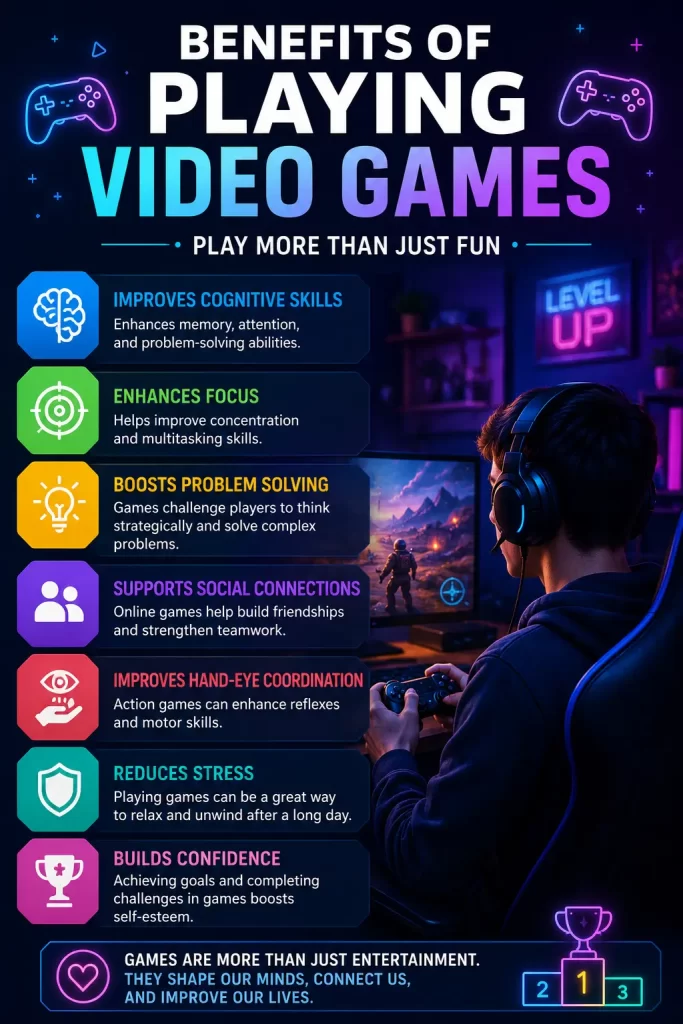
This post rounds up 20 benefits of playing video games, backed by real research from psychologists, universities, and industry studies. Some of these might surprise you.
Whether you’re a casual mobile gamer or someone who logs serious hours on console, you’ll find plenty of reasons here to stop apologizing for your favorite pastime.
Cognitive Benefits of Playing Video Games
Your brain does more work during a gaming session than you might expect. These benefits show up most clearly in studies on memory, reasoning, and spatial skills.
1. Improved Problem-Solving Skills
Most games are built around puzzles, whether that’s figuring out a boss fight or managing resources in a strategy game. You’ll naturally get better at breaking problems into smaller steps the more you play.
2. Better Spatial Awareness
Action and shooter games in particular have been shown to strengthen your ability to think in three dimensions. A well-known 2013 meta-analysis found this effect was comparable to taking an academic course designed for the same purpose.
3. Sharper Memory
Games that require you to remember maps, item locations, or complex storylines give your working memory a regular workout. Over time, this kind of repeated practice can carry over into everyday tasks.
4. Faster Reaction Time
Fast-paced games train your brain to process visual information and respond quickly. You’ll notice this most in games that demand split-second decisions, like competitive shooters or racing titles.
5. Enhanced Multitasking Ability
Many games ask you to track multiple things at once — enemy positions, health bars, resources, and objectives. You’ll build a genuine capacity for handling several streams of information simultaneously.
6. Improved Strategic Thinking
Strategy and simulation games force you to plan several steps ahead and adjust when your plan doesn’t work. This kind of long-term thinking is a skill that transfers well beyond the screen.
7. Better Hand-Eye Coordination
Precise movement and timing are baked into most game genres, from platformers to first-person shooters. You’ll sharpen the connection between what you see and how your hands respond.
Emotional and Mental Health Benefits
Video games aren’t just mentally stimulating — they can genuinely support how you feel day to day.
8. Reduced Stress Levels
According to a global survey of nearly 13,000 active gamers, the vast majority reported feeling less stressed after playing. Games give your mind a clear focus point away from daily worries.
9. Lower Anxiety
Related research found that a large share of gamers also felt less anxious after gaming sessions. The immersive nature of games can pull your attention away from anxious thought loops.
10. A Safe Outlet for Emotions
Games let you experience intense situations — conflict, loss, victory — in a low-stakes environment. You’ll process a wide range of emotions without any real-world consequences.
11. Increased Resilience
Recent research from Boston University found that gaming helps many players build coping skills and emotional resilience. Failing a level repeatedly and trying again teaches persistence in a very direct way.
12. A Boost in Self-Esteem
Completing a difficult level or improving your skill over time gives you a tangible sense of accomplishment. That feeling of progress can carry over into how you view your abilities elsewhere.
13. Mood Improvement
Research published in American Psychologist described gaming as one of the most effective ways to generate positive feelings, particularly for children and teens. Even a short session can shift your mood in a noticeably positive direction.
Social Benefits of Playing Video Games
Gaming has a reputation for being isolating, but the research tells a different story.
14. Stronger Social Connections
Multiplayer games create shared experiences that often turn into lasting friendships. You’ll find that some of the strongest online communities exist because of a shared game.
15. Reduced Feelings of Loneliness
Survey data shows a majority of gamers report feeling less isolated after playing, especially when playing with others. Voice chat and co-op modes make gaming a genuinely social activity for many people.
16. Improved Teamwork Skills
Team-based games require coordination, communication, and shared decision-making under pressure. You’ll build real collaboration skills that apply just as well outside of gaming.
17. Increased Empathy
Studies on prosocial games — those that reward cooperation and helping others — have found players show more empathy and are more likely to help others in real situations. The habits you build in-game don’t always stay in-game.
18. Better Conflict Resolution
Research from Villanova and Stetson University found that gaming gives players practice working through conflict and negotiating different outcomes with others. That’s a skill that comes in handy well beyond your friend group’s Discord server.
Practical and Everyday Benefits
Beyond the mental and emotional side, gaming offers a few benefits that are easy to overlook.
19. A Genuinely Enjoyable Hobby
Sometimes the simplest benefit is the most important one — gaming is fun. You don’t need a research study to tell you that a good session leaves you feeling better than when you started.
20. Transferable Job Skills
Certain game genres build skills that show up directly in the workplace: strategic planning, resource management, quick decision-making, and teamwork. Some employers in tech and logistics fields have even started recognizing competitive gaming experience as a relevant skill on a resume.
How to Get the Most Out of Gaming
Not every benefit shows up automatically just by picking up a controller. A few habits help you get more out of your time gaming.
- Choose games that match the benefit you’re after — puzzle games for cognitive skills, co-op games for social connection
- Set a time limit so gaming stays a positive habit instead of crowding out sleep or other responsibilities
- Play with friends when possible, since the social benefits are strongest in multiplayer settings
- Mix genres occasionally to build a wider range of skills instead of repeating the same patterns
- Pay attention to how you feel during and after playing, and adjust if a particular game leaves you more stressed than relaxed
Common Myths About Gaming Worth Clearing Up
Even with all this research, a few outdated ideas about gaming still stick around. It’s worth addressing them directly.
Myth: Gaming Is Always Isolating
This idea persists despite plenty of evidence pointing the other way. Survey data consistently shows that multiplayer gaming builds real friendships and reduces feelings of loneliness for a large share of players, rather than cutting people off from others.
Myth: Violent Games Only Cause Harm
Research has found that even violent shooter games can improve spatial reasoning and problem-solving skills. That doesn’t mean content doesn’t matter at all, but the relationship between game content and outcomes is more nuanced than the stereotype suggests.
Myth: Gaming Is Just for Kids
The average gamer today spans a wide range of ages, and the reported benefits — stress relief, social connection, cognitive improvement — apply just as much to adults as to teenagers. Plenty of working professionals game regularly as a way to unwind.
Myth: There’s Nothing to Learn From Games
Strategy games teach planning and resource management. Puzzle games sharpen logical thinking. Cooperative games build communication skills. The idea that gaming offers “nothing” beyond entertainment doesn’t hold up against the research.
Choosing Games That Match Your Goals
If you want to lean into specific benefits, picking the right genre makes a real difference.
- For memory and problem-solving, try puzzle games or strategy titles
- For social connection, choose cooperative multiplayer games you can play with friends
- For stress relief, look for slower-paced games with low time pressure
- For reaction time and coordination, fast-paced action or racing games work well
- For empathy and perspective-taking, narrative-driven games with strong character development tend to stand out
Matching your game choice to your goal makes it much easier to notice the benefits showing up in your day-to-day life.
Frequently Asked Questions
Are video games actually good for your brain?
Yes, according to multiple studies. Research has linked gaming to improvements in memory, spatial reasoning, problem-solving, and reaction time, particularly with action and puzzle genres.
Do video games help with mental health?
Research suggests they can. Surveys and academic studies have connected gaming with reduced stress, lower anxiety, and improved mood, especially when playing isn’t excessive.
Can video games improve social skills?
Yes, especially multiplayer and cooperative games. Studies show gaming can reduce loneliness, build teamwork skills, and even increase empathy in certain game types.
How much gaming is considered healthy?
There’s no single universal number, but most research on the benefits of playing video games focuses on moderate, balanced play rather than excessive use that interferes with sleep, work, or relationships.
Do all video games offer the same benefits?
No. Different genres offer different advantages — puzzle games tend to boost problem-solving, while multiplayer and cooperative games are more closely linked to social benefits.
Final Thoughts
The benefits of playing video games go far beyond simple entertainment. From sharper thinking skills to real emotional and social support, there’s solid research behind why so many people find gaming genuinely good for them.
You don’t need to game for hours a day to see these benefits. Even regular, moderate play can support your brain, your mood, and your relationships in ways that are easy to underestimate.
Editor’s Opinion
Honestly I always felt bad for gaming so much growing up but turns out theres real science behind it helping your brain. I notice im way less stressed after a session of somthing relaxing like a puzzle game, its like a reset button for my brain. My advice, dont feel guilty about gaming, just balance it with everything else and youll be fine.
