This is my claim: Bob Dylan is our century’s most significant artist and songwriter. While other populærartister trying to tyne the youthful rockemyten all the way into the old age, powers of Dylan to give artistic expression to all of life’s stages. Time and time again he has reinvented himself. He has lived so many lives now, that it is becoming more interesting to listen to him.
Dylan has had enough of the temptations in the course of his career: He could have remained a 60 protestsanger. He could have remained a 70’s rocker. He could have remained a 80s gospelartist. But no – Dylan goes further, as a rule, long before the audience realizes what’s going on. All these changes have happened during the huge protests from the fans – the most extreme of them had rather seen that Dylan was dead, than to be witness to what they perceive as the hero’s big betrayal.
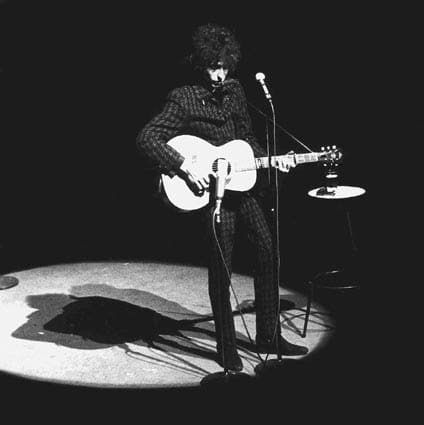
“Don’t look back”, called a classic film about Dylan, and he looks at never back. He rejects the nostalgia consistent. He has admittedly had problems from time to time with finding his place and his function as an artist, especially in the 80s and partly the 90s. But now, towards the end of this millennium, Dylan is back – with death as the driving force.
“Work as long as it is day, for soon comes the night when none can work”. This verse – free from John’s gospel – compulsion Dylan started with his last album, the melancholic masterpiece “Time out of mind” (1997). After having heard regularly on this album for two years, I dare assert that “Time out of mind” is completely on a par with the best he has done.
All the songs on the album hanging on by a show together, they depict the same state of unhappiness and disillusionment. You can take a line from one song and replace it with a line from another, without that the texts lose meaning because of it. The main character in the songs wander alone along the muddy roads. There is no asphalt, no cars, no modern technology whatsoever. It is not something modern by this record, neither the content or when it comes to producer Daniel Lanois’ sound. Everything is old and timeless at the same time.
I-the person in the songs (collectively, the “Singer”) is completely immersed in melancholy. The party is over, everything is hollow and empty, and there are less and less left to say. He is sad by other people’s laughter. He is distanced from everything and everyone: “I got new eyes. Everything looks far away”. Before went time for the fort, now it is gone in the stand. He wishes that someone could come and turn the clock back, but know all too well that this is impossible. He sees what is waiting, he is staring death in the kvitøyet, and he knows that it is just as before: “It’s not dark yet, but it’s getting there”.
Age weight, clearly. But the feeling that marks the Singer on this album is a kind of melancholy as well-can affect relatively young people. It is not age as such that has sake in the gloom – probably, it is very strong heartache and a general livslede. He has been around in the entire world. He has seen much – too much. Life has nothing more to offer. Now it remains only to get to heaven before the door closes.
Bob dylan’s music has always been closely linked to the u.s. relationship with phillips. And on this album perhaps more than ever. His method of “Time out of mind” is as follows: He takes a line from an old song, and the poet to some of his own expense. Dylan has plowed through old ballads, blues songs and spiritual songs, and stirred all this together with his own substance. One of the strongest songs on the record: “Trying to get to heaven before they close the door” contains at least a dozen loans from the american tradition. And he quotes the course itself also: the 70’s hit: “Knocking on heavens door” jokes behind the title “Trying too get to heaven before they close the door.” And the phrase “take me disappearin’ through the smoke rings of my mind”, from the drug-inspired song “Mr. Tambourine man”, is on this album changed to: “I’m strolling through the lonely graveyard of my mind”. It says quite a lot about the difference between Dylan in the mid 60’s, and the Dylan we meet now at the turn of the millennium.
In an interview with the New York Times, Dylan said the following about his relationship to the american relationship with phillips: “These old songs are my lexicon and my quarters. All my beliefs are based in these old songs, literally, anything from ‘Let me rest on that peaceful mountain’ to ‘Keep on the sunny side”. You can find all my philosophy in those old songs. I believe in a God, in time and space, but if people ask me about it, I will point back to these songs. I believe in Hank Williams when he sings “I saw the light”. I have also seen the light.”
It was a violent resurrection, when Bob Dylan was “born again” in 1979.
Hundreds of thousands of fans were shaken. After his conversion followed the three albums, that belong to what we might call dylan’s “evangelical” period. Since that time it has not been directed so much attention to dylan’s belief in god. It is a little sin, for the faith that comes to expression in today’s dylan-songs, is in my opinion far more interesting than the one he portrayed in the newly converted period at the beginning of the 80’s.
The album “Time out of mind” ends with a 17 minute-long blues track that provides a beautiful and almost touching expression of the Singer’s melancholy, his disillusionment and his hard prøvete faith. The singer feels like a prisoner in an incomprehensible world, he is on the border of madness, but his heart longs for “the Highlands” – to the Highlands – as purely literal seems to be the scottish tablelands, but figuratively is a picture of the Sky. The singer does not want anything from anyone anymore, there is not much more to take. He has seen everything, he can’t expect something more in this life. He sees youth in the park, in bright coloured clothes – but everything is far away – his heart yearns towards the Highlands, and he will go there when he feels good enough to go. He is convinced that this is where he should, when he is called home. There is no other place to go. He is there already in the tank – and that’s good enough right now.
