I launched my first store with about $80 total — domain, a cheap theme, and a few dollars on sample orders. No warehouse, no boxes stacked in a spare room, nothing. That’s the actual appeal of dropshipping, and it’s also where most beginners get confused, because “no inventory” doesn’t mean “no cost” or “no work.” Here’s what the model actually looks like once you strip away the hype.
Quick Answer
- Dropshipping lets you sell products without buying stock upfront — your supplier ships directly to the customer after each sale
- Realistic starting costs in 2026 land somewhere between $100 and $500 for a lean beginner setup, not counting ad spend
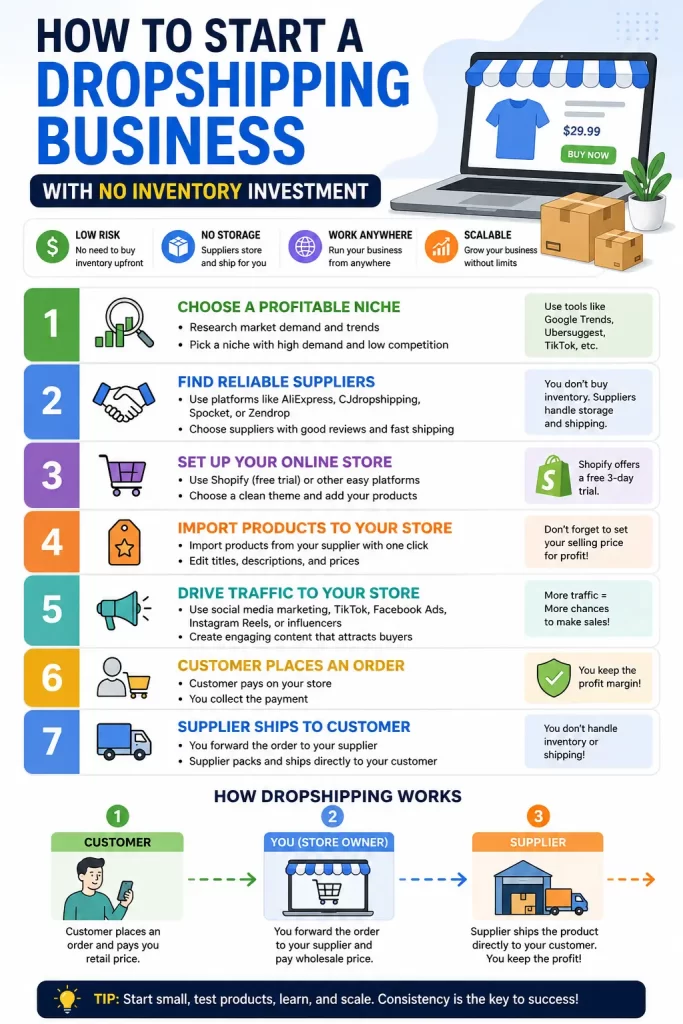
- Core steps: pick a niche, vet a supplier, build a store, list products, drive traffic, handle orders as they come in
- You only pay your supplier’s wholesale price after the customer has already paid you retail
- Growth without a big budget is possible through organic content, but it’s slower and more manual than paid ads
Why “No Inventory” Doesn’t Mean “No Money Needed”
A lot of people hear “no inventory” and assume dropshipping is basically free to start. It’s not, and getting that expectation wrong is honestly one of the fastest ways to feel discouraged in the first month.
You still need infrastructure. A store platform, a domain, and usually some kind of payment processing setup all cost something, even if it’s small. Shopify plans start around $21 a month, and even marketplace options like eBay or TikTok Shop take a cut per sale even though they skip the monthly platform fee.
Marketing is the actual expense, not the product. Since you’re not paying for stock, most of your early budget ends up going toward driving traffic — whether that’s a small paid ad test or just the time cost of organic content. And this is the part a lot of “$0 to start” guides gloss over.
Supplier quality directly determines your reputation, and cheap suppliers aren’t free in the long run. A slow or unreliable supplier means refunds, angry customers, and chargebacks, which cost you more than a slightly pricier but faster supplier would have in the first place.
The Three-Party Model, Simplified
Dropshipping connects you, the customer, and a supplier. The customer pays your retail price, you forward the order to your supplier at wholesale cost, and the supplier ships directly to the customer under your branding. The difference between what the customer paid and what you paid the supplier is your margin. So if you sell something for $40 and your supplier charges $25, you keep $15 before fees and ad costs.
That’s the whole mechanism. It sounds almost too simple, and in a way it is — the hard part isn’t understanding the model, it’s executing every piece of it well enough that customers don’t notice they’re buying through a middleman.
Step-by-Step: Launching Without Buying Stock
Step 1: Pick a niche you can actually market to. Broad “sell everything” stores struggle because there’s no clear audience to target with ads or content. A focused category — home office gear, pet accessories, whatever — makes it easier to build a consistent brand voice and find the right customers.
Step 2: Vet suppliers before committing to any of them. Check reviews, ask about processing times, and actually message them with a couple of questions before listing their products. A slow or vague response to a simple question is a decent early signal of what customer service will look like once orders start coming in.
Step 3: Order a sample yourself. This step gets skipped constantly and it shouldn’t. You need to see the actual product quality, the packaging, and how long shipping really takes — not just what the supplier’s listing claims.
Step 4: Choose your selling platform. Shopify and WooCommerce give you full control over branding but require more setup. Marketplaces like eBay, Etsy, or TikTok Shop come with built-in traffic but less flexibility and a cut of every sale. Beginners with zero budget for ads sometimes do better starting on a marketplace, since the platform itself brings some organic discovery.
Step 5: List products with real photos and clear descriptions. Don’t just copy the supplier’s stock images and call it done — differentiate slightly with your own descriptions and, if possible, your own product shots. Identical listings across a hundred other stores are part of why some products stop converting once they’re everywhere.
Step 6: Drive traffic before you spend on ads. Organic content on TikTok or Instagram, SEO-optimized product pages, and even Reddit communities in your niche can get your first sales without a marketing budget. It’s slower than paid ads, but it’s genuinely how a lot of $0-start stores get their first few sales.
Step 7: Fulfill orders as they come in. When a sale happens, you place the same order with your supplier and pay them the wholesale price. Manual fulfillment works fine at low volume; once you’re processing dozens of orders a day, automation tools become worth the cost just to avoid mistakes.
Platform Comparison for Beginners
| Platform | Setup Cost | Traffic | Control | Best For |
|---|---|---|---|---|
| Shopify | ~$21+/month | You drive it yourself | Full branding control | Sellers ready to invest in marketing |
| TikTok Shop | Free to list | Built-in discovery | Limited branding | Fast organic testing, low budget |
| eBay | Free to list, fees per sale | Existing marketplace traffic | Minimal branding | Quick first sales, less brand-building |
| WooCommerce | Hosting cost varies | You drive it yourself | Full control, more technical | Sellers comfortable with WordPress |
Not one of these is objectively “best” — it depends on whether you have any budget for ads or you’re leaning entirely on organic reach to get started.
What Actually Worked For Me
My first mistake was picking a platform based on what looked the most professional rather than what matched my actual budget. I built a full Shopify store, paid for a premium theme, and then had basically nothing left for traffic. It sat there looking nice and getting zero visitors for weeks.
What actually got me my first sale wasn’t the store at all — it was a single TikTok video I posted almost as an afterthought, showing the product in use rather than trying to sell it directly. That video did more for traffic in three days than the store’s design ever did in a month. Not a clean, planned strategy, more like I stumbled into what actually worked after doing the “proper” thing first and watching it flop.
Advanced Considerations and Edge Cases
Business registration matters more than people think early on. Depending on where you’re based, operating without any formal registration can complicate taxes and payment processor approval later. It’s not usually urgent on day one, but it’s worth looking into before you’re processing real volume.
Supplier diversification protects you from stockouts. Relying on a single supplier for your whole catalog means one disruption on their end becomes your problem overnight. Having a backup option for your best-selling items, even if you never need it, saves a lot of stress.
Payment processor holds can catch new sellers off guard. Stripe and PayPal sometimes hold funds for new accounts, especially with a spike in sudden sales. Understanding your processor’s policies before you scale hard avoids a nasty cash-flow surprise right when you need the money most.
Prevention Tips
Keep your first month’s budget realistic instead of assuming free platforms mean free growth — even at $0 upfront, your actual cost is time and effort, and underestimating that leads to burnout fast. Order samples before listing anything, every time, even from suppliers with good reviews. And don’t build your entire brand around one product; a single-item store is fragile the moment that product’s trend cools off.
FAQ
Can I really start dropshipping with $0? Sort of. You can avoid nearly all upfront costs using free marketplaces and organic traffic, but it trades money for a lot more manual time and slower growth.
Do I need a business license to start dropshipping? Depends on your location and how serious you plan to get. Small-scale testing is often fine without one, but it’s worth checking local requirements before you’re processing consistent sales.
How long until a dropshipping store makes its first sale? No fixed timeline — some stores get a sale in days through a viral organic post, others take weeks of consistent content before anything converts.
Is dropshipping still worth starting in 2026? It’s more competitive than it used to be, but the low-risk, no-inventory structure still makes it accessible for testing an idea without much capital.
Editor’s Opinion
the no inventory part is real and it’s genuinely the best part of this model, but don’t let it trick you into thinking it’s low effort too. i spent more hours on content and customer messages than i ever expected for a business that technically has “no stock to manage.” still worth it though, just go in knowing the free part is the inventory, not the work.
