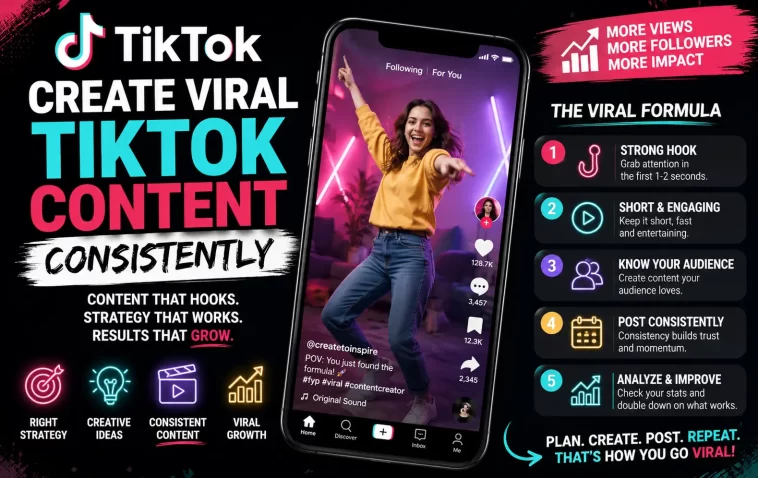
I had one video hit 400K views last year and then spent four months posting into what felt like a void. That gap is what pushed me to actually dig into how the TikTok algorithm works right now, not how it worked when I got lucky. So here’s what I’ve pieced together, and what I’m actually doing differently because of it.
Quick Answer
- Hook viewers in the first 3 seconds — no slow intros, no logo animations
- Aim for a completion rate near 70%, which is the rough bar TikTok now uses before pushing content wider
- New videos get tested with your existing followers first before reaching anyone else
- Shares and saves matter more than likes for triggering wider distribution
- Post 3-5 times a week consistently rather than chasing one big viral swing
Why Most People Never Go Viral Consistently
Here’s the thing that took me way too long to accept: TikTok isn’t randomly picking winners. It’s running a test-and-expand system, and most creators are failing the test in the first hour without realizing it.
Reason one — follower testing changed everything. As of the 2026 rollout, a new video gets shown to your existing followers first, not blasted to strangers right away. If your own audience doesn’t watch it through or engage quickly, the video basically dies quietly before it ever gets a shot at a wider push. That’s a big shift from a couple years back when a cold-start account could occasionally get lucky straight out the gate.
Reason two — completion rate expectations went up. The bar for a video to be treated as “worth pushing” sits around 70% completion now, up from roughly 50% a couple years ago. And that means a decent chunk of content that would’ve done fine in 2024 just quietly underperforms today, not because it’s worse, just because the goalposts moved.
Reason three — likes don’t carry the weight they used to. Shares and saves are the stronger signal now. A video that gets liked a lot but never gets sent to a friend just doesn’t snowball the way it used to. So chasing likes as your main metric is kind of a dead end at this point.
There’s a fourth cause that people overlook constantly: posting content edited entirely in third-party apps with a visible watermark or export artifact. TikTok has been pretty open about down-ranking recycled or watermark-heavy content, and from what I’ve seen, native editing tools genuinely do get a small distribution bump over stuff exported from CapCut or similar and reuploaded elsewhere.
Where Creators Typically Get Stuck
New accounts often assume they need thousands of followers before anything takes off. Not true, but the follower-first testing phase does mean your very first fans matter more than you’d think, since they’re the initial test pool.
Established accounts with a plateau usually have the opposite problem — their existing audience has grown numb, engagement velocity drops, and the algorithm reads that as “this creator’s content isn’t landing anymore,” even if raw view counts still look okay on paper.
Niche creators (cooking, tech reviews, fitness, whatever) tend to actually have it a little easier, because TikTok’s interest-cluster system rewards content that resonates hard within a smaller group over content that’s broadly fine for everyone.
Ranking Signal Comparison
| Signal | Weight in 2026 | Easy to Fake? | Notes |
|---|---|---|---|
| Completion rate | High (~40-50% of ranking weight) | No | Needs a genuinely strong hook and pacing |
| Shares/saves | High | Somewhat | Bots inflate this but get caught eventually |
| Likes | Lower than before | Yes | Still useful, just not the main lever anymore |
| Comment depth/quality | Moderate, growing | No | Short “🔥🔥” comments count less than real replies |
| Follower engagement in first hour | Very high | No | This is the actual gatekeeper now |
Step-by-Step: Building Content That Actually Gets Pushed
Step 1: Write your hook before you film anything. Literally script the first 3 seconds separately from the rest of the video. If it doesn’t make someone stop scrolling on its own, out of context, it’s not strong enough yet.
Step 2: Cut for pacing, not for polish. Every dead second is a chance for someone to swipe away. Watch your own edit back and ask where you’d personally lose interest — usually there’s at least one clip you’re keeping just because you like it, not because it earns its place.
Step 3: Post when your followers are actually online. Since the first-hour follower response determines whether your video gets tested further, check your analytics for when your specific audience is active rather than copying generic “best time to post” charts.
Step 4: Use 3-5 hashtags, not fifteen. Hashtag stuffing doesn’t help discovery anymore and can actually confuse how the algorithm categorizes your content. Pick a couple of broad ones and a couple genuinely niche ones.
Step 5: Write captions like a search query. TikTok search has grown a lot, and captions phrased the way people actually type — “easy dinner for one person” instead of “yum!!” — get pulled into search results long after the initial push fades.
Step 6: Reply to early comments with video replies. This isn’t just good community management. It creates additional watch-time content and signals ongoing engagement on that video during the exact window the algorithm is weighing hardest.
What Actually Worked For Me
I tried the obvious stuff first — posting more often, using every trending sound I could find, stuffing captions with hashtags. None of it moved the needle much, and honestly it felt like throwing things at a wall. The thing that actually shifted my numbers was almost accidental: I started replying to my own comments with short video replies instead of text, mostly because it was faster to just talk into the camera. Views on the original videos started climbing a few hours after I did that, and it took me a minute to connect the two things.
That said, I still haven’t fully cracked why some videos with a strong hook and good completion rate still stall out. My best guess, and it’s genuinely just a guess, is that the follower-testing phase is unforgiving if your recent uploads before it have been inconsistent in tone or topic — the algorithm seems to hedge on pushing something further when it’s not sure who exactly wants it.
Advanced Tactics and Edge Cases
Engagement velocity matters more than total engagement. A video that gets 500 comments over three days performs worse in testing than one that gets 200 comments in the first 90 minutes. If you can, be online and actively responding right after you post, at least for the first hour.
Original audio gets a quiet boost. Trending sounds still work for tapping into an existing wave, but layering your own voiceover or a twist on the trending audio tends to read as more original to the system than using a sound completely untouched.
Deleting underperforming videos can hurt more than it helps. It’s tempting to clean up your profile, but removing videos has generally been associated with a temporary dip in how the algorithm treats your account afterward — worth knowing before you do a big cleanup pass.
Prevention Tips (Staying Consistent, Not Just Lucky)
Post 3-5 times a week on a schedule you can actually sustain, since sporadic viral swings don’t build the kind of follower-testing pool that makes future videos easier to push. Keep a running note of which hooks and formats got your audience to comment in full sentences rather than emoji, and lean into that pattern instead of guessing every time. And don’t chase every trending sound blindly — if it doesn’t fit your niche, it usually just confuses the algorithm’s read on who you’re actually for.
FAQ
Why did my video get views for an hour and then stop completely? That’s usually the follower-testing phase failing to convert into a wider push — engagement from your existing audience wasn’t strong enough in that first window.
Does TikTok punish you for using CapCut instead of the native editor? Not officially confirmed as a hard penalty, but plenty of creators report native-edited videos getting a small distribution edge. Your mileage may vary.
Is it still worth using trending sounds in 2026? Yes, but pair them with your own voiceover or twist. Untouched trending audio alone doesn’t carry the same weight it used to.
How many hashtags should I actually use? 3 to 5, mixing one or two broad tags with a couple specific ones. More than that tends to muddy the categorization rather than help it.
Editor’s Opinion
not gonna lie, the “post consistently and be patient” advice is annoying to hear but it’s basically true, i just didn’t want it to be. chasing one big viral swing burned me out way more than posting boring, steady, decent videos ever did. the algorithm rewards showing up, which is kind of unglamorous but also kind of a relief once you stop trying to reverse engineer magic.
