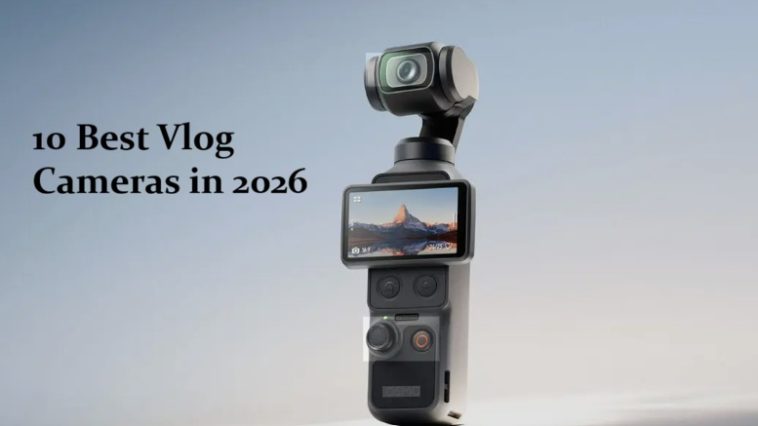
Best vlog cameras in 2026 are better, smaller, and more capable than anything that existed three years ago. The gap between “smartphone footage” and “professional content” has never been easier to close — if you pick the right camera.
Whether you’re just starting a YouTube channel, growing a travel vlog on TikTok, or upgrading your current setup for cinematic-quality content, the right camera makes a measurable difference. Bad audio, shaky footage, and blown-out highlights all go away when you’re using the right tool.
This guide covers the 10 best vlogging cameras available right now — ranked by real-world usability, video quality, and value for money. Each pick comes with honest pros, cons, who it’s for, and current pricing.
What Makes a Great Vlog Camera in 2026?
Before the list, it’s worth knowing what actually matters. The specs that look impressive on paper don’t always translate into better vlogs.
The features that genuinely matter in 2026:
- Stabilization — Mechanical gimbal or in-body optical stabilization (IBIS) is far superior to digital-only. This is the single biggest factor in whether your footage looks professional or amateurish.
- Autofocus with face/eye tracking — Solo creators shoot themselves constantly. If the camera can’t reliably track your face, you’ll waste hours in the edit.
- Flip-out touchscreen — Non-negotiable for self-shooting. A screen that flips 180° toward you is essential.
- Audio input — A 3.5mm microphone jack matters more than most people realize. Built-in mics are fine for casual use; a decent external mic transforms your audio.
- 4K video — Everything worth buying in 2026 shoots 4K. The question is frame rate and bit depth, not whether 4K is available.
- Battery life — Nothing kills a shooting day faster than a dead battery halfway through.
- Size and weight — The best camera is the one you actually bring with you.
With those priorities in mind, here are the top 10.
1. DJI Osmo Pocket 4 — Best Overall Vlog Camera 2026
Price: From $499 (Creator Combo: $649–$749)
The DJI Osmo Pocket 4 launched in April 2026 and immediately became the most talked-about vlogging camera of the year. It packs a 1-inch CMOS sensor, 4K video at up to 240fps, and 14 stops of dynamic range into a body small enough to slip into a jacket pocket — without a gimbal rig attached, because the gimbal is built in.
The three-axis mechanical stabilization is what sets the Osmo Pocket series apart. No matter how quickly you walk, how uneven the terrain is, or how fast you spin around, the footage stays smooth. Software stabilization on other cameras simply cannot match this.
Key upgrades over the Pocket 3 include better low-light performance, improved color profiles for grading, ActiveTrack 7.0 for subject tracking, and 107GB of built-in storage running at 800MB/s. There’s no microSD card slot — a controversial choice — but for most creators, 107GB is more than enough for a full day of shooting.
The Creator Combo adds a DJI Mic 3 transmitter, wide-angle lens, magnetic fill light, and mini tripod. For new buyers, it’s the better value.
One important note for US-based creators: DJI was added to the FCC’s Covered List in December 2025, meaning the Pocket 4 is not officially available through US retail channels. American buyers are sourcing it through grey-market importers from Europe and Asia, which voids the warranty.
Best for: Travel vloggers, daily creators, anyone who wants great footage with zero setup time.
Pros:
- Unmatched mechanical gimbal stabilization
- 4K/240fps slow motion in a pocket-sized body
- 14 stops of dynamic range
- ActiveTrack 7.0 face and subject tracking
- 107GB internal storage at 800MB/s
Cons:
- No microSD expansion
- US availability limited to grey-market imports
- Battery lasts ~2.5–3 hours at 4K
2. Sony ZV-E10 II — Best Interchangeable Lens Vlog Camera
Price: $999 (body only) / $1,099 (with kit lens)
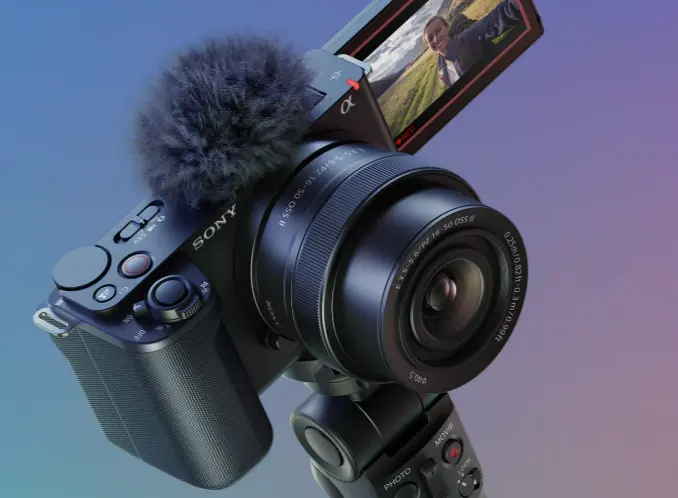
The Sony ZV-E10 II is the camera most working creators recommend in 2026. It combines a 26MP APS-C sensor — the same one found in the more expensive Sony a6700 — with 4K/60fps recording, 10-bit color, and 759-point phase detection autofocus, all in a vlogger-friendly body designed for self-shooting.
The fully articulating touchscreen flips 180° to face you, face and eye tracking is reliable and fast, and the E-mount system gives you access to over 200 compatible lenses from Sony, Sigma, Tamron, and others. As your channel grows, your lens options grow with it — a major long-term advantage over fixed-lens cameras.
The main limitation is the lack of in-body image stabilization (IBIS). Handheld walking shots require some form of electronic stabilization or a gimbal attachment. For creators who primarily shoot in controlled environments (room vlogs, talking-head content, product reviews), this isn’t much of an issue. For run-and-gun travel shooters, it’s worth noting.
Best for: Creators who want professional image quality with room to grow their lens system.
Pros:
- Flagship-level 26MP sensor at a mid-range price
- 4K/60fps with 10-bit color
- Outstanding autofocus with face and eye tracking
- Access to 200+ E-mount lenses
- Fully articulating screen, dedicated vlogging controls
Cons:
- No IBIS — handheld walking footage needs stabilization help
- No built-in ND filter
- No EVF (electronic viewfinder)
3. Panasonic Lumix GH7 — Best for Advanced Video Creators
Price: ~$1,621
The Panasonic Lumix GH7 is what happens when you take a 15-year legacy of video-focused cameras and finally add the one thing creators had been demanding: phase detection autofocus. The result is a Micro Four Thirds camera that shoots up to 5.7K at 60fps, supports Apple ProRes RAW recording internally, and now tracks subjects accurately without the focus wobble that plagued previous GH models.
The GH7 is the camera that professional YouTube creators and documentary-style vloggers reach for when they need cinematic results without spending $5,000 on a cinema camera. Open-gate recording, powerful video formats, weather sealing, and a fully articulating screen round out a package that would have cost twice as much five years ago.
At $1,621, it’s not cheap — but it undercuts the Sony ZV-E1 by over a thousand dollars while delivering comparable (and in some ways superior) video capabilities.
Best for: Advanced creators, YouTube filmmakers, and cinematographers who need professional formats at a reasonable price.
Pros:
- ProRes RAW internal recording up to 5.7K
- New phase detection AF — finally reliable tracking
- Weather-sealed body
- Open-gate recording for flexible aspect ratios
- Powerful video options at a price well below cinema cameras
Cons:
- Micro Four Thirds sensor (smaller than APS-C)
- Steeper learning curve for beginners
- Larger and heavier than compact options
4. GoPro HERO 13 Black — Best Action Vlog Camera
Price: $329
For vloggers who create content outdoors, in extreme conditions, or in situations where a traditional camera would get damaged or get in the way, the GoPro HERO 13 Black is still the go-to in 2026.
It’s waterproof to 33 feet without a housing, shoots 5.3K video, and now features a modular HB lens system that opens up new creative options — including an anamorphic lens for a cinematic widescreen look. The 1900mAh battery delivers up to 90 minutes at 4K/30fps, and the newer camera stabilization (HyperSmooth 6.0) is genuinely impressive for action footage.
The HERO 13 Black isn’t the right camera for talking-head content or low-light indoor shooting. But for surf, skiing, cycling, hiking, or any scenario where you need a rugged, compact camera that you can strap to your body — nothing touches it at this price.
Best for: Outdoor creators, action sports vloggers, travel creators who need a weatherproof secondary camera.
Pros:
- Waterproof to 33ft without a case
- 5.3K video, HyperSmooth 6.0 stabilization
- Modular HB lens system for creative versatility
- Compact and mountable on helmets, bikes, chest rigs
- $329 is accessible for most budgets
Cons:
- No flip-out selfie screen (limited self-shooting)
- Weak in low-light compared to larger-sensor cameras
- Not ideal for stationary, dialogue-heavy content
5. Fujifilm X-M5 — Best Under $1,000 for Aesthetics and Film Looks
Price: ~$799 (body only)
The Fujifilm X-M5 is the most aesthetically distinctive vlogging camera on this list, and intentionally so. It’s built around Fujifilm’s famous film simulation modes — 20 different looks including Classic Chrome, Velvia, and Acros — all accessible via a dedicated dial on the camera body. Footage straight out of the camera looks finished in a way that no other brand achieves.
Video specs are strong: 6.2K at 30fps, 4K at 60fps, 10-bit internal recording, and a 9:16 vertical vlogging mode built specifically for TikTok, Instagram Reels, and YouTube Shorts. Built-in directional microphones and a fully articulating screen complete the package.
The X-M5 lacks optical stabilization, which is a limitation for handheld walking content. It also doesn’t have an electronic viewfinder. But for creators who shoot primarily in controlled environments, or who use a small gimbal for outdoor shots, the X-M5’s color science and film simulation options give your content a visual identity that’s genuinely hard to replicate.
Best for: Lifestyle vloggers, aesthetic creators, TikTok and Instagram creators who want a distinctive visual style.
Pros:
- 20 film simulation modes — the best color science available
- 6.2K/30fps and 4K/60fps with 10-bit color
- Dedicated vertical 9:16 shooting mode
- Compact, affordable under-$1,000 entry point
- Interchangeable Fujifilm X-mount lenses
Cons:
- No in-body or optical stabilization
- No EVF
- Can overheat during extended video sessions
6. Sony a6700 — Best All-Around Mirrorless for Vloggers
Price: ~$1,399 (body only)
The Sony a6700 is the camera for creators who want the best possible autofocus, the flexibility to shoot both video and stills at a professional level, and true in-body image stabilization — all in an APS-C body smaller than a full-frame camera.
It shares the same 26MP BSI APS-C sensor as the ZV-E10 II, but adds five-axis IBIS, 4K/120fps slow motion (with a 1.6x crop), a built-in ND filter, and an electronic viewfinder. The BIONZ XR processor and AI-powered subject tracking make it one of the most capable autofocus systems in any camera at this price point.
For vloggers who also want to use their camera for travel photography, product photography, or events, the a6700 is the all-rounder the ZV-E10 II can’t quite be. The price premium over the ZV-E10 II is roughly $400 — but you get IBIS, which for many creators is worth the difference on its own.
Best for: Hybrid creators who need professional photo and video performance in a compact body.
Pros:
- Five-axis IBIS for stabilized handheld shooting
- Same 26MP sensor as ZV-E10 II, plus more professional features
- 4K/120fps slow motion
- Built-in ND filter
- Excellent AI-powered autofocus
Cons:
- 4K/120fps has a 1.6x crop
- More expensive than vlog-specific alternatives
- Slightly larger and heavier than the ZV-E10 II
7. Canon PowerShot V1 — Best Compact Fixed-Lens Vlog Camera
Price: ~$900 / £909
The Canon PowerShot V1 is the spiritual successor to the beloved G7X line, redesigned specifically for content creators. It combines a large 1-inch sensor with a 16-50mm equivalent zoom lens in a body compact enough to carry anywhere, and backs it up with Canon’s excellent Dual Pixel autofocus — one of the most reliable face-tracking systems available.
The fully articulating 3-inch touchscreen is responsive and bright enough for outdoor use, 4K/60fps footage looks clean and detailed, and the overall design feels solid despite its pocketable dimensions. For vloggers who don’t want to deal with interchangeable lenses, the V1 is a strong all-in-one option.
The main limitation is the fixed lens — you can’t adapt it for telephoto or ultra-wide shooting beyond what the built-in zoom offers. It also lacks in-body image stabilization, though Canon’s digital stabilization helps for steady walking shots.
Best for: Casual vloggers, travel creators, and anyone who wants a compact, capable camera without lens management.
Pros:
- Large 1-inch sensor in a compact body
- Canon Dual Pixel autofocus with reliable face tracking
- 4K/60fps recording
- Fully articulating touchscreen
- No lens changing needed — great for travel
Cons:
- Fixed lens limits creative flexibility
- No IBIS
- Not weather-sealed
8. Insta360 X5 — Best 360° Camera for Vloggers
Price: $559
The Insta360 X5 is the best 360-degree camera for content creators in 2026. What makes it so useful for vlogging specifically is a trick that sounds simple but changes everything: you shoot in every direction at once, then choose your framing in post-production.
That means no cameraman needed for wide shots. No worrying about being in frame. No missed moments because the camera was pointed the wrong way. You capture everything, and you reframe it later. The X5 shoots 8K 360° video and also functions as a conventional single-lens camera for straightforward vlogging or action shots.
Waterproof to 33 feet and built to survive outdoor conditions, the X5 is especially popular with travel vloggers, adventure creators, and anyone who shoots dynamic content where traditional cameras would miss key moments.
Best for: Travel vloggers, adventure creators, solo creators who want maximum reframing flexibility.
Pros:
- Reframe your shots in post — never miss a moment
- 8K 360° video, also usable as a standard action cam
- Waterproof to 33ft
- Unique visual perspectives impossible with traditional cameras
- Strong low-light performance for its category
Cons:
- Editing 360° footage requires more post-production time
- Stitching artifacts can appear in some lighting conditions
- More expensive than standard action cameras
9. Sony ZV-E1 — Best Full-Frame Vlog Camera
Price: ~$2,000+
The Sony ZV-E1 is in a category of its own: a full-frame camera designed specifically for vloggers. It uses the same 12MP BSI CMOS sensor as the Sony A7S III — one of the best low-light video sensors ever made — in a body that weighs just 17 ounces and fits in a large jacket pocket.
It includes all the vlogger-specific features Sony has refined over years: background defocus mode, product showcase mode (where autofocus switches to objects held in front of the camera), and AI-based subject tracking. The full-frame sensor delivers a level of depth of field, bokeh, and low-light performance that no APS-C or Micro Four Thirds camera can match.
At $2,000+, the ZV-E1 is not an entry-level purchase. But for creators who want the absolute best image quality in a camera small enough to bring anywhere — and who primarily shoot video rather than stills — it’s exceptional value compared to full-frame cinema alternatives.
Best for: Professional creators, full-time YouTubers, and creators who prioritize low-light performance and bokeh over everything else.
Pros:
- Full-frame 12MP sensor — same as the Sony A7S III
- Outstanding low-light performance
- Vlogger-specific features: background defocus, product showcase
- Compact for a full-frame camera
- 4K/60fps video
Cons:
- Expensive — $2,000+ body only
- 12MP is lower resolution than APS-C competitors for stills
- Requires E-mount lenses (additional cost)
10. DJI Osmo Action 6 — Best Budget Action Vlog Camera
Price: ~$199–$249
If you need an action camera for outdoor content but the GoPro HERO 13 Black is outside your budget, the DJI Osmo Action 6 is the most compelling alternative. It offers strong 4K stabilization, a front-facing screen for self-shooting (something the GoPro HERO 13 doesn’t have), good low-light performance for an action camera, and a user-friendly interface that makes it accessible to complete beginners.
The front-facing screen alone makes a significant difference for vloggers — you can actually see yourself in frame while recording, which GoPro requires an additional LCD add-on to achieve. For creators in harsh environments who want a capable, affordable camera with solid selfie-mode functionality, the Action 6 punches well above its price.
Best for: Budget-conscious creators, beginners, outdoor vloggers who want an alternative to GoPro.
Pros:
- Front-facing screen for easy self-shooting
- Strong 4K stabilization for an action camera
- Affordable entry point
- Magnetic mounting system
- Good performance in outdoor lighting
Cons:
- Smaller sensor limits low-light and cinematic quality
- Not ideal as a primary camera for talking-head content
- Less accessory ecosystem than GoPro
Full Comparison Table
| Camera | Price | Sensor | Best For | Stabilization |
|---|---|---|---|---|
| DJI Osmo Pocket 4 | $499 | 1-inch | Travel, daily vlogging | 3-axis gimbal |
| Sony ZV-E10 II | $999 | APS-C 26MP | Growing creators | Electronic only |
| Panasonic GH7 | $1,621 | MFT 25.2MP | Advanced video | IBIS |
| GoPro HERO 13 Black | $329 | 1/1.9″ | Outdoor/action | HyperSmooth 6.0 |
| Fujifilm X-M5 | $799 | APS-C 26MP | Aesthetic/lifestyle | Electronic only |
| Sony a6700 | $1,399 | APS-C 26MP | Hybrid photo+video | 5-axis IBIS |
| Canon PowerShot V1 | ~$900 | 1-inch | Compact travel | Digital |
| Insta360 X5 | $559 | Dual lens | 360° adventure | FlowState |
| Sony ZV-E1 | $2,000+ | Full-frame 12MP | Professional | IBIS |
| DJI Osmo Action 6 | ~$229 | 1/1.3″ | Budget outdoor | RockSteady |
How to Choose the Right Vlog Camera for You
Not sure where to start? Here’s a simple decision framework:
If you’re a complete beginner → Start with the DJI Osmo Action 6 or DJI Osmo Pocket 4. Both are plug-and-play, produce great footage, and don’t require technical knowledge.
If you shoot travel or outdoor content → DJI Osmo Pocket 4 for maximum portability, GoPro HERO 13 Black for waterproof action, or Insta360 X5 for reframeable 360° coverage.
If you shoot talking-head, room, or review content → Sony ZV-E10 II for the best autofocus and lens flexibility, or Canon PowerShot V1 for a compact all-in-one.
If you care about film aesthetics and color → Fujifilm X-M5 with its 20 film simulation modes is in a class of its own.
If you need professional-grade video → Panasonic GH7 for advanced formats at a reasonable price, or Sony ZV-E1 for the best low-light full-frame quality.
If budget is the priority → GoPro HERO 13 Black at $329 or DJI Osmo Action 6 at ~$229 give you more than enough to create quality content.
FAQ: Best Vlog Cameras 2026
Q: What is the best vlog camera overall in 2026?
The DJI Osmo Pocket 4 is the most well-rounded option for most creators. It combines mechanical gimbal stabilization, a 1-inch sensor, 4K/240fps capability, and a pocketable form factor in a way no competitor currently matches.
Q: What is the best vlog camera under $500?
The GoPro HERO 13 Black at $329 is the standout pick under $500 for outdoor and action content. For general vlogging, the DJI Osmo Pocket 4 starts at $499 and offers significantly better image quality and stabilization.
Q: Do I need 4K for vlogging in 2026?
Every camera worth buying in 2026 shoots 4K anyway, so the better question is frame rate and bit depth. 4K/60fps with 10-bit color gives you slow-motion capability and better color grading flexibility — look for those specs if you’re serious about production quality.
Q: Is a phone good enough for vlogging in 2026?
Modern flagship phones shoot impressively, but they struggle with autofocus tracking, external microphone support, and cinematic depth of field. The moment you want a professional look, a dedicated camera pulls ahead — especially for low-light footage and subject separation (bokeh).
Q: What vlog camera is best for YouTube in 2026?
The Sony ZV-E10 II is the most recommended camera specifically for YouTube in 2026. Its combination of autofocus reliability, 4K/60fps with 10-bit color, and access to the E-mount lens system gives creators everything they need to scale their production quality over time.
Q: Is the DJI Osmo Pocket 4 available in the US?
Not through official retail channels. DJI was placed on the FCC’s Covered List in December 2025, which prevents official US availability. American creators are sourcing it through grey-market imports from Europe and Asia, though this voids the official warranty.
Q: What’s the difference between a vlogging camera and an action camera?
Vlogging cameras (like the Sony ZV-E10 II or Canon PowerShot V1) are optimized for controlled shooting — talking-head content, room vlogs, and lifestyle video. Action cameras (like the GoPro HERO 13 Black) are built for rugged, outdoor, mountable use. Many creators use one of each.
Final Thoughts
The best vlogging cameras in 2026 have genuinely crossed a threshold — the footage they produce would have required a $5,000+ professional rig just five years ago. You no longer need a huge budget to make content that looks and sounds professional.
Pick the camera that fits how you actually create. A $329 GoPro used consistently will produce better results than a $2,000 camera that stays on the shelf because it’s too complicated to carry. Match the tool to the workflow, and focus most of your energy on lighting, audio, and editing — that’s where the real quality difference is made.
All prices listed are approximate and based on information available as of June 2026. Prices may vary by region and retailer.
