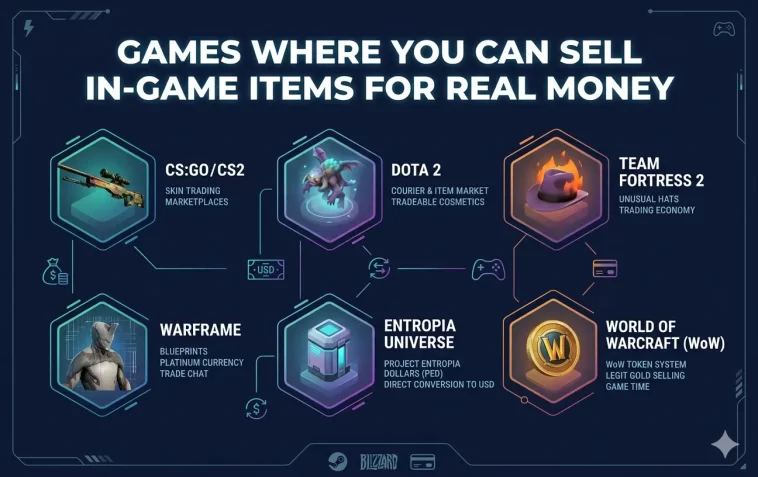
Selling in-game items for real money is one of the oldest ways to earn from gaming — and in 2026, it’s bigger than ever. We’re not talking about streaming or competing professionally. We’re talking about playing a game, collecting or crafting items inside it, and selling those items to other players for actual cash.
Some people do this casually and earn an extra $50–$100 a month. Others treat it like a part-time job and clear several hundred dollars consistently. A small group has turned specific game economies into serious income.
This guide covers the best games across every category — Steam/PC titles, MMOs, and Web3 games — where in-game item selling is real, active, and accessible.
How Selling In-Game Items Actually Works
Before we get into specific games, here’s the basic model:
Every game on this list has an in-game economy — a marketplace where players buy and sell items using either in-game currency, real money, or crypto tokens. The items might be weapon skins, rare equipment, crafting materials, collectible cards, or NFTs.
Your job as a seller is to acquire those items (through gameplay, crafting, trading, or farming) and sell them at a profit. The profit comes from either:
- Time arbitrage — you grind for items other players don’t want to grind for
- Market arbitrage — you buy underpriced items and resell at market value
- Skill — you craft rare items that require knowledge or difficult gameplay to produce
Now let’s look at where this actually happens.
PC / Steam Games
1. Counter-Strike 2 (CS2)
Platform: PC (Steam) Marketplace: Steam Community Market + third-party sites
CS2 has one of the most active item economies in gaming history. Weapon skins range from a few cents to thousands of dollars for rare knives and gloves. The Steam Community Market lets you list and sell items directly to other players, with Steam taking a 15% cut.
For real cash (not Steam wallet credit), third-party marketplaces like Skinport, CS.Money, SkinBaron, and BitSkins are the go-to options. These platforms let you withdraw actual money via PayPal or bank transfer.
How to earn:
- Open cases (risky — usually not profitable)
- Buy cheap skins and flip them at a higher price
- Farm operation missions that drop exclusive items
- Trade up contracts to create higher-tier skins
Earning potential: Flippers who understand the market can earn $100–$500/month. Casual sellers earn less but consistently.
Watch out for: Steam wallet credit vs. real cash — the Steam Market only pays in Steam balance. Use third-party sites for actual withdrawals.
2. Dota 2
Platform: PC (Steam) Marketplace: Steam Community Market + third-party traders
Dota 2 has a rich cosmetic economy with hero sets, couriers, and rare items called Immortals and Arcanas. Some limited-edition items sell for hundreds of dollars.
Unlike CS2, Dota 2 item values are heavily tied to seasonal events and Battle Pass exclusives. Items from old Battle Passes that are no longer obtainable can command premium prices.
How to earn:
- Participate in seasonal events for exclusive drops
- Trade with other players for rare legacy items
- Flip underpriced items on the marketplace
Earning potential: Lower volume market than CS2, but rare items can yield significant one-time profits.
3. Team Fortress 2 (TF2)
Platform: PC (Steam) Marketplace: Steam Market + backpack.tf
TF2 has one of the oldest player-driven economies in gaming. Unusual hats — cosmetics with particle effects — are the main currency of its economy, with some selling for $50–$500+.
The community-run site backpack.tf is where most serious trading happens. Learning the TF2 economy takes time, but experienced traders can flip items consistently.
How to earn:
- Unbox Mann Co. crates for unusual hats (luck-based)
- Trade up through the community market
- Buy and hold items that tend to appreciate over time
Earning potential: Moderate — best for patient traders who enjoy the community.
4. Rust
Platform: PC (Steam) Marketplace: Steam Community Market + Rust-specific sites
Rust skins — for weapons, clothing, and building pieces — have a healthy market. Limited-time skins from the Rust Store often appreciate after they leave rotation, making early buyers good money later.
The market is smaller than CS2 but less saturated with experienced flippers, which means opportunities are easier to find if you do your research.
How to earn:
- Buy new skins on release and hold for appreciation
- Flip undervalued items on the Steam Market
- Participate in community skin giveaways and events
5. Path of Exile (PoE / PoE 2)
Platform: PC (free to play) Marketplace: In-game trading + poe.trade / pathofexile.com/trade
Path of Exile has one of the deepest item economies in any game. Rare items with the right combination of stats can sell for enormous amounts of in-game currency — which itself is tradeable for real money through third-party platforms.
PoE doesn’t have an official real-money marketplace, but a large grey market exists. Players sell currency and items through sites like G2G and PlayerAuctions.
How to earn:
- Farm specific endgame content that drops valuable items
- Learn the currency flipping meta (buying low, selling high)
- Master crafting systems to create and sell meta-relevant gear
Earning potential: High ceiling for dedicated players — some earn hundreds per league. Requires deep game knowledge.
MMO / RPG Games
6. World of Warcraft (WoW)
Platform: PC Marketplace: In-game Auction House + WoW Token system
World of Warcraft has a unique official system called the WoW Token. You can buy a Token for real money and sell it in-game for gold — or do the reverse: earn gold in-game and convert it to game time or Battle.net balance.
While this doesn’t give you direct cash, it effectively pays for your subscription and other Blizzard games through gameplay. For dedicated gold farmers, this can be worth $15–$30/month in value.
Beyond the Token, grey market gold selling exists (against ToS, so proceed carefully), and rare mounts and pets have been sold between players for real cash.
How to earn:
- Farm dungeons and raids for sellable gear and materials
- Craft and sell consumables on the Auction House
- Flip underpriced items during market dips
7. Final Fantasy XIV (FFXIV)
Platform: PC, PlayStation Marketplace: In-game Market Board
FFXIV’s crafting system is among the deepest in any MMO, and the player-driven Market Board creates genuine earning opportunities. Rare crafted gear, housing furniture, and glamour items (cosmetics) can sell for millions of in-game gil.
Converting gil to real money requires third-party grey market platforms (against ToS), but the in-game economy itself is rich enough to fund your subscription and then some through smart trading.
How to earn:
- Level crafting jobs and sell high-demand gear
- Gather rare materials during patch windows when demand spikes
- Flip housing furniture and seasonal items
8. Diablo IV
Platform: PC, Console Marketplace: Third-party (no official marketplace)
Diablo IV doesn’t have an official player marketplace, but a grey market thrives through sites like G2G and D4 trade Discord servers. Rare items with perfect stats — especially in Hardcore mode — command serious prices from players who want to skip the grind.
How to earn:
- Farm endgame content for high-tier uniques
- Sell meta-relevant gear during new season launches (demand spikes)
- Trade directly with players via community channels
Note: Selling items is technically against Blizzard’s ToS. Most sellers operate in grey market spaces. Do your own risk assessment.
Web3 / NFT Games
9. Gods Unchained
Platform: Web browser (PC/Mac) Marketplace: gods.gg marketplace
Gods Unchained cards are NFTs — you actually own them and can sell them whenever you want. The game is free to play, and winning ranked matches earns you card packs. Good cards from winning streaks or card openings can be listed on the marketplace for real money.
This is one of the cleanest examples of a game where your time directly translates to sellable assets.
How to earn:
- Play ranked games to earn card packs
- Open packs and sell valuable cards
- Buy underpriced cards and resell at market value
Earning potential: $20–$200/month for active players depending on card market prices.
10. Splinterlands
Platform: Web browser Marketplace: Splinterlands marketplace + Hive Engine
Splinterlands is a card battle game where every card is a tradeable asset. High-level cards, summoners, and land plots have real monetary value. The game has been running since 2018 — which in Web3 gaming terms makes it ancient and relatively trustworthy.
How to earn:
- Win ranked battles to earn reward cards and SPS tokens
- Sell unwanted cards on the marketplace
- Rent cards to other players for passive income (a unique feature)
Earning potential: $30–$150/month for active players; card rental income is more passive.
11. Axie Infinity
Platform: Mobile and PC Marketplace: marketplace.axieinfinity.com
Axie Infinity pioneered the play-to-earn model, and while its economy has stabilized significantly from the 2021 boom, it still functions. Each Axie is an NFT you can breed, battle with, or sell. Rare Axies with useful body parts command premium prices.
How to earn:
- Battle to earn SLP tokens
- Breed Axies with desirable traits and sell offspring
- Sell high-stat Axies to competitive players
Earning potential: Highly variable — depends on token prices and your Axie lineup quality.
12. Alien Worlds
Platform: Web browser / Mobile Marketplace: AtomicHub NFT marketplace
Alien Worlds is a mining and strategy game where tools, land, and minions are all NFTs tradeable for real money. It’s one of the most-played blockchain games by user count.
You mine Trilium (TLM) tokens and earn NFT tools through gameplay. Better tools mean faster mining and more earnings.
How to earn:
- Mine daily with your tool NFTs
- Sell earned tools and minions on AtomicHub
- Stake TLM tokens for governance rewards
Earning potential: Lower ceiling than some other Web3 games, but very accessible to beginners.
Where to Actually Sell Your Items
Here’s a quick reference of the main platforms used across all these games:
Steam-based games:
- Steam Community Market (wallet credit only)
- Skinport — CS2 skins, real cash withdrawal
- CS.Money — CS2/Dota 2 trading
- SkinBaron — European-focused, PayPal withdrawal
- BitSkins — multi-game, crypto and PayPal
MMO / Grey market:
- G2G — buy and sell game currency and items across dozens of games
- PlayerAuctions — similar to G2G, longer track record
- Game-specific Discord servers and Reddit communities
Web3 games:
- gods.gg — Gods Unchained
- Splinterlands Marketplace — built into the game
- AtomicHub — WAX blockchain NFTs (Alien Worlds, etc.)
- marketplace.axieinfinity.com — Axie Infinity
Tips Before You Start
Learn the economy before you spend anything. Every game on this list has community resources — subreddits, Discord servers, YouTube channels — where experienced traders share market knowledge. Spend a week learning before you spend a dollar.
Understand the fees. Steam takes 15%. Third-party sites take 5–15%. Web3 marketplaces charge gas fees on some blockchains. Always calculate net profit after fees.
Watch patch notes closely. A balance patch in an MMO or a new season in a loot game can swing item prices dramatically in 24 hours. The best traders are always reading patch notes.
Start with what you already play. If you’re already in CS2 or Path of Exile, you have an advantage — you understand the meta. Don’t jump into a new game just for the money; the learning curve will eat your earnings.
Grey market vs. official market. Some games (WoW, Diablo IV) don’t officially support real-money trading. It happens anyway, but there’s account ban risk. Be aware of each game’s ToS before selling.
FAQ: Selling In-Game Items for Real Money
Q: Is selling in-game items legal? It depends on the game. Steam-based games generally allow it through the Steam Market or tolerate third-party sales. Web3 games are built around it — it’s literally the point. MMOs like WoW and Diablo IV have ToS against real-money trading, though enforcement varies.
Q: How do I get paid? Third-party sites like Skinport, SkinBaron, and G2G pay through PayPal, bank transfer, or crypto. Steam only pays in Steam wallet balance. Web3 games pay in crypto tokens you convert through an exchange.
Q: Can beginners make money doing this? Yes, but start small. The easiest entry point for beginners is probably CS2 (huge market, lots of resources) or Gods Unchained (free to start, clear marketplace). Both have active communities that help newcomers learn.
Q: How much time does it take? Casual flipping on Steam can take 30 minutes a day. Active farming in PoE or an MMO can take several hours. Web3 gaming falls somewhere in between depending on the game.
Q: What’s the fastest way to start earning? If you already own CS2, go to Skinport, check what your current inventory is worth, and list anything valuable. That’s genuinely the fastest zero-investment start. If you’re starting from scratch, Gods Unchained lets you begin for free and start accumulating sellable cards within a few sessions.
Q: Are Web3 game items reliable investments? No — treat them as speculative. Token prices and NFT values can drop significantly. Focus on games where the items have utility (gameplay value) rather than pure speculation, as those economies tend to be more stable.
Q: Do I need a crypto wallet for Web3 games? Yes. For most Web3 games, you’ll need a wallet like MetaMask or a WAX Cloud Wallet depending on the blockchain. Setup takes about 15 minutes and is well-documented on each game’s official site.
Q: What’s the biggest mistake new sellers make? Selling too fast. Most new sellers panic-sell items the moment they drop. Experienced traders know that timing matters — selling a CS2 skin during a major tournament week, or selling PoE gear during the first week of a new league, can double or triple your returns.
Final Thoughts
Selling in-game items for real money is one of the most underrated ways to earn online. Unlike streaming or competitive gaming, it doesn’t require you to be famous or exceptionally skilled — it rewards knowledge, patience, and market awareness.
Pick one game from this list that you already enjoy or want to learn. Study its economy. Start small. The people who make real money from this aren’t necessarily the best players — they’re the ones who understand the market better than everyone else.
That’s a skill anyone can develop.
