I remember the first time I described what I wanted to a coding tool in plain English and watched it generate a working component in seconds. I had spent the previous hour stuck on a boilerplate problem I had solved a dozen times before. That moment didn’t make me feel replaced. It made me feel like I had finally been freed from the part of coding I always found least interesting.
That experience kept nagging at me. If a well-written sentence could do what used to take twenty minutes of typing, what exactly is the future of writing code? More importantly — what does that mean for the people who build software for a living?
Intent-driven development is the answer to those questions. And the more I dug into it, the more I realized this isn’t just a new tool category. It’s a fundamental shift in how software gets made.
What Is Intent-Driven Development?
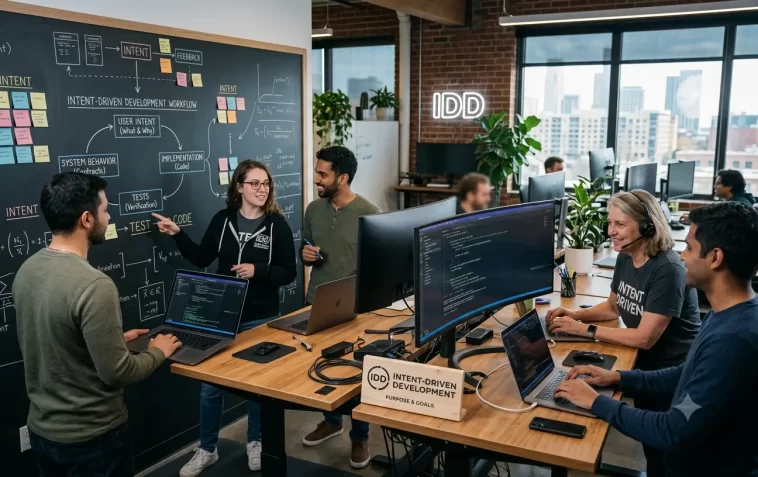
Intent-driven development (IDD) is a software engineering approach where the developer’s primary job shifts from writing implementation code to expressing what needs to be built — clearly, precisely, and in terms that AI systems can act on.
Instead of opening an IDE and writing functions line by line, you describe the desired behavior. The AI translates that description into code, tests, and sometimes even deployment steps. The human stays involved at the beginning (defining the goal) and at the end (validating the result). Everything in between is increasingly automated.
This is different from simply using an AI code assistant. A code assistant helps you type faster. IDD changes what you’re responsible for — from implementation to specification.
The term isn’t brand new, but it became central to how developers talk about their work in 2025 and 2026, partly because the tools finally became capable enough to make it real, not just theoretical.
How Did We Get Here? A Quick History
To understand why IDD matters, it helps to see it as part of a longer pattern. Programming has always been moving away from the machine and toward the human.
In the early days of computing, programmers wrote machine code — raw binary instructions. Then came assembly language, which was slightly more readable. Then high-level languages like C, Java, and Python, which are closer to how humans think. Each step up the abstraction ladder made developers more productive without requiring them to understand every layer below.
Intent-driven development is the next step on that same ladder. Instead of writing Python functions, you write a specification of what the function should do — and the AI writes the Python.
The key difference this time is the scale of the leap. The jump from assembly to C was big. The jump from writing code to describing intent might be bigger.
The Role of AI in Making IDD Real
Large Language Models Changed the Game
The reason IDD is a practical reality today — not just an idea — is the emergence of large language models (LLMs) capable of understanding and generating code from natural language. Tools like GitHub Copilot, Cursor, Claude Code, and others brought this capability into everyday development workflows.
By 2026, the numbers tell a clear story. Around 92% of developers in the US use AI coding tools daily. Nearly half of all code committed to GitHub is now AI-generated. Those aren’t small shifts — they represent a structural change in how software gets written.
From Autocomplete to Agentic Systems
The early AI coding tools were essentially smart autocomplete. You typed a comment describing a function, and the AI suggested the implementation. Useful, but still fundamentally reactive.
What’s happening now is different. Modern AI coding agents — sometimes called agentic systems — can read an entire codebase, understand its architecture and patterns, and implement a feature request end-to-end. They can write the code, write the tests, check for conflicts with existing modules, and open a pull request. All from a single clear instruction.
This is what Anthropic’s 2026 Agentic Coding Trends Report calls “repository intelligence” — AI that understands not just lines of code, but the relationships and intent behind them.
Intent-Driven Development vs. Traditional Coding
It helps to see the contrast clearly.
In traditional coding:
- You translate a requirement into logic yourself
- You write the implementation step by step
- You handle syntax, structure, and edge cases manually
- You test what you built
In intent-driven development:
- You define the goal precisely in natural language (or a structured spec)
- An AI agent translates that into implementation
- You review, validate, and direct corrections
- You focus on whether the output matches the intent — not whether the syntax is correct
The role of the human doesn’t disappear. It moves upstream. You become the person who defines what “done” looks like — not the person who types every step to get there.
What “Vibe Coding” Gets Right (and Wrong)
You may have encountered a related term: vibe coding. Computer scientist Andrej Karpathy coined it in February 2025 to describe a development style where you describe what you want in loose, conversational language and accept whatever the AI produces without carefully reading the output.
Vibe coding captures the spirit of intent-driven work — you’re focused on outcomes, not syntax. But it’s also drawn criticism for encouraging a careless relationship with AI-generated code. Around 41% of surveyed developers say they avoid the full vibe coding approach because of security concerns. AI-generated code, if accepted without review, can introduce subtle bugs and vulnerabilities that are hard to catch.
The more mature version of this idea is intent-driven development: you still express your intent clearly and naturally, but you maintain responsibility for validating the output. The AI handles implementation. You handle judgment.
Step 1: Learn to Write Precise Intent Statements
If you want to work effectively in an intent-driven workflow, the first skill to develop is writing clear, precise specifications.
This is harder than it sounds. “Build a login system” is vague. “Build a JWT-based authentication endpoint that accepts email and password, validates against a PostgreSQL users table, returns a signed token on success, and returns a 401 with no details on failure” is an intent statement an AI agent can act on.
Here’s how to practice:
- Before touching any AI tool, write out what you want in one or two sentences.
- Include constraints, edge cases, and expected outputs.
- Specify what the code should not do, not just what it should.
- Treat your intent statement the way you’d treat a story in a sprint — it needs to be complete enough for someone else to execute.
The quality of your output from AI systems is almost entirely determined by the quality of your input. Teams that succeed with IDD treat specification as their primary skill, not an afterthought.
Step 2: Shift From Writing Code to Reviewing It
In an IDD workflow, your relationship with code changes. You’re no longer the author — you’re the editor.
That means developing a sharp eye for AI-generated code. Here’s what to focus on:
- Logic gaps: AI agents write code that works in isolation. Does it work in your specific system, with your data structures and dependencies?
- Edge cases: AI tends to handle the happy path well. Check what happens when inputs are empty, malformed, or unexpected.
- Security assumptions: AI-generated code often makes convenient security assumptions. Verify that authentication, input validation, and data exposure are handled correctly.
- Architectural fit: Does the generated code follow your team’s existing patterns? Or does it introduce new conventions that will create inconsistency?
This kind of review is faster than writing from scratch — but it’s not passive. You’re applying judgment that the AI can’t substitute.
Step 3: Develop Systems Thinking Over Syntax Mastery
One of the clearest changes in what developers need to know is the shift from syntax mastery to systems thinking. When AI can write the code, the scarce skill becomes understanding how systems behave at scale.
To develop this:
- Study architecture patterns — how components communicate, how data flows, how failures propagate.
- Learn to think in trade-offs: latency vs. consistency, simplicity vs. flexibility, speed of development vs. maintainability.
- Understand the difference between code that works and code that belongs — code that fits cleanly into an existing system without introducing friction.
- Practice reading code more than you write it. Understanding codebases at a high level becomes more valuable than typing speed.
One senior engineering lead put it well in early 2026: “AI handles the typing. We handle the judgment.” That reframing is accurate — and it tells you exactly where to invest your development time.
Step 4: Get Comfortable With Prompt Engineering for Code
Prompt engineering became a major discipline in 2025, and while AI systems are getting better at inferring intent, knowing how to communicate clearly with AI tools is still a meaningful advantage.
For code-specific prompts:
- Be specific about constraints — language, framework, performance requirements, compatibility.
- Give context — paste the relevant parts of your existing codebase, not just the isolated problem.
- Iterate conversationally — don’t expect the first output to be perfect. Treat it as a first draft and refine from there.
- Ask for explanations — have the AI explain what it generated and why. This helps you catch errors and learn simultaneously.
The goal isn’t to memorize prompt templates. It’s to learn to communicate with precision — which is a skill that transfers across tools and will matter regardless of how the tooling evolves.
Step 5: Understand What AI Still Gets Wrong
This step is critical. One of the risks of the IDD shift is that developers stop learning the things AI handles well — and then find themselves unable to debug when things go wrong.
AI coding agents consistently struggle with:
- Complex debugging — particularly race conditions, concurrency issues, and subtle state bugs that only appear under real-world load.
- Architectural decisions — AI can implement a design, but it can’t decide which design fits your business, your team, and your long-term roadmap.
- Institutional knowledge — AI has no memory of why your system was built the way it was. Context that lives in someone’s head or in informal conversations is invisible to it.
- Business logic translation — translating ambiguous human requirements into precise specifications is still a human domain. Someone still has to decide what the code should do and confirm that the AI output aligns with business goals.
Junior developers who rely on AI without building foundational understanding often struggle with these exact problems. The advice isn’t to avoid AI — it’s to use it as an accelerator for things you already understand, not as a substitute for understanding them.
Step 6: Redefine What “Being a Developer” Means to You
This is the most personal step, and probably the most important. Intent-driven development is forcing a redefinition of developer identity — and how you respond to that determines a lot about your trajectory.
The parts of development that are shrinking:
- Writing boilerplate
- Scaffolding standard patterns
- Routine debugging of syntax errors
- Repetitive testing of simple functions
The parts that are growing:
- Defining what needs to be built and why
- Evaluating AI output for correctness and fit
- Making architectural and product decisions
- Communicating with stakeholders in both technical and business language
- Understanding systems at a level that lets you catch what AI misses
In February 2026, Spotify revealed that some of its best engineers hadn’t written a line of code since December. They were directing AI agents, reviewing outputs, and making architectural decisions. That’s not a loss of capability — it’s a shift in how capability is applied.
You don’t have to choose between being a “real developer” and embracing these tools. But you do have to decide what kind of thinking you want to be known for.
Is Coding Actually Dead?
No. But the question itself is worth taking seriously.
Entry-level repetitive coding — writing boilerplate, scaffolding CRUD endpoints, generating test cases — is being automated rapidly. Entry-level developer hiring fell 25% in 2024 alone. That’s a real shift with real consequences for people entering the field.
At the same time, experienced developers who can work effectively with AI tools are commanding salary premiums of 15–25% above peers who can’t. The Bureau of Labor Statistics still projects 17% growth in software developer jobs through 2033.
What’s dying is the path where you build a career by typing faster than the next person. What’s growing is the path where you build a career by thinking more clearly, defining problems more precisely, and directing systems — human and AI — toward the right outcomes.
The game didn’t end. It moved to a harder mode. The syntax layer got automated. The judgment layer is more valuable than ever.
FAQ
What exactly is intent-driven development in simple terms?
Intent-driven development means that instead of writing code line by line, a developer focuses on clearly describing what they want the software to do. AI tools then handle the actual implementation. The developer’s job shifts from writing to specifying, reviewing, and validating.
Is intent-driven development the same as vibe coding?
They’re related but different. Vibe coding (coined by Andrej Karpathy in 2025) emphasizes a loose, conversational style where you describe what you want and accept AI output without deep review. Intent-driven development is a more disciplined version — you still express intent in natural language, but you maintain responsibility for validating the output carefully.
Do I still need to learn to code if intent-driven development takes over?
Yes. Understanding programming fundamentals — logic, data structures, system design, APIs — is still valuable. It helps you write better intent statements, catch AI errors, and understand what’s happening when things break. Developers who use AI fluently while maintaining solid technical foundations are the ones commanding the highest salaries right now.
What skills become more important in an intent-driven development world?
Systems thinking, architectural decision-making, precise communication, business logic translation, and the ability to review and validate AI-generated code. The less mechanical and more judgment-based your skills, the more valuable they become as AI handles implementation.
What kinds of tasks does AI still struggle with in coding?
Complex debugging (especially concurrency and race conditions), architectural decisions that depend on business context, understanding why a system was built a certain way, and translating genuinely ambiguous requirements into precise behavior. These are areas where human judgment remains essential.
Will intent-driven development replace junior developers?
It’s changing entry-level work significantly. Routine, repetitive tasks that used to be good starting-point work for juniors are increasingly automated. However, developers who learn early to work effectively alongside AI — reviewing outputs, writing clear specs, thinking about systems — will find the field more accessible, not less. The danger is for those who try to learn to code without developing the judgment that complements AI assistance.
What tools are used for intent-driven development today?
The most commonly used are Cursor, GitHub Copilot, Claude Code, and Sourcegraph Amp. These tools range from AI-enhanced editors to fully agentic systems that can read a repository, plan an implementation, write the code, run tests, and open a pull request — all from a clear natural-language instruction.
Final Thoughts
The era of writing every line of code by hand isn’t ending overnight. But it is ending. And the developers who will look back on this period as an opportunity rather than a threat are the ones who understood the shift early and started repositioning accordingly.
Intent-driven development isn’t about trusting AI blindly. It’s about applying your thinking at the level where it creates the most value — and letting AI handle the level below. That’s not a demotion. It’s how every generation of developers has moved forward.
The question was never whether tools would get better. The question is always: what will you do with better tools?
