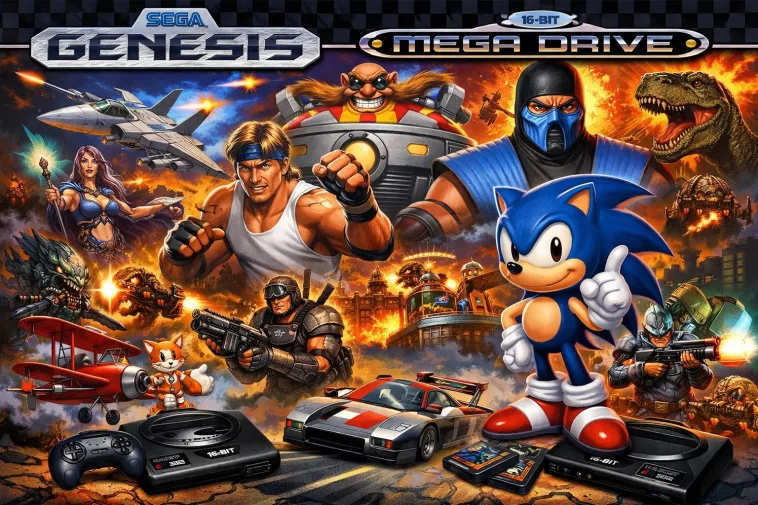
I was seven years old when I first sat in front of a Sega Genesis. The opening screen of Sonic the Hedgehog flashed on the TV, that iconic blue blur tapped his foot impatiently on the title screen, and I was completely hooked. For kids growing up in the early 1990s, the Genesis wasn’t just a gaming console — it was a lifestyle. It was the “cool” machine. The one with attitude. The one that played louder, moved faster, and had blood in its version of Mortal Kombat.
Decades later, the Genesis library still holds up remarkably well. Some of these games are genuinely timeless — the kind that get better the older you get, because you start to appreciate the craft behind them.
This list covers the 50 best Sega Genesis and Mega Drive games ever made. You’ll find platformers, brawlers, RPGs, shooters, and everything in between. Whether you grew up with the console or you’re discovering it for the first time through an emulator or the Mini, these are the games you need to play.
A Quick Word on the Console
The Sega Mega Drive launched in Japan in 1988 and arrived in North America as the Genesis in 1989. It was the world’s first true 16-bit home console to reach wide audiences, and it sold over 30 million units worldwide. It competed fiercely with the Super Nintendo and carved out its own identity with faster gameplay, a more aggressive style, and an arcade-heavy library that felt unlike anything else on the market.
The slogan “Genesis Does What Nintendon’t” wasn’t just marketing — it reflected a real philosophical difference between the two platforms. The Genesis was louder, edgier, and proudly imperfect. That’s exactly why so many people loved it.
The Top 50 Sega Genesis / Mega Drive Games
1. Streets of Rage 2 (1992)
If you could only play one Genesis game for the rest of your life, Streets of Rage 2 would be a defensible choice. It refined everything that made the original great and added more moves, more characters, and a combat system so satisfying that it still feels good today. The soundtrack by Yuzo Koshiro — a blend of techno, house, and funk — remains one of the greatest in gaming history. With four distinct playable characters and superb co-op, it set a benchmark for beat ’em ups that few games since have matched.
2. Sonic the Hedgehog 2 (1992)
Sonic 2 is the game that made the Genesis a household name. Introducing Miles “Tails” Prower as a second player and adding the iconic Spin Dash move, it polished every rough edge from the original and delivered one of the fastest, most colorful platformers the 16-bit era ever produced. Chemical Plant Zone, Aquatic Ruin, and Casino Night remain some of the best-designed platformer stages ever made. It sold over 6 million copies — second only to the original Sonic on the platform.
3. Gunstar Heroes (1993)
Treasure’s debut game is a masterclass in run-and-gun design. Two players, a flexible weapon combination system, explosive bosses, and an art style that pushed the Genesis hardware to places nobody thought possible. Every level throws something completely new at you — a dice board, a shoot ’em up segment, a vertical chase sequence — and the pace never lets up. Gunstar Heroes is pure, joyful chaos, and it’s never been topped in its genre on the system.
4. Phantasy Star IV: The End of the Millennium (1993)
The Genesis had a reputation for being weak on RPGs compared to the SNES. Phantasy Star IV obliterated that reputation. This was a genuinely epic sci-fi RPG with rich world-building, manga-style comic panel cutscenes, a memorable cast of characters, and boss battles that demanded real strategy. The macro-combo system — which allowed characters to chain abilities into powerful combination attacks — was years ahead of its time. Some consider it the best RPG of the 16-bit era, period.
5. Sonic the Hedgehog 3 & Knuckles (1994)
Technically two games — Sonic 3 and Sonic & Knuckles — that lock together to form one massive adventure. When combined, you get the most complete 2D Sonic experience ever made: multiple playable characters with distinct abilities, save states, expanded Super and Hyper forms, and a sprawling world that took the franchise’s design philosophy to its logical peak. The Carnival Night Zone barrel remains controversial. The rest of the game is flawless.
6. Shinobi III: Return of the Ninja Master (1993)
The best Shinobi game on any platform. Responsive controls, a diverse move set that included horseback combat and surfing sequences, fluid animation, and a difficulty curve that challenged without punishing. You play as Joe Musashi — a ninja who looks cooler doing absolutely nothing than most game characters look doing their best move. Shinobi III rewarded skill in a way that made every cleared stage feel genuinely earned.
7. Contra: Hard Corps (1994)
The North American console release of Hard Corps is one of the toughest games on the Genesis — and one of the best. Four playable characters with unique weapons and movesets, branching storylines leading to multiple endings, and some of the most inventive boss designs in any 16-bit game. The Japanese and European version (Probotector) gave you three lives to spare. The US release gave you one. Either way, you’re in for a ride.
8. Castlevania: Bloodlines (1994)
While the SNES got Super Castlevania IV, the Genesis received Bloodlines — and it is, in many ways, the better game. Two playable characters with completely different playstyles, globe-trotting levels set across Europe, and a harder edge that made it feel more mature than its Nintendo counterpart. The infamous Hall of Mirrors level in Versailles remains a technical showpiece. An unfairly overlooked gem that deserves far more recognition than it gets.
9. Rocket Knight Adventures (1993)
Konami’s possum-in-armor platformer might be the most underrated game on this entire list. Sparkster uses a rocket pack to boost, attack, and ricochet off walls in ways that felt genuinely innovative for 1993. The game’s variety is astonishing — every level introduces new mechanics, from giant robot battles to vertical spaceship sections. It’s polished, charming, and constantly inventive. The kind of game you discover and immediately wonder why nobody talked about it more.
10. Shining Force II (1993)
The best tactical RPG on the Genesis and one of the finest in the genre’s history. Shining Force II expanded on the original in every meaningful way — a larger world to explore, more complex battle maps, deeper character customization, and a story with genuine emotional weight. The game rewarded careful unit management and long-term thinking without ever becoming inaccessible. It introduced generations of players to tactical RPGs who had never considered the genre before.
11. Sonic the Hedgehog (1991)
The original. Before the sequels refined it, this was the game that announced the Genesis’s arrival. Green Hill Zone’s opening seconds remain one of the most iconic moments in gaming history. The level design is looser than what followed, but the sense of speed and visual personality were unlike anything players had experienced on a home console up to that point. It sold 14 million copies and made Sonic a cultural icon overnight.
12. Golden Axe (1989)
One of the definitive arcade beat ’em ups of its era, and the Genesis port was sensational. Three warriors, a fantasy world full of soldiers and beasts, magic spells unleashed by throwing gnomes, and some of the most satisfying button-mashing ever committed to cartridge. Golden Axe looked and felt like an arcade experience delivered directly to your living room — which was exactly what Sega was selling.
13. Aladdin (1993)
The Virgin Games Genesis version of Aladdin and the Capcom SNES version have been argued over for thirty years. Both are excellent. The Genesis version, developed with direct involvement from Disney animators, featured silky-smooth character animation that genuinely looked like the film come to life. The gameplay was fast and fun, the sword combat added variety, and the whole thing captured the film’s energy better than any licensed game had a right to.
14. Ristar (1995)
Sega’s secret weapon, released far too late in the Genesis’s life cycle to get the attention it deserved. Ristar uses its long, elastic arms to grab enemies, swing across platforms, and pull itself toward stars. The mechanic was genuinely original, the level design was inventive and varied, and the visuals were among the most impressive the hardware ever produced. It’s a crime this character didn’t become a Sega mascot.
15. Thunder Force IV / Lightening Force (1992)
The greatest shoot ’em up on the Genesis and one of the best in the genre’s entire history. Blazing speed, a powerful weapon selection system, and music so relentlessly energetic it should probably be illegal. Thunder Force IV pushed the hardware further than almost any other shmup of the era and delivered a challenge that was brutally fair — hard enough to feel earned, never cheap enough to feel frustrating.
16. Comix Zone (1995)
One of the most creative games Sega ever produced. You play as a comic artist trapped inside his own comic book, literally fighting enemies from panel to panel across comic book pages. The art style was jaw-dropping for 1995, the combat had surprising depth, and the concept was so original that nothing quite like it had been attempted before. It was difficult, but every panel felt like a hand-drawn adventure.
17. Ecco the Dolphin (1992)
Strange, beautiful, and deeply unsettling in the best possible way. You play as a dolphin exploring increasingly surreal underwater environments, solving puzzles and uncovering a genuinely bizarre science fiction story. The atmosphere is unlike anything else on the platform — serene and alien at the same time. Ecco was a creative risk that paid off entirely.
18. Streets of Rage (1991)
The original Streets of Rage established the template that made the series famous. Three characters, a crime-ridden city, and a special move that literally called in an air strike. Simpler than the sequel but still enormously satisfying, especially in two-player co-op. It also featured one of the most memorable 16-bit soundtracks of its year.
19. The Revenge of Shinobi (1989)
The game that proved the Genesis could deliver arcade-quality experiences at home. Joe Musashi’s first Genesis outing featured some genuinely demanding platforming, iconic boss cameos, and a soundtrack by Yuzo Koshiro that influenced electronic music for years afterward. A foundational game for the system and the action-platformer genre as a whole.
20. Vectorman (1995)
A technical marvel for its time. Vectorman used pre-rendered CGI-style graphics to create a futuristic robot protagonist who moved with a fluidity that was shocking on aging Genesis hardware. The game looked like it belonged on a more advanced machine, and the gameplay backed up the visuals with tight controls and creative level design.
21. Shining Force (1992)
The game that introduced many Western players to the concept of tactical RPGs. Commanding a squad of fantasy fighters across grid-based battlefields sounds complicated, but Shining Force made it accessible without dumbing it down. A rich roster of recruitable characters and a story that knew when to get out of its own way made this one of the most welcoming strategy games ever made.
22. Mortal Kombat II (1993)
Where the original Mortal Kombat made waves by being allowed to keep its blood on Genesis, the sequel simply delivered the better game. New characters, expanded fatalities, more fluid combat, and the introduction of Kitana, Mileena, Kung Lao, and Johnny Cage’s shadow kick into the cultural consciousness. The Genesis port was exceptional and put arcades in living rooms.
23. Earthworm Jim (1994)
Earthworm Jim was the embodiment of 1990s gaming humor and creativity. The rubber-hose animation, the surreal humor, the complete absurdity of every level concept — it was unlike anything else on the shelf. Jim uses his worm-body as a whip, blasts aliens with a ray gun, and at one point pilots a spaceship. The variety never stopped and neither did the laughs.
24. Landstalker: The Treasures of King Nole (1992)
An isometric action-RPG that squeezed an enormous amount of depth and character out of the Genesis hardware. The jumping puzzles frustrated many players at the time, but the witty dialogue, massive world, and genuinely clever dungeon design made it impossible to put down. Landstalker is a hidden gem that any RPG fan owes themselves.
25. Road Rash II (1993)
The best entry in EA’s legendary motorcycle combat racing series. You race, you fight, you knock opponents off their bikes with chains and fists, and you do it all at enough speed to feel genuinely exhilarating. Road Rash II’s split-screen two-player mode alone made it one of the most-played cartridges in countless households during the early 1990s.
26. TMNT: The Hyperstone Heist (1992)
The Genesis’s answer to the SNES’s Turtles in Time — and a worthy alternative. Featuring all four turtles in fast, fluid beat ’em up action across stages inspired by the cartoon, Hyperstone Heist was everything a TMNT fan could want. Shorter than its SNES counterpart but arguably faster and more aggressive.
27. Dynamite Headdy (1994)
Another Treasure masterpiece, and one of the most overlooked games in the entire Genesis library. Dynamite Headdy uses his detachable head as both weapon and tool, collecting different head types with different abilities throughout the game. The boss fights were spectacular, the visual creativity was unmatched, and the Japanese version — with its complete story translation — is considered one of the most technically impressive platformers on the platform.
28. Castle of Illusion Starring Mickey Mouse (1990)
Proof that licensed games didn’t have to be cynical cash grabs. Castle of Illusion was a genuinely crafted platformer with excellent level design, beautiful graphics, and surprisingly satisfying gameplay. Mickey throws apples and bounces on enemies with a butt-stomp in a game that could easily stand alongside the best non-licensed platformers of its era.
29. Ghouls ‘n Ghosts (1989)
A punishing, brilliant action-platformer ported from the arcade with exceptional results. Arthur the knight fights through graveyard after graveyard, monster after monster, losing his armor at the slightest hit and being forced to complete the entire game twice to see the true ending. It was merciless, iconic, and somehow completely fair.
30. Alien Soldier (1995)
From Treasure, the same team behind Gunstar Heroes. Alien Soldier strips away everything except boss fights — 25 of them, back to back, each completely different from the last. It’s one of the most demanding games on the system and one of the most purely rewarding. The weapon-switching system required real-time thinking under pressure, and mastering it felt like genuinely developing a skill.
31. M.U.S.H.A. (1990)
Full name: Metallic Uniframe Super Hybrid Armor. M.U.S.H.A. is a vertical shoot ’em up that belongs in the conversation with the finest examples of its genre. Explosive action, a power-up system with real strategic depth, and visuals that genuinely impressed even late in the era. Original cartridges now fetch over $100 at retro game stores — a testament to just how beloved it remains.
32. Herzog Zwei (1989)
One of the earliest real-time strategy games ever made, and one of the best. You control a transforming mech — switching between jet and robot modes — while simultaneously managing units across the battlefield. Herzog Zwei invented mechanics that would later define the entire RTS genre, including Command & Conquer. Playing it today still feels surprisingly modern.
33. Strider (1990)
A remarkable arcade port that retained the kinetic energy and impressive visuals of the original. Hiryu leaps, slides, and slashes through levels with a fluidity that felt impossibly smooth for the era. The Genesis version lost a little in translation but remained one of the most impressive action games on the system, and one of the first games that truly demonstrated the hardware’s potential.
34. Beyond Oasis / Story of Thor (1994)
An underrated Zelda-style action-RPG that deserves far more recognition. You play as Prince Ali, wielding a golden armlet that can summon elemental spirits — each with unique combat and puzzle-solving abilities. The combat was snappy and responsive, the world was generous in size, and the art style had a warmth and personality that set it apart from its contemporaries.
35. Phantasy Star II (1989)
One of the earliest console RPGs to tell a genuinely dark, science-fiction story. Phantasy Star II was ahead of its time in almost every way — mature themes, a female protagonist, and a world-building approach that influenced the genre for decades. It was difficult and demanding, with no in-game maps, but those who completed it remembered it forever.
36. Vectorman 2 (1996)
More of what made the original great, with expanded level variety and improved visuals. Vectorman 2 may not have innovated wildly on its predecessor, but as a late-era Genesis title it showed that the aging hardware still had impressive things left to say. A satisfying sequel that rewarded fans of the first game.
37. Kid Chameleon (1992)
A massive, sprawling platformer built around a transforming mechanic — collecting helmets to become different characters with different abilities. Kid Chameleon had over 100 levels, a rebellious attitude that matched the era, and genuine mechanical depth beneath its simple surface. It was Sega’s attempt at a platform mascot that never quite broke through, but the game itself was excellent.
38. Quackshot Starring Donald Duck (1991)
One of the finest Disney games on the platform and one of the most charming action-platformers of the early 1990s. Donald Duck hunts for treasure across globe-trotting stages, using plunger guns and popcorn blasters to clear his path. The level design was imaginative, the character animation was authentic to the cartoons, and the whole thing was considerably more fun than a duck-based game had any right to be.
39. Eternal Champions (1993)
Sega’s answer to Mortal Kombat and Street Fighter, Eternal Champions had a concept that nobody else was doing: a fighting game built around historical warriors from across time, resurrected to compete for a chance to cheat death. The lore was surprisingly deep, the roster was creative, and the finishing moves — which included context-specific “Overkills” based on stage hazards — were inventive in ways that went beyond simply copying the competition.
40. Golden Axe II (1991)
A direct improvement on the original in almost every way — tighter controls, better magic animations, more complex enemy encounters, and expanded co-op mechanics. Not as groundbreaking as the first game but more refined in every technical sense. For players who loved the original, this was simply more of a great thing.
41. Toejam & Earl (1991)
A genuinely weird, genuinely wonderful game about two alien rappers stranded on a bizarre version of Earth, searching for parts to repair their spaceship. Toejam & Earl featured roguelike level generation before most players knew what roguelikes were, a soundtrack drenched in funk, and a co-op experience completely unlike anything else on the platform. It was strange, joyful, and completely original.
42. Splatterhouse 2 (1992)
One of the darker games in the Genesis library — a brutal side-scrolling horror brawler inspired by splatter films. Rick wears a demonic hockey mask and tears through monsters with his bare hands and whatever weapons he can find. The atmosphere was genuinely unnerving for a home console game of that era, and the combat had enough variety to keep it engaging throughout.
43. Ranger X (1993)
A criminally overlooked mech action game that used the Genesis’s hardware in ways that left players confused about how it was technically possible. Ranger X featured parallax scrolling, massive enemies, and a mechasuit that could physically dock with a motorcycle. The presentation was cinematic and the action was relentless. One of the best games on the system that almost nobody played.
44. Zombies Ate My Neighbors (1993)
A co-op action game dripping with love for B-movie horror. You fight zombies, chainsaw maniacs, giant babies, and creatures from the lagoon with increasingly absurd weapons — squirt guns, weed whackers, bazooka-launched silverware. The top-down view and frantic pace made it a perfect party game, and the sense of humor kept it from ever taking itself seriously. Essential two-player material.
45. NBA Jam (1993)
Two-on-two basketball, no fouls, and the most chaotic fun the sports genre had seen up to that point. “He’s on fire!” entered the cultural vocabulary because of this game. The Genesis port was outstanding — fast, responsive, and impossible to put down with a second controller in the room. NBA Jam understood that sports games didn’t need to be simulations to be great.
46. World of Illusion Starring Mickey Mouse and Donald Duck (1992)
A beautiful co-op platformer set in a magical world that Mickey and Donald accidentally stumble into during a magic show. Each character had unique abilities and unique paths through each level, which encouraged replaying the game with a different partner. Visually stunning for its time, World of Illusion is one of the most underrated co-op platformers of the 16-bit era.
47. Mortal Kombat (1992)
The original was a phenomenon. Home consoles had received violent arcade games before, but Mortal Kombat with its digitized actors, realistic blood, and spine-ripping fatalities felt genuinely transgressive for the era. The Genesis version kept the blood while the SNES version famously didn’t — a console war talking point that sold millions of cartridges by itself.
48. Gain Ground (1990)
An oddity in the best sense — a strategy-action hybrid where you guide units across enemy territory to a goal point, rescuing stranded soldiers along the way. It sounds simple but the escalating complexity of the stages and the variety of playable characters gave it surprising depth. The two-player cooperative mode was particularly well-designed.
49. Sonic Spinball (1993)
Built on the concept of Sonic’s iconic pinball bonus stages from the main games, Sonic Spinball expanded the idea into a full game with actual level design and objectives. It was harder and stranger than mainline Sonic games but had its own identity. The Metal Sonic boss encounter alone earned it a place in the Genesis library.
50. Altered Beast (1988)
The game that launched with the console in many regions and became permanently associated with the Genesis’s identity. “Rise from your grave” is one of the most quoted gaming lines of the entire era. Altered Beast was a straightforward brawler with a transformation mechanic — collect enough power orbs and turn into a werewolf, werebear, or weretiger — and it was the first taste many players ever got of what 16-bit gaming could look like.
Final Thoughts
Fifty games barely scratches the surface of what the Genesis library has to offer. There are dozens more that deserved a spot — Ecco: The Tides of Time, Earthworm Jim 2, Streets of Rage 3, Shadow Dancer, Sword of Vermilion, and countless others. The platform was remarkably deep for its era, and a huge portion of it has aged far better than people expect.
Whether you play through the Sega Genesis Mini, an emulator, or original hardware with original cartridges, these fifty games represent some of the finest work game developers produced during one of the most creative eras in gaming history. Start at the top and work your way down. You won’t regret it.
FAQ: Sega Genesis / Mega Drive Games
What is the best Sega Genesis game of all time?
Streets of Rage 2 consistently tops fan polls and critical rankings as the single best game on the platform. Sonic 2, Gunstar Heroes, and Phantasy Star IV are close competitors depending on who you ask and what genre they prefer. There’s no single wrong answer among those four.
How many games were released for the Sega Genesis?
Over 900 games were officially released for the Sega Genesis and Mega Drive across its lifespan, with the library varying slightly by region. The North American, European, and Japanese libraries each had exclusive titles that didn’t always cross over.
Is the Sega Genesis Mini worth buying?
Yes, especially for newcomers. The Sega Genesis Mini 1 and Mini 2 include curated selections of the library’s best games in an authentic form factor. It’s the easiest entry point for playing classic Genesis titles legally on modern hardware.
What is the rarest Sega Genesis game?
M.U.S.H.A., Crusader of Centy, and Mega Turrican are among the most valuable Genesis cartridges. Original copies of M.U.S.H.A. regularly sell for well over $100. Beggar Prince, an unlicensed game, can fetch several hundred dollars at auction.
What’s the difference between the Genesis and Mega Drive?
They are the same console with different regional names. Mega Drive was the name used in Japan and most of the world outside North America. Sega renamed it the Genesis for the North American market for trademark reasons. The hardware is essentially identical, though some regional versions had minor revisions.
Can you still play Sega Genesis games today?
Absolutely. Options include the Sega Genesis Mini consoles, the Sega Genesis Classics collection on Steam and current-generation consoles, Nintendo Switch Online’s Genesis library (with a Nintendo Switch Online + Expansion Pack subscription), and original hardware with original cartridges.
