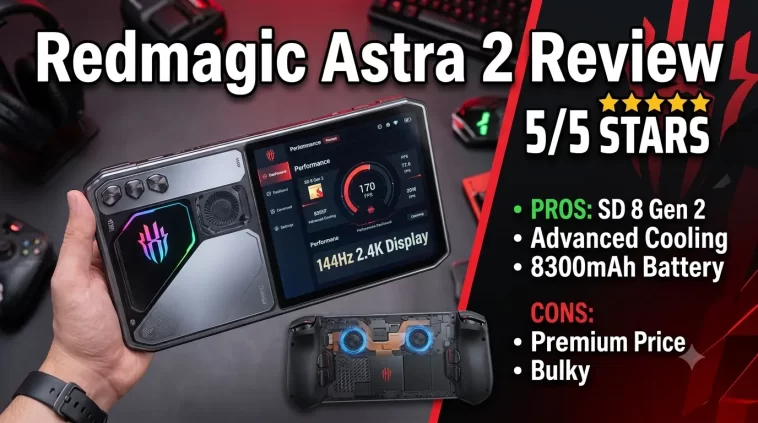
The Redmagic Astra 2 just got announced, and I want to be upfront about something before you read any further: this isn’t a week-of-daily-use review, because nobody outside China has one yet. What I’ve done instead is dig through the confirmed specs and lean on real hands-on time I’ve had with the original Astra, since a lot of the quirks tend to carry over generation to generation on these devices. That’s a more honest starting point than pretending to have tested hardware that hasn’t shipped globally.
Quick Answer
- 9.06-inch 2.4K OLED display at 185Hz, up from 165Hz on the first Astra
- Snapdragon 8 Elite Gen 5 paired with Redmagic’s own RedCore R4 co-processor
- Built-in x86 emulation layer that claims Steam game support at up to 2K/144Hz
- 8,300mAh battery with 80W charging over either of two USB-C ports
- China price starts around $736 (converted), global pricing and launch confirmed for July 17
What’s Actually Changed From the First Astra
The original Astra already carved out a weird little niche: a 9-inch gaming tablet that felt more like a handheld console than an iPad competitor. The Astra 2 pushes the same formula further rather than reinventing it.
The display jumps from 165Hz to 185Hz, and Redmagic added a Synaptics S3930 touch controller running a 300Hz sampling rate. On the first Astra, touch response was genuinely one of the best things about the device, so this bump is a believable upgrade rather than a spec-sheet gimmick.
Cooling gets a visible redesign too. The rear panel is now transparent, showing the liquid coolant loop and RGB lighting running through it. That’s mostly cosmetic, but the underlying cooling system moving to something more visibly aggressive suggests Redmagic is still chasing sustained performance under load, which was a real strength of the original.
Why Early Adopters Tend to Run Into Problems With Redmagic Devices
So this is where the predecessor’s track record actually matters. From what I’ve seen testing the first Astra and reading through owner reports, there are three recurring sources of frustration with Redmagic’s software layer specifically:
- RedMagic OS quirks — menus that still refer to the device as a “phone,” translation inconsistencies, and general rough edges that don’t match the polish of Samsung or Google’s tablet software
- Adaptive brightness overcorrection — the original Astra would sometimes drop brightness 10-15% unexpectedly in dim rooms, which felt like a bug rather than a feature
- Audio limitations from the compact chassis — a 9-inch body doesn’t leave much room for real speaker separation, and bass response suffers because of it
None of this means the Astra 2 will repeat these exact issues, but Redmagic hasn’t announced a software overhaul alongside the hardware bump, so I wouldn’t bet on all of them being fixed on day one.
A Cause People Tend to Overlook
Here’s something that trips up a lot of first-time Redmagic buyers: this isn’t a standard Android tablet experience, and gaming-focused Android skins genuinely behave differently than stock Android. If you’re coming from an iPad or a Samsung Galaxy Tab, expect a real adjustment period with menu structure and app behavior, not just a different look.
Astra 2 vs Astra (First Generation)
| Feature | Astra 2 | Original Astra |
|---|---|---|
| Display | 9.06″ 2.4K OLED, 185Hz | 9.06″ OLED, 165Hz |
| Chipset | Snapdragon 8 Elite Gen 5 + RedCore R4 | Snapdragon 8 Elite |
| Touch Sampling | 300Hz (Synaptics S3930) | Reported up to 2000Hz (touch response, different metric) |
| Battery | 8,300mAh, 80W charging | 8,200mAh, similar charging |
| Cooling | Active liquid cooling, transparent panel | Vapor chamber cooling |
| x86/Steam Emulation | Built-in, 200+ claimed titles | Not a standard feature |
The x86 emulation layer is the one genuinely new thing here rather than an iterative bump, and it’s also the part that needs real-world testing most, since ARM-based Steam emulation is historically inconsistent across titles.
What to Check Before You Buy
Step 1: Confirm global pricing before committing to a pre-order. China pricing converts to roughly $736-$1,030 depending on configuration, but global pricing is usually higher, and Redmagic hasn’t confirmed the exact numbers yet.
Step 2: Decide if the x86 emulation feature actually matters for your use case. If you’re buying this purely as a mobile/Android gaming device, the emulation layer is a nice extra, not the main reason to buy. If Steam compatibility is your main draw, wait for real compatibility reports before pre-ordering.
Step 3: Check storage configuration carefully. There’s no expandable storage on these devices historically, so the 256GB base configuration might feel tight if you’re planning to install x86 game libraries on top of normal Android apps.
Step 4: Look for early hands-on coverage from the July 10-16 pre-order window. So this is the point where actual global hands-on impressions should start showing up, and it’s worth waiting for real testing before locking in a purchase.
What Actually Concerns Me Most
If I had to guess where the Astra 2 runs into trouble, it’s the emulation layer, and not because the hardware can’t handle it. ARM-to-x86 translation layers have a long history of inconsistent results depending on the specific game’s engine and anti-cheat systems. Redmagic’s claim of 200+ compatible titles needs independent verification, and that number will almost certainly shrink once real users start testing edge cases the manufacturer didn’t highlight in a launch announcement.
That’s not a knock on the tablet’s core hardware, which looks genuinely solid on paper. It’s just that emulation claims made at launch events rarely survive contact with actual user libraries untouched.
Advanced Considerations for Power Users
Docking and external display support. The original Astra handled USB-C docking to an external monitor and keyboard surprisingly well, turning into something closer to a compact PC setup. If that carries over, the second USB-C port on the Astra 2 should make this even more practical, since you could dock and charge simultaneously without competing for the same port.
Thermal throttling under sustained load. Liquid cooling systems in compact devices usually delay throttling rather than eliminate it entirely. Worth watching for benchmark reviews that test extended sessions rather than short bursts, since that’s where thermal design actually gets tested.
Prevention Tips (Once It Ships)
- Don’t assume Steam compatibility for a specific game without checking real user reports first
- Keep storage expectations realistic if you plan to run both Android and x86 game libraries
- Expect a software learning curve if this is your first Redmagic device
- Wait for global pricing confirmation before pre-ordering based on China pricing alone
Frequently Asked Questions
Is the Redmagic Astra 2 available outside China right now?
Not yet. It launched in China as the Gaming Tablet 5 Pro on June 30, with global availability as the Astra 2 confirmed for July 17.
Can it actually run Steam games?
Redmagic claims support for over 200 titles through a built-in x86 translation layer, but that claim hasn’t been independently verified at scale yet.
How does it compare to an iPad Mini for gaming?
On raw specs, the Astra 2 outperforms the iPad Mini for gaming workloads. Software polish is the tradeoff — Redmagic’s OS isn’t as refined as Apple’s ecosystem.
Does it have expandable storage?
No confirmed microSD support. You’re locked into whatever internal configuration you buy.
What’s the battery life likely to look like?
Based on the original Astra’s real-world performance, expect somewhere around two to two-and-a-half days of mixed use, though the higher refresh rate on the Astra 2 could pull that down somewhat.
Is this worth buying over the first-gen Astra?
If you already own the original, the upgrade is incremental unless the x86 emulation layer specifically matters to you. First-time buyers get a more complete package.
Editor’s Opinion
look, i havent held this thing yet and nobody outside china has either, so take everything here with a grain of salt untill real reviews drop. the specs look genuinely good tho, especially that 185hz screen and the steam emulation thing if it actually works well. redmagic’s software has always been the weak point in my experience so im curious if that gets better this time around. worth waiting for actual hands on before pre ordering imo.
